CLAS (Computerized Language Analysis System)
CLAS (Computerized Language Analysis System) was an important historic text analysis system available in the 1970s. It was written in PL/I for IBM 360/370 punch card machines and performed standard statistical tests and concordances on natural language texts.
Documentation
Attributes
- Type of analysis: Natural Language Processing Analysis Content Analysis
- Background Processing: Not Applicable
- Ease of Use: Moderate
- Historic Tool (developed before 2005): Influential No longer in active development
- TaDiRAH Goals: Analysis
- TaDiRAH Methods: Content Analysis Other (analysis) Statistical Analysis
List this tool appear on
Rating
Suggested Tools
Comments
More information on CLAS, its development and its application is available in the following articles:
Borden, George A. and James J. Watts. \"A Computerized Language Analysis System.\" Computers and the Humanities 5.3 (1971): 129-141. Web.
Waltman, Franklin M. \"C.L.A.S. and the Cantar de Mio Cid.\" Computers and the Humanities 10.3 (1976): 145-152. Web.
Program Overview
CLAS (Computerized Language Analysis System) was a software package for text analysis that combined standard statistical tests with concordance functions (Oakman 179). It was developed by George Borden and James Watts of Pennsylvania State University (Borden and Watts 129) and ran in PL/I on IBM 360/370 machines (Borden and Watts 136).
In their 1971 paper \"A Computerized Language System,\" Borden and Watts described CLAS as
a general-purpose computer system that can perform standard statistical tests on natural language texts as well as print a concordance or index of all the words of that text or a specified subset of those words. It was developed from a simple concordance generating program on the belief that since the computer had already separated the text into its constituent words, it might as well do some statistical and semantic operation on this text to aid the scholar in his research. (Borden and Watts 129)
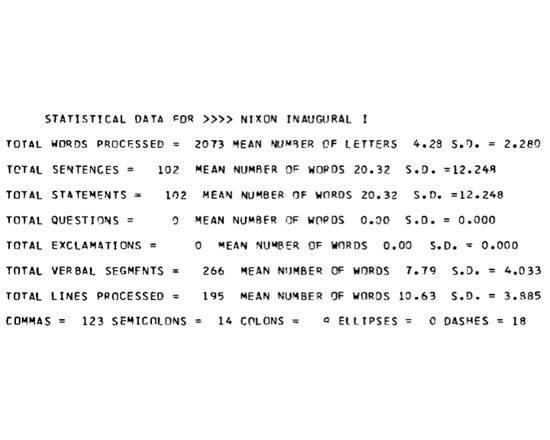
CLAS required the text to be keypunched on punch cards, which it used to generate an index and generate statistical data such as word counts, or numbers of lines, sentences and punctuation marks (Oakman 179). It could also generate mean word and sentence lengths with standard deviations (179). Borden and Watts found the statistical output particularly useful, as \"[t]his allows one to accumulate a bank of statistical data for natural language analysis\" (Borden and Watts 132).
The system was designed to work with natural language text with standard spacing and punctuation, though it required users to manually keypunch a variable length identifier at the beginning of each line (Borden and Watts 129). This identifier was used to locate words out of context (Borden and Watts 130). Users could generate concordances and indexes for either the full text or a specified subset (Borden and Watts 130-131). The subsets were specified via word lists for exclusion or inclusion (Borden and Watts 131), or via a word frequency cap that caused the system to only index or concord those words falling below that frequency (Borden and Watts 132).
Particularly notably, CLAS could recognize statements ending in a period as sentences, and colons and semi-colons as in-sentence delimiters for determining 'verbal segments' (132). Colons and semi-colons were not the only markers of verbal segments. Rather, \"[a] verbal segment is considered to be that linguistic string falling between any two segment delimiters, i.e., (;) (:) (,) (--) (...) (?) (.) (!)\" (132). CLAS generated counts for each of these markers and included them in its statistics (132).
Various statistics could be output in bar graph form, showing information such as frequency distributions, type/token ratios, or the number of word types in relation to the total counts for the text (Oakman 179-180). Beyond graphs, the system could generate a
detailed statistical analysis of vocabulary types and tokens. This option causes the system to divide the text into a number of equal length linguistic strings (the length of the string is specified by the user: defaults to 100 words). This series of linguistic strings then becomes the basis for a series of type/token analyses. (Borden and Watts 134)
For thematic analysis, the system could also generate printouts of particular words based on a selected text division (Borden and Watts 135).
To run, CLAS required 240 bytes of external storage per word in the text to be processed, and the developers recommended that external storage be sequential in disk, drum or magnetic tape form (Borden and Watts 136). Punch cards and paper tape was also supported, but not recommended (136). The system's input was governed by a parameter card that specified the text to be processed, the name of the job and what program options to use (Borden and Watts 137). As a whole, CLAS consisted of six programs, being a main monitor program governing order of execution, and five subprograms performing specific functions on the user's text (Borden and Watts 136-137). The subprograms, named according to their purpose, were Initialization, Word-Break-Up, Concordance/Index, Decreasing Word Frequency, and Increasing Word Length (Borden and Watts 137).
CLAS was designed to allow users to run large batch jobs and provide feedback if the process stopped prematurely (Borden and Watts 138). In the case of an error, jobs could be restarted from the middle (Borden and Watts 139). Borden and Watts considered this restart function its most powerful feature:
When execution must be terminated due to a recoverable error or from a lack of time or records, the monitor will halt execution and note where it stopped so that the system can be restarted. The restart capability is especially useful under a system which limits the amount of time and records a user can run at any one time. The restart capability allows the maximum amount of data to be run. (Borden and Watts 140)
In terms of speed, Borden and Watts found CLAS took approximately 100 seconds when tested with a 1000-word text using all phases of the program on an IBM 360/67, and found that the larger the text, as with a batch job, the less time per word the system required (Borden and Watts 141).
In addition to the benefits of CLAS' speed and batch processing capacity, Borden and Watts provided a means for users to modify the system's built-in collating sequence, which opened up CLAS to languages beyond English (141). This facility with other languages proved valuable to its audience, enabling text analysis studies such as Franklin Waltman's 1976 authorship study of the medieval Spanish epic poem Cantar de Mio Cid, described in his paper \"C.L.A.S. and the Cantar de Mio Cid\" (Waltman 145). He focused on CLAS' concordance function to examine the text for formulas and formulaic expressions (145). In particular, he made use of a new feature, \"[a] theme segment analysis [which] has recently been added to C.L.A.S. This provides a concordance, statistical data, and theme density maps for analysis of particular themes\" (Waltman 146).
Waltman's final assessment of CLAS was favourable:
The use of the C.L.A.S. has permitted an analysis which indicates that there are no great differences among the three cantares of the poem, nor any statistical evidence which can be considered conclusive proof that two poets had a hand in composing the poem as it exists today. C.L.A.S. has been an extremely valuable tool in this research. (Waltman 146)
Sources
Borden, George A. and James J. Watts. \"A Computerized Language Analysis System.\" Computers and the Humanities 5.3 (1971): 129-141. Web.
Oakman, Robert L. Computer Methods for Literary Research. Athens: University of Georgia Press, 1984.
Waltman, Franklin M. \"C.L.A.S. and the Cantar de Mio Cid.\" Computers and the Humanities 10.3 (1976): 145-152. Web.