RATS (Random-Accessible Text Systems)
RATS (Random-Accessible Text Systems) was a PL/I utility for text analysis developed by John B. Smith of Pennsylvania State Univeristy in the early 1970s. It was aimed at researchers with some experience with programming and aimed to streamline the text analysis process while permitting users to customize the program to suit their work. As a system, Smith promoted RATS for concordences, thematic distributions and transitional matrixes.
Documentation
Attributes
- Type of analysis: Analysis Programming
- Ease of Use: Moderate
- Historic Tool (developed before 2005): Influential No longer in active development
- TaDiRAH Goals: Creation Analysis
- TaDiRAH Methods: Other (analysis) Programming Statistical Analysis
List this tool appear on
Rating
Suggested Tools
Comments
For more information about RATS, see John B. Smith's paper:
Smith, John B. \"RATS: A Mid-Level Text Utility System.\" Computers and the Humanities 6.5 (1972): 277-283. Web.
Program Overview
RATS (Random-Accessible Text Systems) was a PL/I utility \"for the researcher with some knowledge of programming\" developed by John B. Smith of Pennsylvania State University in the early 1970s (Smith 277).
Smith designed RATS to allow researchers to skip over file creation and proceed directly to text analysis (277). As an analysis tool, it aimed to provide \"a highly flexible representation of a text, allowing the researcher to write specific programs to perform the exact analysis he desires\" (277).
It integrated the INDEX program from VIA-II, developed by S. Y. Sedelow, as its initial text scanner (277). RATS accepted text punched in columns and used spaces as delimiters between words and punctuation (277). It tokenized the text for its output, assigning each token to a record with a numeric index plus markers for volume, chapter, paragraph, sentence and word (277).
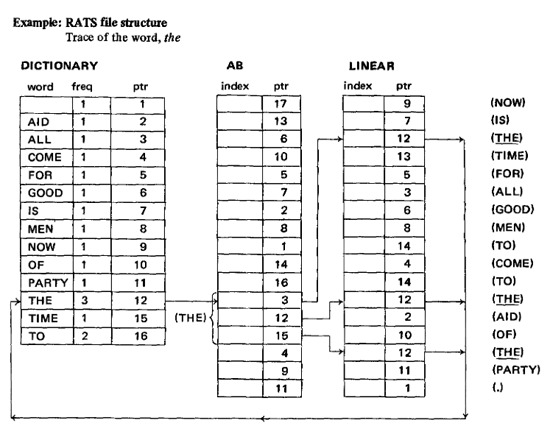
These tokens were stored on tape, disk or other available storage, and used to generate three sets: Dictionary, which contained each word and punctuation mark with its frequency, cross-referenced to the index; AB which indexed each occurrence of a word, arranged alphabetically; and LIN which indexed each occurrence of a word, arranged in order of appearance in the text, cross-referenced to the Dictionary (Smith 278).
RATS used its BUILD program to generate the Dictionary, AB and LIN sets, while two additional programs, COMPRESS and EXPAND, provided its text analysis functions (Smith 279). COMPRESS permitted users to specify which words from the Dictionary to work with, as it \"takes the file structure created by BUILD and compresses it to either a linear subset of the text or a subset represented by a partitioning of the dictionary\" (279). EXPAND, not available at the time of Smith's publication, \"takes the file structures created by BUILD for several texts or subsets of a text and combines them into a single RATS file structure\" (Smith 279-280). Smith projected a summer 1972 release for the BUILD program (Smith 280), with additional functions and programs to follow by fall of the same year (Smith 283).
As a text analysis tool, Smith promoted RATS for concordance generation (Smith 280), for creating thematic distribution line graphs (Smith 281), and for creating transitional matrixes (Smith 282). To extend the system's functionality, he was developing a RANDOM program for writing RATS datasets to random-access files, and a RETURN/SEARCH program that would allow users to specify a set of information to examine and a word or group of words to search for (Smith 283).
Smith found that
While this system does not supply all of the features we might wish, it does facilities greatly many of the tasks that humanists and language analysts often perform. Its general flexibility should enable the user to design and implement procedures that fit his analytic model more precisely and sensitively than is generally possible. (283)
A decade later, Robert Oakman reflected on Smith's work and RATS and judged that
[a]lthough Smith has shown admirable concern for achieving efficiency in computer storage, his programs seem, by and large, too complex for most inexperienced literary scholars to use with ease. Practically one of the other PL/I program packages may be more convenient for the novice. (Oakman 180n)
Sources
Oakman, Robert L. Computer Methods for Literary Research. Athens: University of Georgia Press, 1984.
Smith, John B. \"RATS: A Mid-Level Text Utility System.\" Computers and the Humanities 6.5 (1972): 277-283. Web.
The website cannot be found