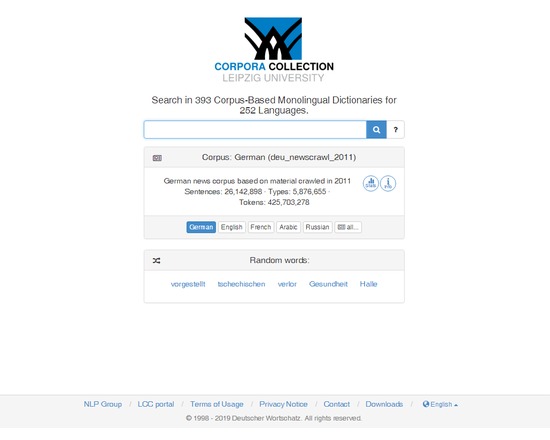
This tool allows you to search for words in 252 languages and will give you information about that word based on the corpora they have available. Examples of information returned include examples sentences using that word, coocurrences, similar words/phrases, and a mind-map style graph.
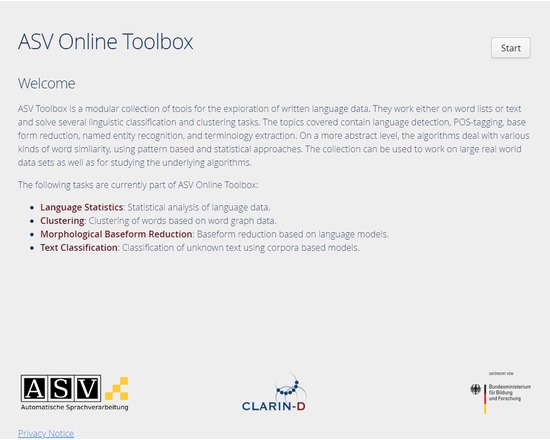
ASV Toolbox is a modular collection of tools for the exploration of written language data. They work either on word lists or text and solve several linguistic classification and clustering tasks. The topics covered contain language detection, POS-tagging, base form reduction, named entity recognition, and terminology extraction. On a more abstract level, the algorithms deal with various kinds of word similarity, using pattern based and statistical approaches. The collection can be used to work on large real world data sets as well as for studying the underlying algorithms.
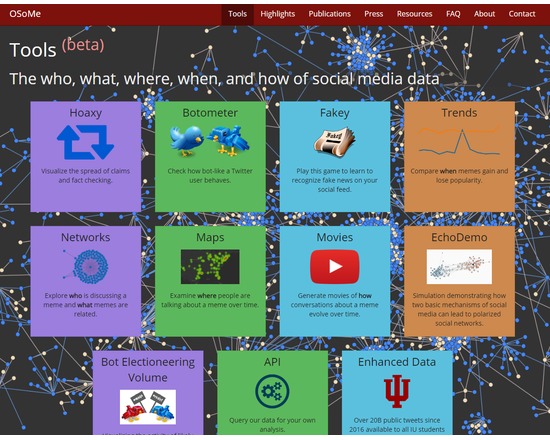
OSoMe (awe•some) is a joint project of the Indiana University Network Science Institute (IUNI) and the Center for Complex Networks and Systems Research (CNetS), aimed to study information diffusion in social media. Here we highlight findings, publications, and resources. Use our tools to explore how ideas spread through online social networks. Hoaxy: Visualize the spread of claims and fact checking. Botometer: Check how bot-like a Twitter user behaves. Fakey: PLay this game to learn to recognize fake news on your social feed. Trends: Compare when memes gain and lose popularity. Networks: Explore who is discussing a meme and what memes are related. Maps: Examine where people are talking about a meme over time. Movies: Generate movies of how conversations about a meme evolve over time. EchoDemo: Simulation demonstrating how two basic mechanisms of social media can lead to polarized social networks. Bot Electioneering Volume: Visualizing the activity of likely bots on Twitter around the 2018 US midterm elections. As well as API and Enhanced Data available.
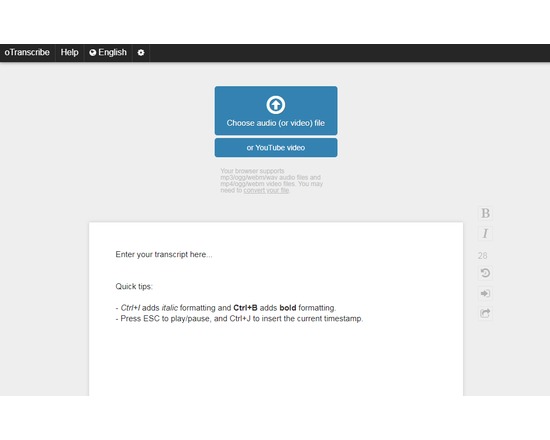
A free web app to take the pain out of transcribing recorded interviews. No more switching between Quicktime and Word. Pause, rewind and fast-forward without taking your hands off the keyboard. Interactive timestamps to navigate through your transcript with. Automatically saved to your browser's storage every second. Private - your audio file and transcript never leave your computer. Export to Markdown, plain text and Google Docs. Video file support with integrated player. Open source under the MIT license.
Community textual editing tool that runs as a service over the web. Alllows one to see manuscript image and edit the XML. Also provides collation tools.
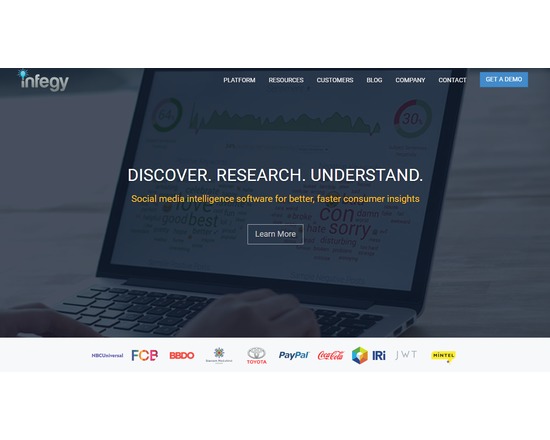
Social media research software that provides true understanding of how people feel about any topic being discussed on the social web. Fully customize and white label all your social data projects Integrate social data and text analysis into your business critical applications.
The “CINCO SCCE Meta Tooling Framework” is a generator-driven development environment for domain-specific graphical modeling tools. It is based on the Eclipse Modeling Framework and Graphiti Graphical Tooling Infrastructrure, but aims to hide much of their complexity and intricate APIs. A graphical modeling tool developed with CINCO is completely generated from an intuitive higher-level abstract specification language. Semantics-inducing parts of the tool that are difficult to define in an abstract declarative way (such as model interpreters, transformations, or code generators) are written in Java against a simple model-based API. CINCO handles the inclusion of the right buttons in the GUI that trigger those actions. Furthermore, CINCO supports the integration of the Java Application Building Center (jABC) into the development process, so that even people with little or no programming experience can express model behavior in a process-oriented fashion.
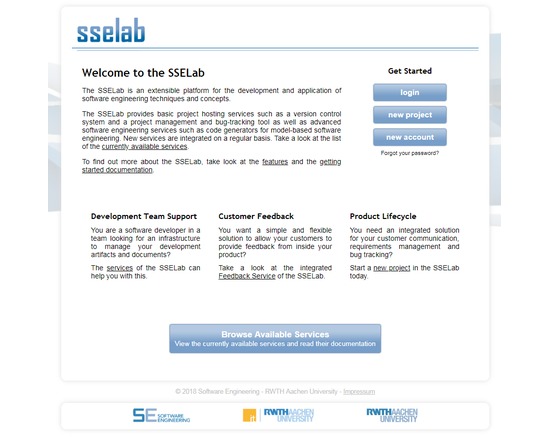
The SSELab is an extensible platform for the development and application of software engineering techniques and concepts. The SSELab provides basic project hosting services such as a version control system and a project management and bug-tracking tool as well as advanced software engineering services such as code generators for model-based software engineering.
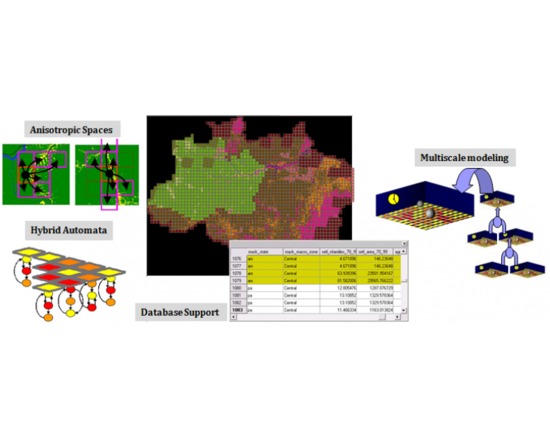
TerraME is a programming environment for spatial dynamical modelling. It supports cellular automata, agent-based models, and network models running in 2D cell spaces. TerraME provides an interface to TerraLib geographical database, allowing models direct access to geospatial data. Its modelling language has in-built functions that makes it easier to develop multi-scale and multi-paradigm models for environmental applications. Two important innovations in TerraME are its use of anisotropic spaces and of hybrid automata models. Anisotropic spaces arise when modeling natural and human-related phenomena. For example, land settlers in a new area do not occupy all places at the same time. They follow roads and rivers, leading to an anisotropic pattern. Anisotropic spaces are implemented in TerraME using Generalized Proximity Matrices (GPM). The GPM is an extension of the usual definition of the spatial relations and include a combination of neighborhood measures in the absolute space and in the relative space. A hybrid automaton is an abstract model for a system whose behavior has discrete and continuous parts. It extends the idea of finite automata to allow continuous change to take place between transitions. Adopting hybrid automata in spatial dynamical models allows complex models which include critical transitions.