BIBCON was a key-word-out-of-context system for concordances developed in FORTRAN and available in the 1960s. It was a modified version of another system, KWIC.
Use BibDesk to edit and manage your bibliography. It will keep track of both the bibliographic information and the associated files or web links for you. BibDesk’s services will simplify using your bibliography in other applications and are particularly well suited for LATEX users.
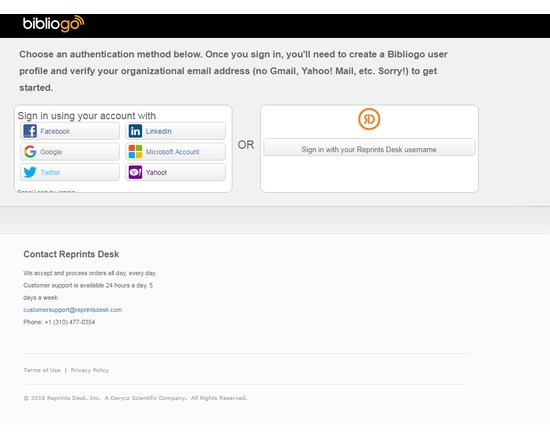
Bibliogo is a journal article web app that allows you to create and share bibliographies, manage journal alerts, follow feeds, tag citations, and order articles. You can connect your LinkedIn account, and others, with this web-based app.
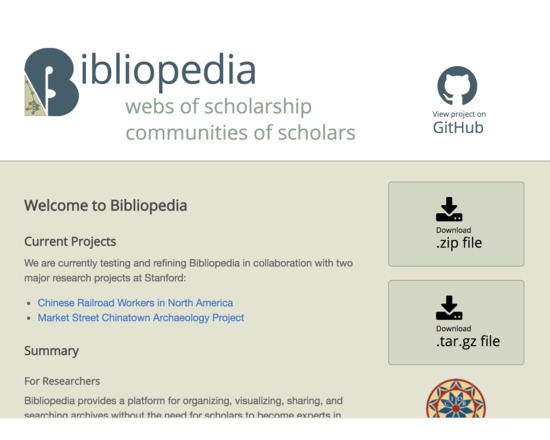
Bibliopedia will perform advanced data-mining and cross-referencing of scholarly literature to create a humanities-centered collaboratory. As a prototype, it will search resources including JSTOR and Library of Congress for metadata about scholarly articles and books that mention the famed medieval travel narrative The Travels of Sir John Mandeville, examine the articles and books for citations, then save the results in a publicly accessible database. Although using works centered around a single text as a test case, Bibliopedia will be designed to work with all humanities scholarship. Bibliopedia will also allow users to create browsable and customizable bibliographies of all the works cited by each article and book. Most importantly, it will use semantic web technology to perform automated textual analysis, data extraction, cross-referencing, and visualizations of the relationships among texts and authors. Bibliopedia will crawl, aggregate, cross-reference, and display multiple scholarly repositories such as JSTOR, Library of Congress, Project Muse, and Google Books. The project will transform bibliographic data that is currently readable only by humans into machine-readable data via semantic web technology, which will make scholarly resources available for automated analyses, inferences, and visualizations.
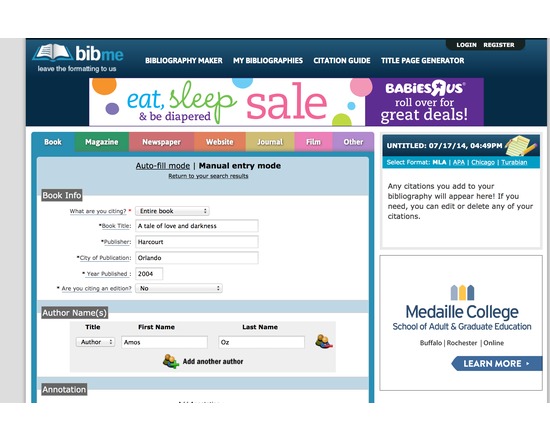
BibMe is an automatic bibliography maker that auto-fills information, allowing you to build easily a works cited page. You can download your bibliography in either MLA, APA, Chicago, or Turbian formats.
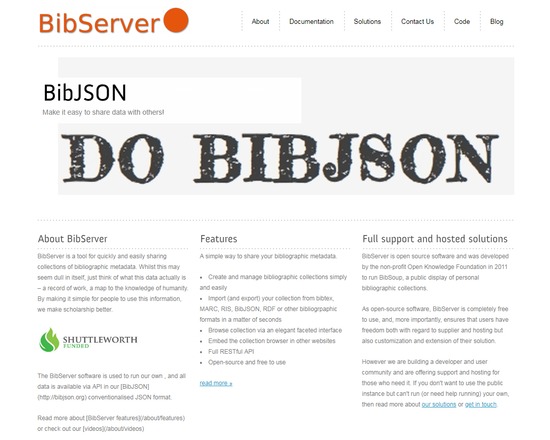
BibServer is an open-source RESTful bibliographic data server. BibServer makes it easy to create and manage collections of bibliographic records such as reading lists, publication lists and even complete library catalogs. Its main features include Create and manage bibliographic collections simply and easily Import (and export) your collection from bibtex, MARC, RIS, BibJSON, RDF or other bibliogrpaphic formats in a matter of seconds Browse collection via an elegant faceted interface Embed the collection browser in other websites Full RESTful API
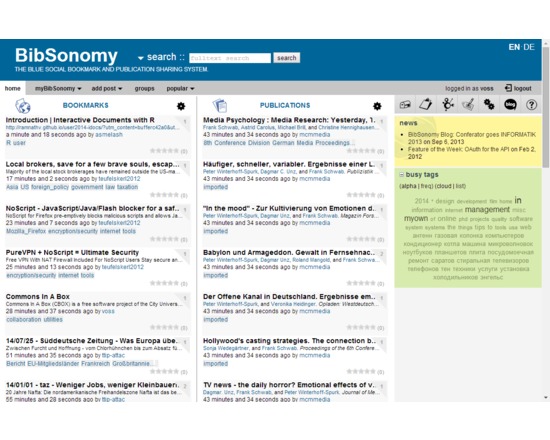
BibSonomy is a social bookmarking and publication-sharing system. It aims to integrate the features of bookmarking systems as well as team-oriented publication management. BibSonomy offers users the ability to store and organize their bookmarks and publication entries and supports the integration of different communities and people by offering a social platform for literature exchange. Both bookmarks and publication entries can be tagged to help structure and re-find information. As the descriptive terms can be freely chosen, the assignment of tags from different users creates a spontaneous, uncontrolled vocabulary: a folksonomy. In BibSonomy, the folksonomy evolves from the participation of research groups, learning communities and individual users, organizing their information needs. Publication posts in BibSonomy are stored in the BibTeX format. Export in other formats such as EndNote or HTML (e. g. for publication list creation) is possible. The service was developed by a team of students and scientists working at the Institute of Knowledge and Data Engineering and is hosted by the University of Kassel in Germany. [Description taken from the Wikipedia article about BiBSonomy]
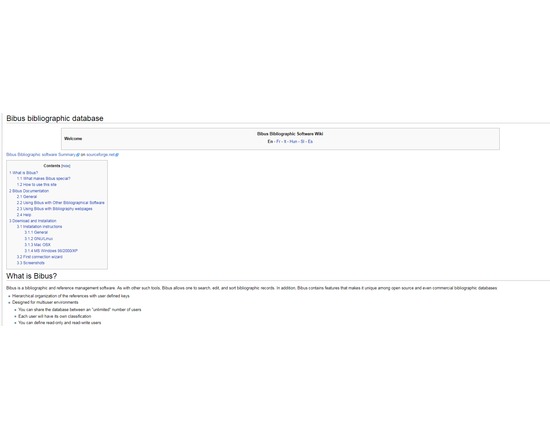
Bibus is a bibliographic and reference management software. As with other such tools, Bibus allows one to search, edit, and sort bibliographic records. In addition, Bibus contains features that makes it unique among open source and even commercial bibliographic databases: Hierarchical organization of the references with user defined keys Designed for multiuser environments Database sharing among an "unlimited" number of users Individual classification for each user Ability to define read-only and read-write users Live queries; that is searches that update as the database changes Online PubMed queries Online eTBLAST queries Insertion of references and formatting of bibliographies into three widely used Word Processors (LibreOffice.org,OpenOffice.org and Microsoft Word) Foreign language support through Unicode and gettext. As of version 1.4, Bibus is available in English, Chinese, Czech, French, German, Hungarian, Portuguese, Slovenian, Spanish.
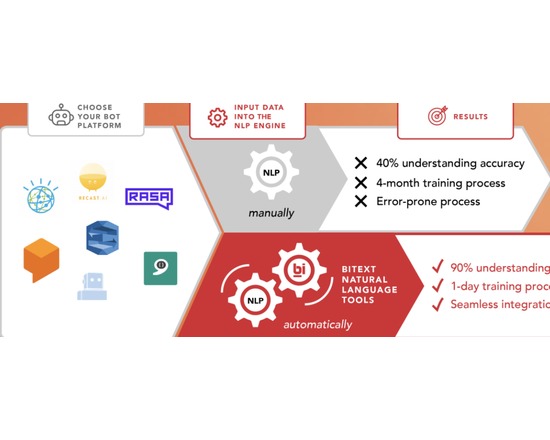
Bitext provides multilingual semantic technologies in the field of Text Analyics via API with services like Entity Extraction, Concept Extraction, Sentiment Analysis, and Text Categorisation.
Bitly is a link shortening service that also helps you share, track, and analyze your links. Now includes "bundles" which can be public or private, to gather your links by categories you choose. A social network style feed of other people's bitly links can be added to your dashboard. An iOS app is available for iPhone. Wordpress plugin and API are available. Site includes a sub-site about the API for developers here: dev.bitly.com