LibLime's Koha is a web-based, open source integrated library system (ILS) that has also been used for virtual library systems (e.g. recreating historic libraries). LibLime Koha offers libraries circulation policies, patron management modules, parent-child relationship for patron records, club and service management features, in-depth "holds" support, single click batch import "undo" option, EzProxy compatibility, self-checkout interface and more.
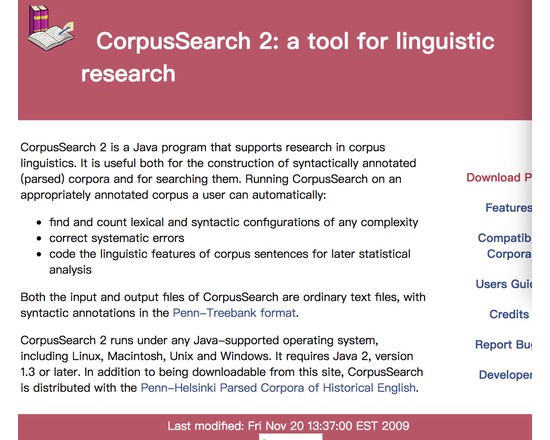
CorpusSearch 2 allows users to construct and search syntactically annotated corpora, including finding and counting lexical and syntactic patterns, correcting systemic errors, and coding linguistic features. The software is released under Mozilla Public License 1.1 (MPL 1.1) .
iTunesCyrFix can convert jibberish text in the title, artist, artist, or other ID3 tags in iTunes (e.g. Ñïëèí) into readable UTF-8 Cyrillic text. The jaberish text arises when song names or artist names have letters that are not part of the English alphanumeric system. Usually it occurs when itunes uses a different text encoding system.
The Bamboo Person Service can help scholars access all the resources (tools, collections, and shared data) they have permissions for due to their institutional affiliations, scholarly society membership, association with research groups, etc. By connecting accounts from these different groups (e.g. a Google account for a research group, a university ID, and a generic username for a scholarly society), scholars will be able to use resources provided by any of these groups, in any work space or tool environment within the Bamboo ecosystem. Where previously research groups would have to agree on a single environment to work collaboratively and share their data, the Bamboo Person Service can allow group leaders to indicate which scholars in the Bamboo Person Service should have access to a set of data, which will then become accessible for each of those people in the environment of their choosing. The Bamboo Person Service also provides mechanisms for making contributions to projects easier to document (e.g. to present to tenure and review committees), by keeping track of which individuals are doing curation work on corpora, or contributing entries to Bamboo DiRT. As the Bamboo Person Service develops, it may be integrated with social and scholarly networking sites, to allow scholars to opt into sharing the tools they use, as part of their profile. For tool developers and collection holders, the Bamboo Person Service can reduce the time and development effort that would go into writing custom authentication and authorization, and can facilitate quality control in crowdsourced projects by keeping track of the curator assessments made about the validity of individual users' additions.
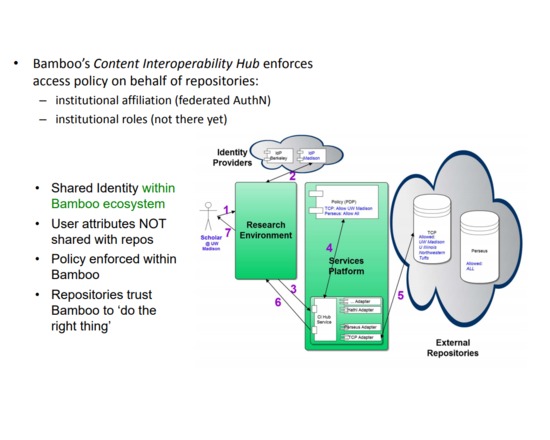
The Bamboo Content Interoperability Hub (CI gub) is an effort to largely automate the time-consuming process of downloading and compiling data from different repositories and archives and standardizing some of the format differences. When scholars browse the repositories whose content they want (and have rights to) use, they can bookmark it at the proper level of granularity in Zotero, and import those Zotero bookmarks into a workspace integrated with the CI hub. The CI hub then retrieves the data, and normalizes it to a certain extent so that data from different sources can be used together. The CI hub also offers a "preview" tool to see what data has been ingested, before that data is handed off to the environment where the scholar will use it. The CI hub currently has adaptors to draw data from TCP-EEBO/ECO, Hathi Trust, Perseus, and AustLit.
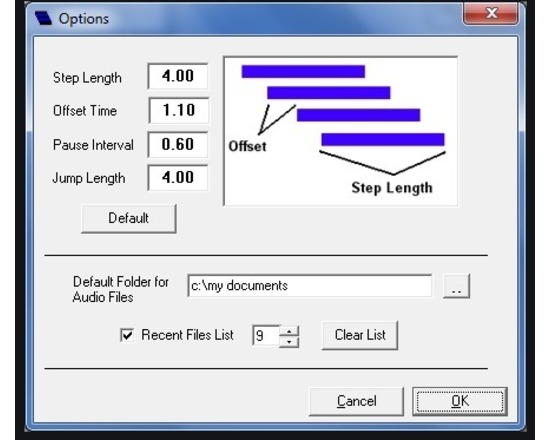
VoiceWalker is a transcriber's tool, designed to help you transcribe audio or video recordings. VoiceWalker lets you play back the sound in a controlled way, with the benefit of being able to systematically step (or "walk") through a recording, repeating short segments for a specified number of repetitions, then moving on to the next segment. The segments overlap, so that the transcriber does not become disoriented. VoiceWalker assumes that you have digitized your recordings as computer files to work with them more easily (for information on how to digitize, see the VoiceWalker manual). VoiceWalker is free, available for Windows only.
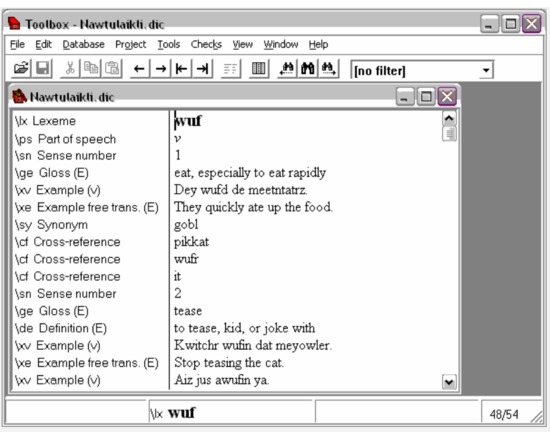
Toolbox is a data management and analysis tool for field linguists. It is especially useful for maintaining lexical data, and for parsing and interlinearizing text, but it can be used to manage virtually any kind of data. Toolbox is free to download and use. Toolbox is especially powerful for handling large corpora and dictionaries. It can handle a corpus of over a million words, and a dictionary of hundreds of thousands of words At heart, Toolbox is a text-oriented database management system (DBMS) with added functionality designed to meet the needs of a field linguist. The underlying DBMS offers full user flexibility in the design of any type of database. But for ease of use, the Toolbox package includes prepared database definitions for a typical dictionary and text corpus. Toolbox also has powerful linguistic functionality. It includes a morphological parser that can handle almost all types of morphophonemic processes. It has a word formula component that allows the linguist to describe all the possible affix patterns that occur in words. It has a user-definable interlinear text generation system which uses the morphological parser and lexicon to generate annotated text
Praat is free software for the phonetic analysis of speech, including support for articulatory and speech synthesis. The most current release is version 6.2.05 . It is now available on a variety of operating systems including Window, Macintosh, Raspberry Pi, Chromebook, Linux. Praat now includes many additional functionalities among which are: - Statistical analysis - Listening experiments - Speech manipulations - Learning algorithms.
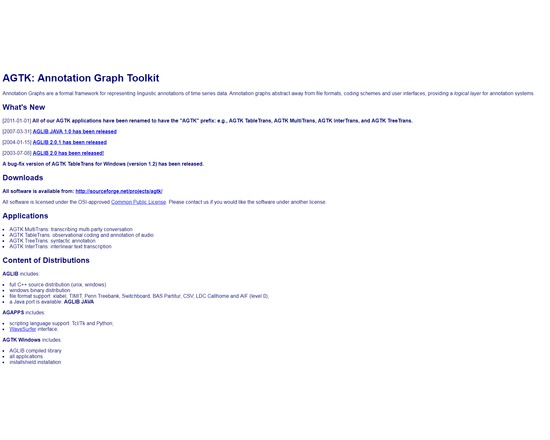
AGTK is a suite of software components for building tools for annotating linguistic signals, time-series data which documents any kind of linguistic behavior (e.g. audio, video). The internal data structures are based on annotation graphs. Annotation Graphs are a formal framework for representing linguistic annotations of time series data. (Note: last release 2007. Last update on sourceforge page 2011). The links on the sourceforge page are broken: software is reportedly released under a 'Common Public Licence', although the link to the licence at http://www.opensource.org/ is broken; link to the project website at the Linguistic Data Consortium is broken.