TuneGlue
TuneGlue is a music search engine that generates and connects nodes containing artist names related to the one queried, and networks the related artists in an interactive web.
TuneGlue is a music search engine that generates and connects nodes containing artist names related to the one queried, and networks the related artists in an interactive web.

Creation
Tumblr is a blogging/microblogging platform with a focus on data sharing between individual blogs. Users can create and disseminate data in a visual or HTML editor, using standard Tumblr posting formats: text, photo, quote, link, chat, audio, and video. Built-in customization tools allow users to manipulate the appearance of their blog with little knowledge of web development. Tumblr also provides a CSS/HTML customization panel for more advanced users, including theme documentation and the ability to upload/alter theme asset files (e.g., CSS, JS).
Organizing
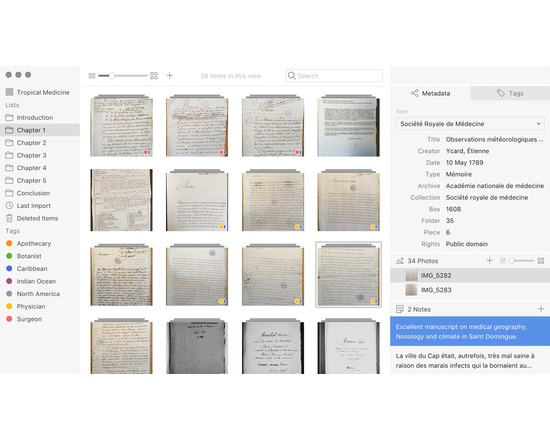
Take control of your research photos with Tropy, a tool that shortens the path from finding archival sources to writing about them. Spend more time using your research photos, and less time searching for them.
Visualization
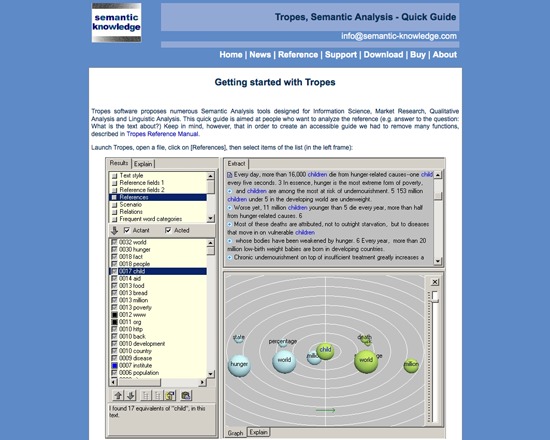
Tropes is a legacy commercial text analysis tool now available for free. It is designed for natural language processing and semantic classification, including chronological analysis of sequential pieces of text and summarization. It includes a graphical interface and can generate a variety of hypertext-based graphs.

Analysis
TRICON was a concordance program developed in the 1960s for the Berkeley Machine Translation Project. The program was designed to work with texts in languages written in non-Roman alphabets, such as Russian (original version) or Judeo Arabic texts (as of 1967). It was developed in FORTRAN G and ran on IBM 360/70 computers.
Natural Language Processing
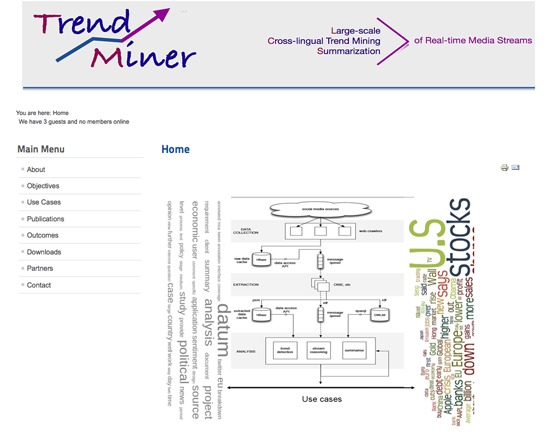
Trend Miner is a tool designed to enable portable open-source real-time methods for cross-lingual mining and summarizing of large-scale stream media. It combines elements from natural language processing, knowledge-based reasoning, machine learning, economics and political science. It is designed to access and interpret data from sources such as blogs, Facebook and Twitter.

Collaboration
Trello is a web-based project management and collaboration tool that allows users to organize projects in a dashboard view, containing one or more project-oriented boards. The dashboard provides a real-time overview of what is being worked on, who is working on what, and overall progress toward project milestones. Useful for organized task management, delegation, communication, and collaboration across teams.
Natural Language Processing
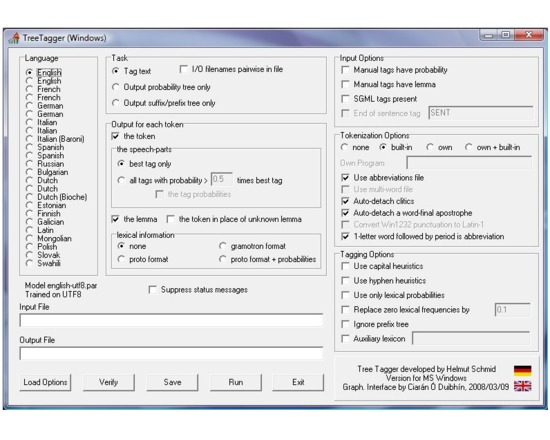
The TreeTagger is a program developed by Helmut Schmid at the University of Stuttgart (now at the University of München), for part-of-speech tagging and lemmatization. Language models (known as “parameters”, file extension .par) are supplied on the TreeTagger webpage for using the program with texts in English, French, German, Italian, Spanish, Russian, Bulgarian, Dutch, Estonian, Finnish, Galician, Latin, Mongolian, Polish, Slovak and Swahili, and models for some other languages are available from sites linked to the TreeTagger webpage. For a language for which no model exists, it is necessary to hand-tag some text, and then run a training program (provided with the TreeTagger) to create the model.
Visualization
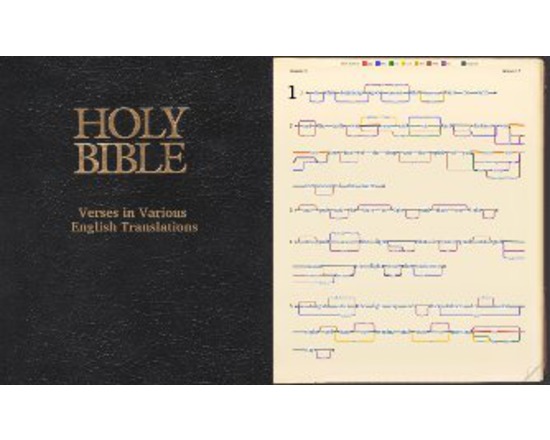
One of the substantial tasks in the field of textual criticism is called collation, which is the cautious comparison of various editions of one and the same text. The traditional approach of a humanities scholar is to put the texts of several editions next to each other and mark the differences among the textual entities (e.g., sentences, sections, chapters). Since this is an extremely laborious approach many Digital Humanities projects investigate tools that support the humanities scholars with computational methods. TRAViz is a JavaScript library that was developed within the Digital Humanities project eTRACES. It generates visualizations for Text Variant Graphs that show the variations between different editions of texts. TRAViz supports the collation task by providing methods to: - align various editions of a text - visualize the alignment - improve the readability for Text Variant Graphs compared to other approaches - interact with the graph to discover how individual editions disseminate

Visualization
TravelTime Maps make it possible to create isochrones (travel time areas) on a map by selecting a start point, the maximum travel time and preferred transport mode. For example users can visualise all locations within 15 minutes drive time from their current location. It also uses walking, cycling and public transport times. It' also possible to download a CSV of all postcodes that fall within this area on request or export to a KML.