
Analysis
Excel
Microsoft Excel is spreadsheet software with calculation, graphing tools, and pivot table options for analyzing data. A cloud-hosted version is available as part of Office 365.
Analysis
Microsoft Excel is spreadsheet software with calculation, graphing tools, and pivot table options for analyzing data. A cloud-hosted version is available as part of Office 365.
Publishing
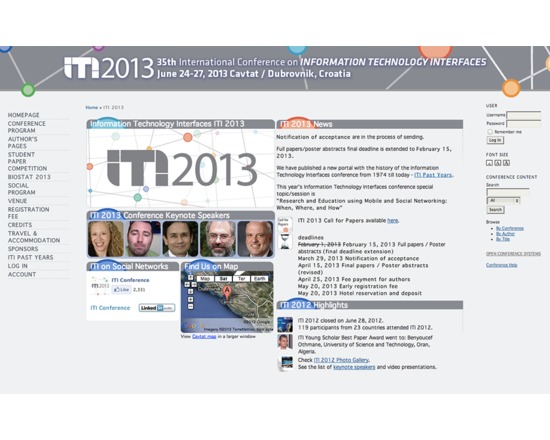
Open Conference Systems (OCS) is a free Web publishing tool that can create a complete Web presence for scholarly conferences. It is a highly flexible management and publishing system that can be downloaded for free and installed on a local Web server. It has been designed to reduce the time and energy devoted to the clerical and managerial tasks associated with managing a conference, while improving the record-keeping and efficiency of editorial processes. It seeks to improve the scholarly and public quality of conference publishing through a number of innovation, from making policies more transparent to improving indexing. Features: - create a conference Web site - Manage conferences that occur more than once (e.g., yearly) - compose and send a call for papers - electronically accept paper and abstract submissions - allow paper submitters to edit their work - Conduct peer reviews - post conference proceedings and papers in a searchable format - Schedule a Conference - post the original data sets - register participants, including accepting payments - integrate post-conference online discussions - utilize an e-mail template system - support multiple languages with localization files - Take advantage of more customizable, scalable and secure code System Requirements: A server environment meeting the following requirements is recommended: - PHP >= 4.2.x (including PHP 5.x); Microsoft IIS requires PHP 5.x - MySQL >= 3.23.23 (including MySQL 4.x) or PostgreSQL >= 7.1 (including - PostgreSQL 8.x) - Apache >= 1.3.2x or >= 2.0.4x or Microsoft IIS 6 Operating system: Any OS that supports the above software, including Linux, BSD, Solaris, Mac OS X, Windows
Visualization
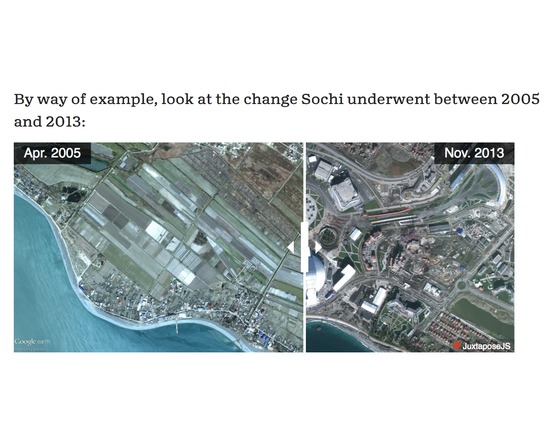
JuxtaposeJS helps tell stories by comparing two image frames, including photos and gifs. It provides a means, by a draggable pane, to see the changes and visually analyse the differences between the two images. It’s an adaptable storytelling tool that is ideal for highlighting then/now stories that explain slow changes over time (growth of a city skyline, regrowth of a forest, etc.) or before/after stories that show the impact of single dramatic events (natural disasters, protests, wars, etc.). JuxtaposeJS is free, easy to use, and open source. Almost anyone can use JuxtaposeJS, so long as you’ve got links to two similar pieces of media (hosted on your own server or on Flickr). Once you’ve got the links, all you need to do is copy and paste the URLs into the appropriate fields at Juxtapose.knightlab.com, modify labels as you see fit, add photo credits, and then copy and paste the resulting embed code into your site. You’ve probably seen similar photo slider tools elsewhere. They work well, but we built JuxtaposeJS without relying on jQuery, which makes the tool more lightweight, flexible, and adaptable. It’s also accessible to any newsroom or journalist, regardless of technical skills. It also offers some customization out of the box. You can modify the handle’s start position to highlight the area of change and choose to click the slider instead of dragging. It is responsive and works on phones and tablets with the touch or swipe of a finger.
Publishing
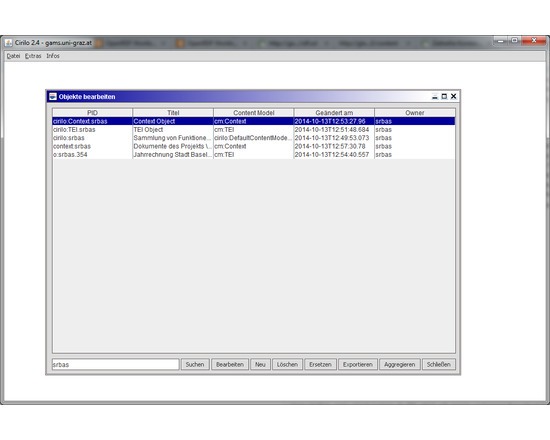
GAMS/Cirilo is an application developed for content preservation and data curation in FEDORA-based repository systems. Content preservation and data curation include object creation and management, versioning, normalization and standards, and the choice of data formats. The client offers functionalities which are especially prone to be used as tools for mass operations on FEDORA objects, such as ingest or replacement processes. Cirilo uses a collection of predefined content models, which can be used without further adjustments for standard workflow scenarios like the management of collections of TEI objects. It encapsulates functions for the resolvement of place names or ontology concepts, thus semantically enriching resources in the digital archive. Various dissemination options can also be assigned with the client. Cirilo is a contribution to the DARIAH-EU task “Reference Software Packages. The source code of the client can be found at https://github.com/acdh/cirilo, the documentation is available at http://gams.uni-graz.at/doku. An „archive-in-a-box“-installation package (Client including a FEDORA 3.5 instance) for Debian-based Linux-distributions can be downloaded from http://gams.uni-graz.at/download/cirilo-installer-2.4.tar.gz

Publishing
Lucidpress is a free online editor for making pamphlets, brochures, flyers, magazines, and more. Features include real-time collaboration, digital publishing, and easy sharing, all of which come in an intuitive, drag-and-drop interface. Upgrade to a professional account for increased storage space and access to additional templates.

Collaboration
Paperpile is a web-based commercial reference management software with special emphasis on integration with Google Docs and Google Scholar. It imports data from academic publisher websites and from databases such as PubMed, Google Scholar, Google Books, and arXiv. Paperpile can retrieve and store publication PDF files to the user's Google Drive account.
Collaboration
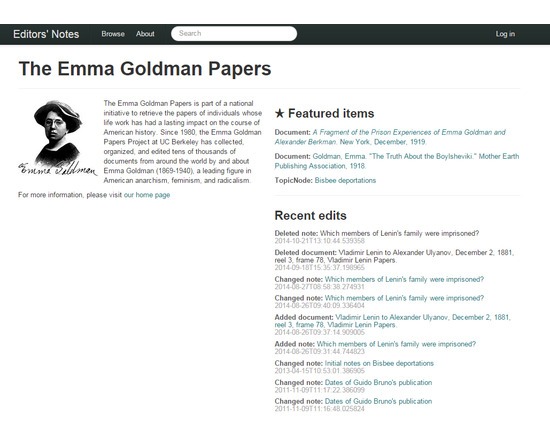
Editors' Notes is an open-source, web-based tool for recording, organizing, preserving, and opening access to research notes, built with the needs of documentary editing projects, archives, and library special collections in mind. Projects that work closely with documents—researching, contextualizing, and ordering them—invariably produce massive amounts of thorough research notes which are too often locked away in filing cabinets or the minds of editors and curators, never to be seen by anyone. The Editors' Notes project is a collaboration between the editors of the Stanton-Anthony Papers, the Emma Goldman Papers, the Margaret Sanger Papers, and the Labadie Collection which aims to preserve those research notes in a way that makes them useful to future scholars and interested minds. Research teams can use Editors' Notes to manage their research and note-taking. Project administrators can assign research tasks to other team members, and they can control who has permission to edit their project's notes. Notes can be organized around documentary sources or thematically around topics (or both). Users can browse by topic, search full text, and filter using bibliographic metadata. Documents can be annotated with bibliographic metadata, topic keywords, and textual notations. Researchers can also upload scanned images of documents into the zoomable interface. Researchers can annotate specific passages in document transcripts. Annotations, like other notes, can include bibliographic metadata and topic keywords and are fully searchable. In addition to creating annotated transcripts, researchers can upload scanned images of documents, which can be viewed in a zoomable interface. New accounts are by invitation only. Request an invitation. Editors' Notes is currently in limited beta release (Nov 10/14)
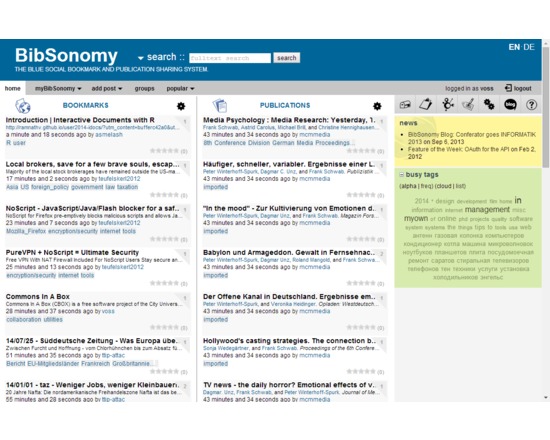
BibSonomy is a social bookmarking and publication-sharing system. It aims to integrate the features of bookmarking systems as well as team-oriented publication management. BibSonomy offers users the ability to store and organize their bookmarks and publication entries and supports the integration of different communities and people by offering a social platform for literature exchange. Both bookmarks and publication entries can be tagged to help structure and re-find information. As the descriptive terms can be freely chosen, the assignment of tags from different users creates a spontaneous, uncontrolled vocabulary: a folksonomy. In BibSonomy, the folksonomy evolves from the participation of research groups, learning communities and individual users, organizing their information needs. Publication posts in BibSonomy are stored in the BibTeX format. Export in other formats such as EndNote or HTML (e. g. for publication list creation) is possible. The service was developed by a team of students and scientists working at the Institute of Knowledge and Data Engineering and is hosted by the University of Kassel in Germany. [Description taken from the Wikipedia article about BiBSonomy]

Collaboration
Microsoft OneNote is a digital notebook that allows you to gather notes and information in a central environment, and search across your shared notebooks to better manage information and work with others. OneNote used to be available as paid software, but is now free across platforms.
Content Analysis
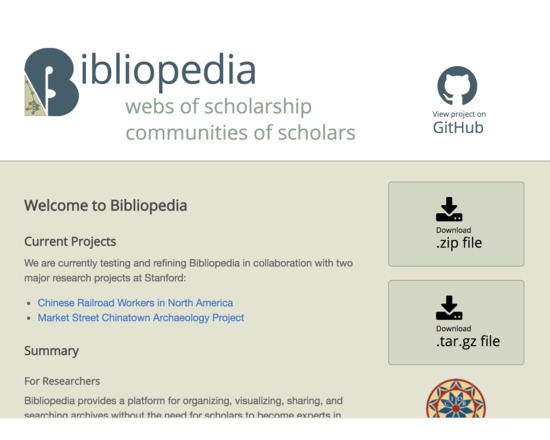
Bibliopedia will perform advanced data-mining and cross-referencing of scholarly literature to create a humanities-centered collaboratory. As a prototype, it will search resources including JSTOR and Library of Congress for metadata about scholarly articles and books that mention the famed medieval travel narrative The Travels of Sir John Mandeville, examine the articles and books for citations, then save the results in a publicly accessible database. Although using works centered around a single text as a test case, Bibliopedia will be designed to work with all humanities scholarship. Bibliopedia will also allow users to create browsable and customizable bibliographies of all the works cited by each article and book. Most importantly, it will use semantic web technology to perform automated textual analysis, data extraction, cross-referencing, and visualizations of the relationships among texts and authors. Bibliopedia will crawl, aggregate, cross-reference, and display multiple scholarly repositories such as JSTOR, Library of Congress, Project Muse, and Google Books. The project will transform bibliographic data that is currently readable only by humans into machine-readable data via semantic web technology, which will make scholarly resources available for automated analyses, inferences, and visualizations.