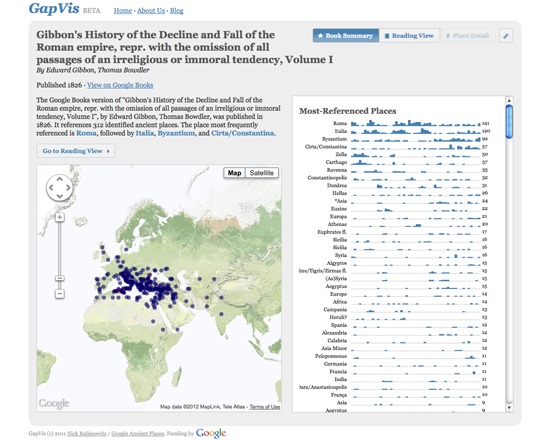
GapVis is a free tool developed in conjunction with Google Ancient Places to visualize the locations within and allow the exploration of books referencing ancient places within the Google Books collection. Users can view text summaries, use an enhanced reading interface and explore the location references through a place detail view. It is intended both to enable location-based text discovery, and to allow users to delve more deeply into a text based on the locations referenced within it. GapVis is currently in beta.
GATE (General Architecture for Text Engineering) is free, open source software offered by the University of Sheffield since 1995. It provides a framework for users to gather a corpus, apply an ontology to it, develop markup, automate the application of the markup to the corpus and add tools such as knowledge facet search, ontology browsing or graphing.
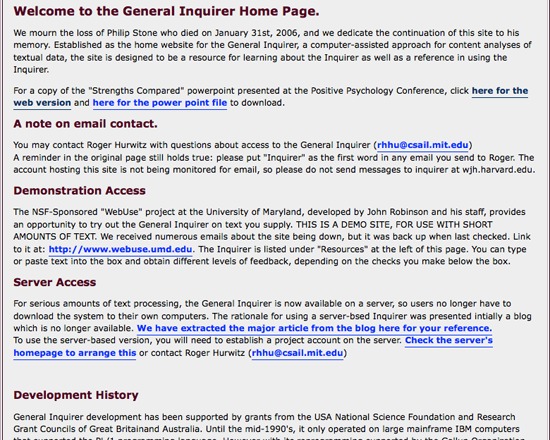
The General Inquirer is a historically important program for content analysis of textual data originally developed in the 1960s by Philip Stone and his colleagues at the Harvard Laboratory of Social Relations. Though the original release used punched cards, a version the program is available by request, and can be obtained by e-mailing Roger Hurwitz from an academic address. A minimalist web version capable of processing small files is also available. The General Inquirer's homepage is maintained in Philip Stone's memory.
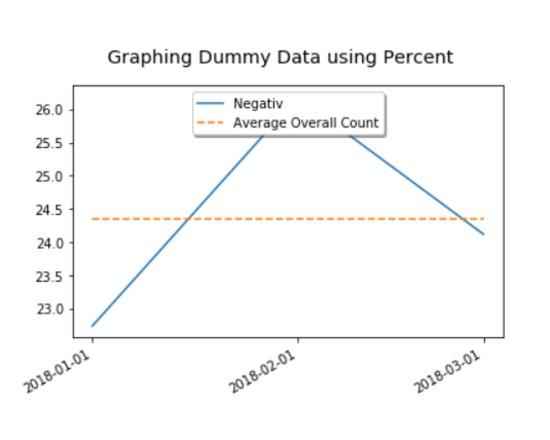
TATR: This notebook is part of a greater series of Juypter Notebook structured around Twitter Tweet analysis. This particular notebook will look at categorizing text using the General Inquirer Categories released by Harvard (http://www.wjh.harvard.edu/~inquirer/spreadsheet_guide.htm). This notebook will showcase how to break down the General Inquirer Category into a dictionary and how it can be tailored to fit your needs.
Gensim is an open-source library for unsupervised topic modeling and natural language processing, using modern statistical machine learning. Gensim is implemented in Python and Cython. Gensim is designed to handle large text collections using data streaming and incremental online algorithms, which differentiates it from most other machine learning software packages that target only in-memory processing. Gensim includes streamed parallelized implementations of fastText, word2vec and doc2vec algorithms, as well as latent semantic analysis (LSA, LSI, SVD), non-negative matrix factorization (NMF), latent Dirichlet allocation (LDA), tf-idf and random projections.
A global geographical database that may be used to identify and tag all references to location. The database contains over 8 million entries, each of which possesses a geographic name (in various languages), latitude, longitude, elevation, population, administrative subdivision and postal codes and information on unique features. Features: Built upon web service, enabling transparent look-up and use of content through third-party tools and sites Browse by geographic location, country name, size of geographic region and other categories. Full text search support Extensible, enabling users to expand existing information or contribute new content Support for the World Geodetic System 1984 (WGS84) co-ordinate system
Geographically Encoded Objects for RSS feeds. GeoRSS was designed as a lightweight, community driven way to extend existing feeds with geographic information. As RSS and Atom become more prevalent as a way to publish and share information, it becomes increasingly important that location is described in an interoperable manner so that applications can request, aggregate, share and map geographically tagged feeds.RSS Map of Digital Humanities centers Two primary GeoRSS encoding exist, including GeoRSS Geography Markup Language (GML) and GeoRSS Simple. GeoRSS-Simple is a lightweight format that supports basic geometries of point, line, box, polygon. GeoRSS GML is a Open Geospatial Consortium (OGC) GML Application Profile, and supports a greater range of features than GeoRSS Simple.
The amount of online data annotated with geospatial and temporal metadata has grown rapidly in the recent years. Providers like Flickr and Twitter are popular, but hard to browse. Many systems exist that, in multiple linked views, show the data under geospatial, temporal, and topical aspects. GeoTemCo is a web-application which easily can be utilized to visualize such kind of data, and furthermore, it allows the comparative analysis of several datasets. GeoTemCo consists of several views showing the datas' several dimensions: a map view for the geospatial distribution of items, a time view for the temporal distribution of items and a detail view for the inspection of individual items. A broad range of interaction abilities allows for explorative comparison and analysis of different datasets representing different topics. GeoTemCo focuses on supporting the user to: - analyze and compare temporal trends - analyze and compare geospatial distributions - detect cooccurences between data items of different datasets - compare geospatial migrations of topics over time - find causalities between different datasets
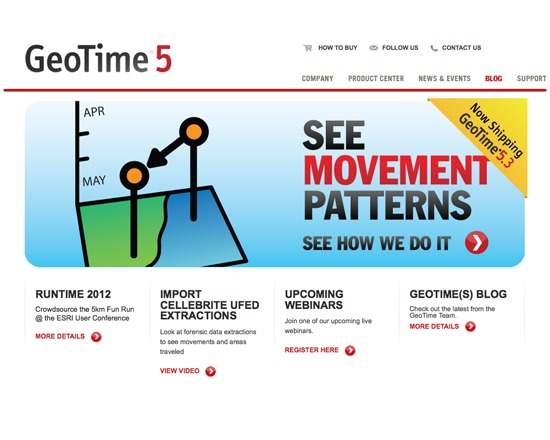
GeoTime is a tool for visualizing complex event-related data available for purchase. It can simultaneously visualize geospatial, temporal and link data to display activities and events. Data can be imported from ArcGIS or Microsoft Excel.
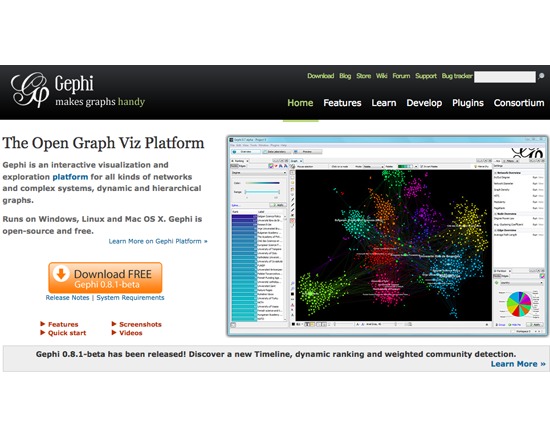
Gephi is a free, open source interactive visualization and data exploration tool. Users can manipulate the display to uncover new facets of the data, enabling intutive exploration.