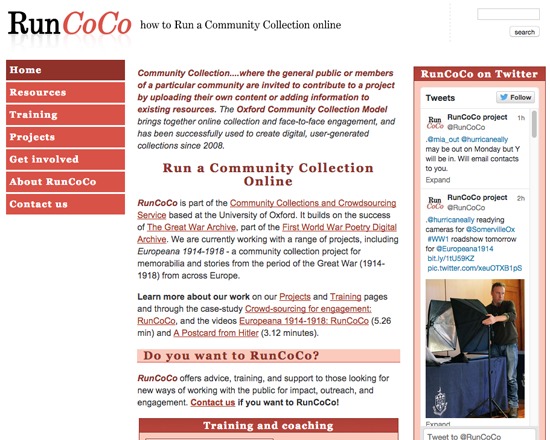
Community Contributed Collection (CoCoCo) is web software developed by the RunCoCo Project at the University of Oxford for collecting, cataloguing and managing web content such as text or uploaded files contributed by a community of users. It enables administrators to assess contributions for quality, approve project-appropriate contributions, and apply metadata where required. Once a contribution is approved, it is available for searching and browsing through the provided interface. CoCoCo utilizes Ruby on Rails, and is available under an Open Source version 3.0 license.
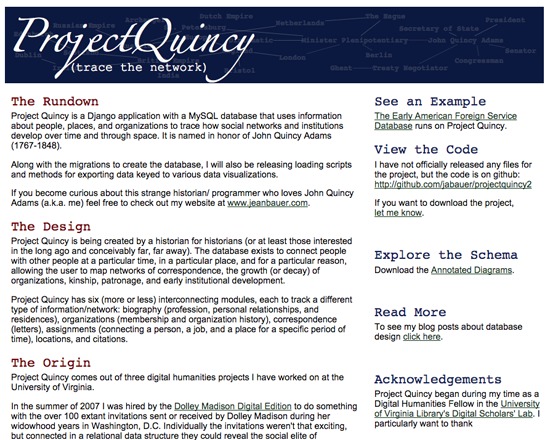
Project Quincy is a free, open source Django application and MySQL database for tracing the development of social networks and instititions across time and space. Aimed at historians, it enables users to map networks in historical documentation such as biographic, organizational, correspondance or location. Creator Jean Bauer has developed Project Quincy as a single generalizable and extensible database with applications beyond mapping historic connections. All code is available via Github repository, or by contacting the creator directly.
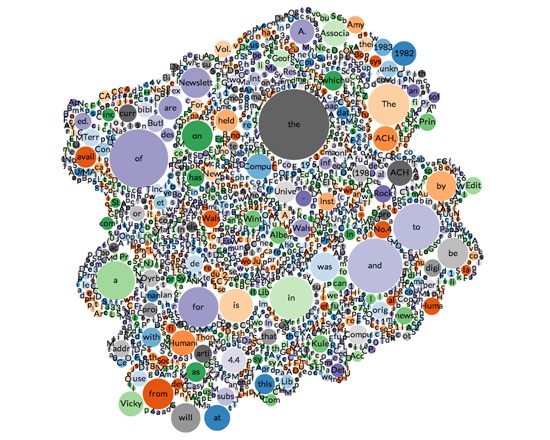
Lexos is a free, web-based workflow for text analysis offered by Wheaton College's Lexomics Project. Lexos is the most recent and distinct iteration of the Lexomics system of tools, enabling users to upload a text and use the Lexos interface to apply transformations, visualizations, scrubbing and analytic processes without needing to re-add the text for each step.
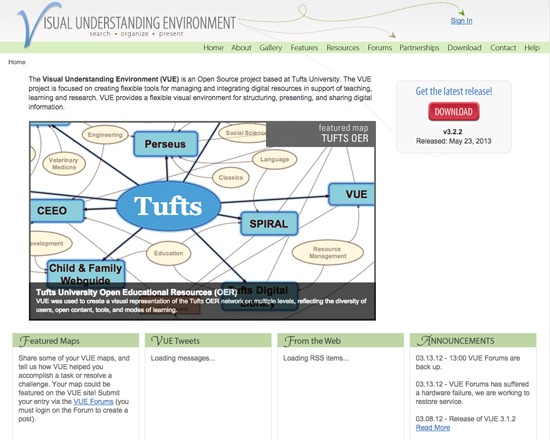
Visual Understanding Environment (VUE) is a free, open source application for mapping concepts, ideas and digital content. It enables users to generate nodes and links, and apply a simple set of tools to explore the relationships. VUE is, in the words of its developers, an application to "integrate, organize and contextualize electronic content" in research or learning environments. Its tools include visualization, dynamic content mapping, semantic mapping, enhanced pathways and search functions.
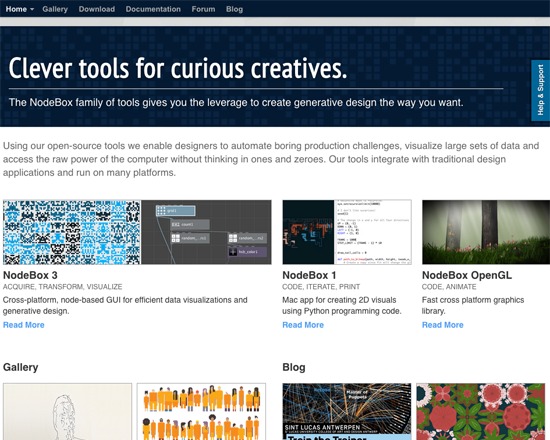
NodeBox is an open-source package of tools that includes the capacity to visualize large data sets. It utilizes interconnected nodes to generate and manipulate data visualizations, and can import data either from common programs such as Excel, or from custom user-developed importers.
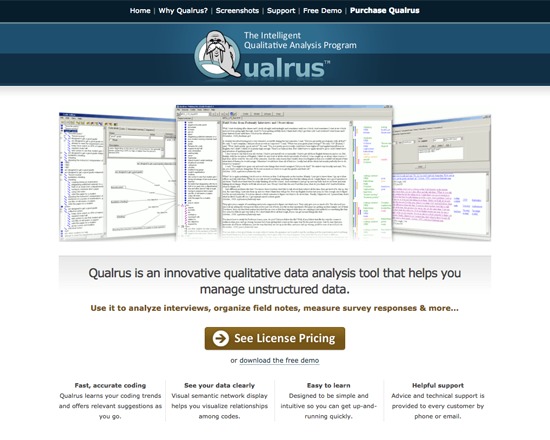
Qualrus is a commercial application for qualitative data analysis, including data coding and statistics functions. It can analyze data from a wide variety of sources, including common text, web, image, video and audio files. The data coding functions are supplemented by machine learning processes to assist data processing and analysis. In terms of analysis, it offers a number of common text analysis functions including tokenization, co-occurences, and Boolean search, and can visualize a network view of interrelationships. It is particularly aimed at academic and institutional applications, and both student and free trial versions are avaiable.
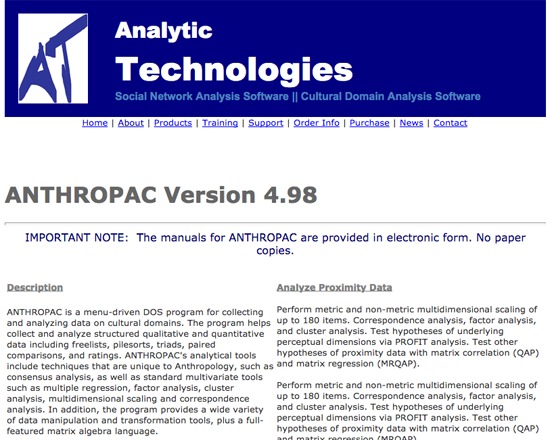
ANTHROPAC, now in version 4.98, is a long-standing menu-driven DOS program developed for working with anthropological and other cultural data. It assists both the collection and analysis of datasets, and can accommodate both qualitiative and quantitative information. ANTHROPAC includes analytic tools such as consensus analysis, factor analysis, cluster analysis and correspondance analysis, in addition to data manipulation and transformation functions. It imports and exports data via ASCII formats, and includes an extensive reference manual, a user's guide and a methods guide tailored for cultural domain analysis.
SwiftRiver is a free, open source platform for filtering and processing large amounts of information. In particular, it can gather and filter data from common web sources such as email, Twitter or RSS. It also enables users to define 'buckets' according to their own criteria rather than relying on, for example, the information's social media popularity status. Utilizing a combination of filters and buckets, users create 'rivers' of data populated by their chosen sources. Developer Ushahidi has made all code available for general access via Github, though a custom, full-service, hosted version is available for a fee by contacting the company directly.
Rated 0.0 out of 5.★★★★★0.0
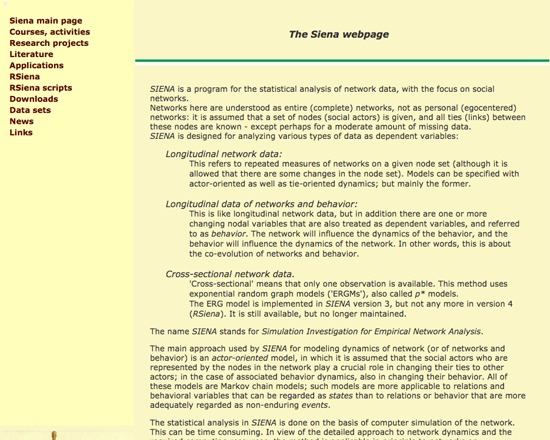
Siena (Simulation Investigation for Empirical Network Analysis)
Siena (Simulation Investigation for Empirical Network Analysis) is a free program for statistical analysis developed particularly to work with social network data, but also applicable to other forms of network data. It models network dynamics via Markov chain models; this approach is best applied to data where relations between actors and their behaviour can be treated as a state rather than as an event. Siena's statistical analysis processes can be time-consuming, as the system works via computer simulation of the network. It was in continuous development from 2001 through 2010, releasing versions up to 3.2. Development on Siena as a stand-alone program has concuded, and the project has shifted focus to RSiena, a version of Siena deployed in R.
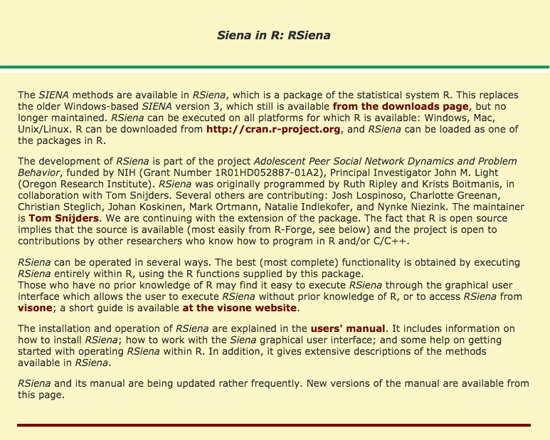
RSiena is a free, open source social network analysis package for R. It replaces Siena (Simulation Investigation for Empirical Network Analysis), which was a stand-alone program for Windows. Like its predecessor, RSiena is optimized for social network data, but is also applicable to other forms of network data, and relies on Markov chain models to generate network dynamics. T his approach is best applied to data where relations between actors and their behaviour can be treated as a state rather than as an event. Users not familiar with R can run RSiena via the provided graphical user interface.