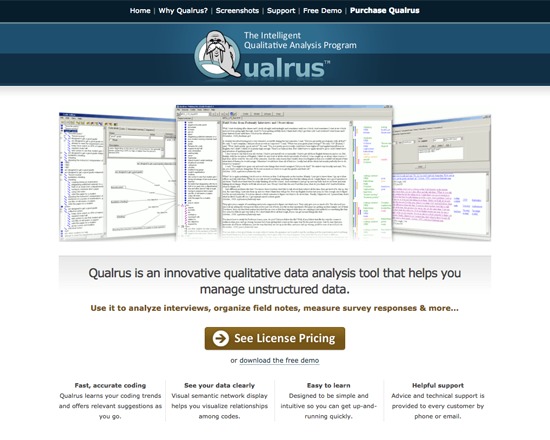
Qualrus is a commercial application for qualitative data analysis, including data coding and statistics functions. It can analyze data from a wide variety of sources, including common text, web, image, video and audio files. The data coding functions are supplemented by machine learning processes to assist data processing and analysis. In terms of analysis, it offers a number of common text analysis functions including tokenization, co-occurences, and Boolean search, and can visualize a network view of interrelationships. It is particularly aimed at academic and institutional applications, and both student and free trial versions are avaiable.
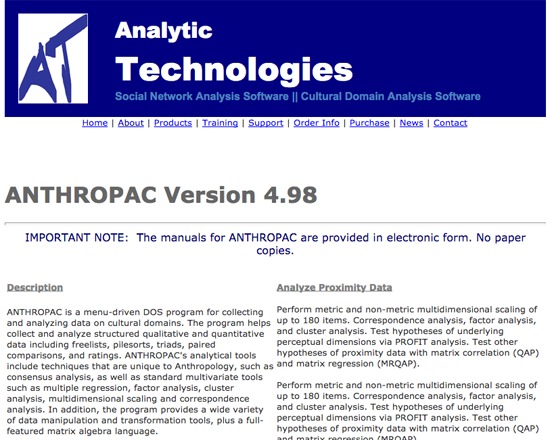
ANTHROPAC, now in version 4.98, is a long-standing menu-driven DOS program developed for working with anthropological and other cultural data. It assists both the collection and analysis of datasets, and can accommodate both qualitiative and quantitative information. ANTHROPAC includes analytic tools such as consensus analysis, factor analysis, cluster analysis and correspondance analysis, in addition to data manipulation and transformation functions. It imports and exports data via ASCII formats, and includes an extensive reference manual, a user's guide and a methods guide tailored for cultural domain analysis.
SwiftRiver is a free, open source platform for filtering and processing large amounts of information. In particular, it can gather and filter data from common web sources such as email, Twitter or RSS. It also enables users to define 'buckets' according to their own criteria rather than relying on, for example, the information's social media popularity status. Utilizing a combination of filters and buckets, users create 'rivers' of data populated by their chosen sources. Developer Ushahidi has made all code available for general access via Github, though a custom, full-service, hosted version is available for a fee by contacting the company directly.
Rated 0.0 out of 5.★★★★★0.0
Siena (Simulation Investigation for Empirical Network Analysis)
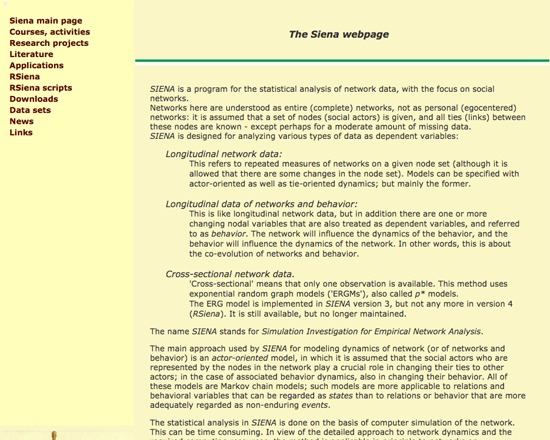
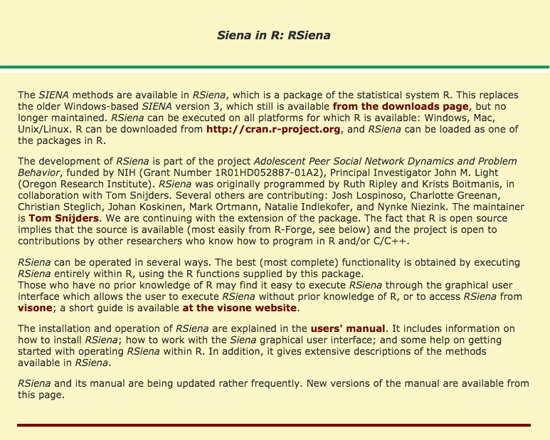
Siena (Simulation Investigation for Empirical Network Analysis) is a free program for statistical analysis developed particularly to work with social network data, but also applicable to other forms of network data. It models network dynamics via Markov chain models; this approach is best applied to data where relations between actors and their behaviour can be treated as a state rather than as an event. Siena's statistical analysis processes can be time-consuming, as the system works via computer simulation of the network. It was in continuous development from 2001 through 2010, releasing versions up to 3.2. Development on Siena as a stand-alone program has concuded, and the project has shifted focus to RSiena, a version of Siena deployed in R.
RSiena is a free, open source social network analysis package for R. It replaces Siena (Simulation Investigation for Empirical Network Analysis), which was a stand-alone program for Windows. Like its predecessor, RSiena is optimized for social network data, but is also applicable to other forms of network data, and relies on Markov chain models to generate network dynamics. T his approach is best applied to data where relations between actors and their behaviour can be treated as a state rather than as an event. Users not familiar with R can run RSiena via the provided graphical user interface.
SARIT (Search and Retrieval of Indic Texts) is a library of Indic texts with tools for search, retrieval and analysis built into the website. This includes options to apply a KWIC or concordance encompassing all matching texts for a site search. SARIT was developed from a modified version of PhiloLogic. The full SARIT collection with TEI-compatible markup is also available via Github.
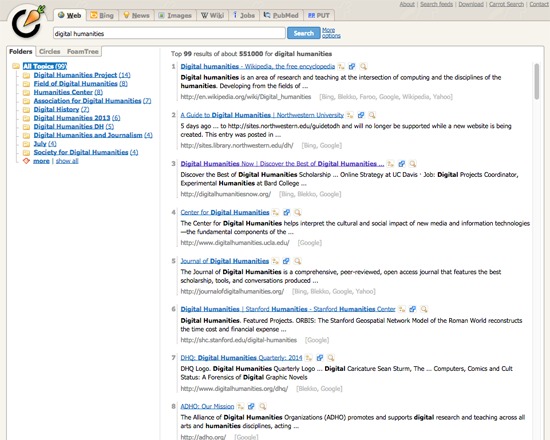
Carrot2 is a free, open source search clustering engine with additional document categorization functions. For each set of search terms, Carrot2 provides a topic tree and subtopics built from the search results, and generates visualizations that enable users to quickly overview their search. Searches can be filtered according to source, such as Bing, image files or the Wikipedia, results can be clustered according to several presets such as K-means or URL, or filtered by country and langauge. Carrot2 enables users to download results in ranges from 50 to 200 for further analysis.
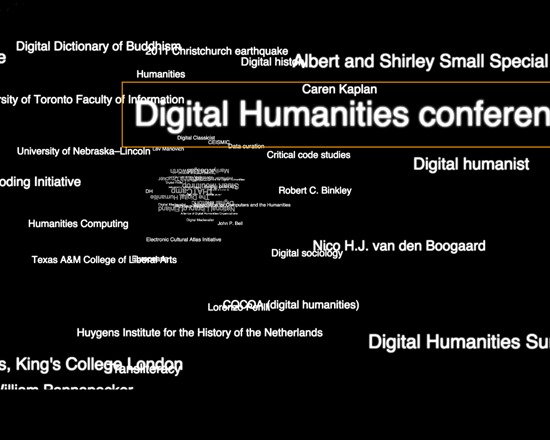
Casual is a free, open source tool for generating a visualization of concepts from a key word search. It uses Wikipedia for conceptual information, and can also include Google Image search results where applicable. Users can click on a term to generate a new search from that term, while image results can be rearranged by clicking and dragging them to the desired location. Casual can produce visualizations ranging from 10 to 400 concepts in size, and can retrieve information for queries in a wide variety of languages. This tool is no longer supported; development appears to have ceased in 2009.
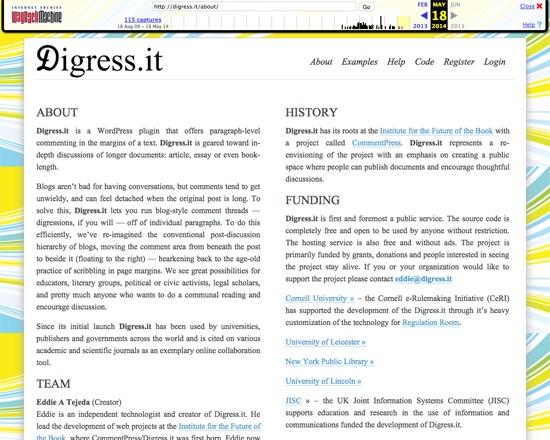
Digress.it was a free, open source WordPress plugin for annotating texts on the paragraph level, particularly of article to book-length documents. It permitted blog-like threaded discussions to occur in the margins of the text, and was aimed at facilitating scholarly, literary, political and other discussions. While the main website is no longer available, Digress.it is still available via the WordPress plugin directory .
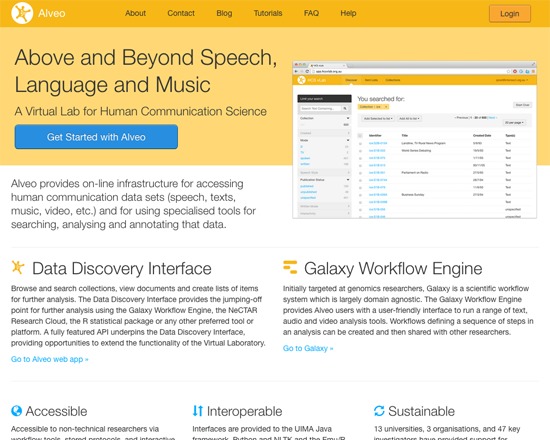
Alveo is a platform for data discovery and analysis focused on communication data such as speech, text or video. Developed by the University of Western Sydney, researchers can use the Alveo infrastructure to store data, create collections, develop workflows, and analyze datasets with Alveo's built-in tools. The tools available span multiple disciplines and include common functions such as tokenization and concordance, plus interfaces between Alveo and other common analysis tools such as Apache's UIMA for NLP, and with programming languages such as Python and Java. Users can segmented and recombined data from multiple collections into a new, focused dataset for close analysis. Collection creators can set their own license and access rights, and users of a collection must accept the creator's conditions in order to use data from it. User accounts are free, but must be requested from and approved by Alveo.