TemaTres is an open source vocabulary server, web application to manage and exploit vocabularies, thesauri, taxonomies and formal representations of knowledge.
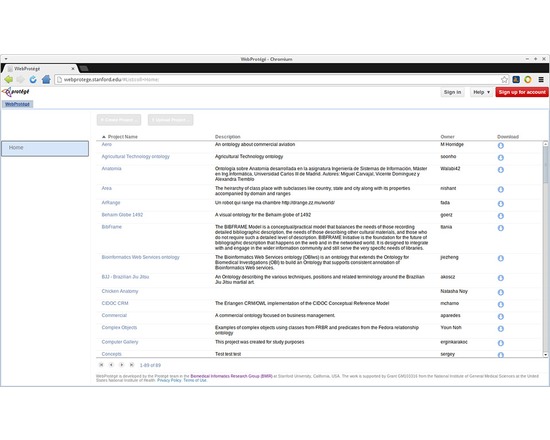
The Protege Project offers WebProtege and Protege Desktop, which are free and open source ontology editing applications. WebProtégé is an ontology development environment for the Web that makes it easy to create, upload, modify, and share ontologies for collaborative viewing and editing. WebProtégé fully supports the latest OWL 2 Web Ontology Language. The highly configurable user interface creates the perfect environment for beginners and experts alike. Collaboration features abound, including sharing and permissions, threaded notes and discussions, watches and email notifications. RDF/XML, Turtle, OWL/XML, OBO, and other formats available for ontology upload and download. Protégé Desktop is a feature rich ontology editing environment with full support for the OWL 2 Web Ontology Language, and direct in-memory connections to description logic reasoners like HermiT and Pellet. Protégé Desktop supports creation and editing of one or more ontologies in a single workspace via a completely customizable user interface. Visualization tools allow for interactive navigation of ontology relationships. Advanced explanation support aids in tracking down inconsistencies. Refactor operations available including ontology merging, moving axioms between ontologies, rename of multiple entities, and more.
A Web-based image annotation tool, built specifically for integration with existing Web pages or portal environments. Annotorious is also available as a plugin to the Annotator Web annotation system by the Open Knowledge Foundation.
Rated 0.0 out of 5.★★★★★0.0
WordStat - Content Analysis & Text Mining Software
WordStat is a text analysis module for QDA Miner or SimStat. WordStat combines content analysis method by using dictionary approach and many algorithms exploration or various text mining methods. WordStat can apply existing categorization dictionaries to a new text corpus. It also may be used in the development and validation of new categorization dictionaries. When used in conjunction with manual coding, this module can provide assistance for a more systematic application of coding rules, help uncover differences in word usage between subgroups of individuals and assist in the revision of existing coding using KWIC (Keyword In Context) tables. WordStat is specifically designed to study textual information such as responses to open-ended questions, interviews, titles, journal articles, public speeches, electronic communications, etc. For more information, visit: http://provalisresearch.com/products/content-analysis-software/
Rated 0.0 out of 5.★★★★★0.0
QDA Miner - Qualitative Data Analysis Software for Qualitative Research
QDA Miner is an easy-to-use mixed-methods qualitative data analysis software package for coding, annotating, retrieving and analyzing small and large collections of documents and images. QDA Miner may be used to analyze interview or focus-group transcripts, legal documents, journal articles, even entire books, as well as drawing, photographs, paintings, and other types of visual documents. Its seamless integration with SimStat, a statistical data analysis tool, and WordStat, a content analysis and text-mining module, gives you unprecedented flexibility for analyzing text and relating its content to structured information, including numerical and categorical data. For more information, visit http://provalisresearch.com/products/qualitative-data-analysis-software/
140kit provides a management layer for tweet collection and analysis. Raw data cannot be passed through to the users, but any analytical process can be run across your dataset, and the data is held for as long as the user wants. When new analytical processes are created, they can be run on existing sets of data. 140kit does not claim any control of the analysis, however it retains ownership of the data collected. Current limits: User: 20,000 Tweets per Dataset or until Dataset time elapses Academic User: 500,000 Tweets per Dataset or until Dataset time elapses
The cross-platform Advene application allows users to easily create comments and analyses of video documents, through the definition of time-aligned annotations and their mobilisation into automatically-generated or user-written comment views (HTML documents). Annotations can also be used to modify the rendition of the audiovisual document, thus providing virtual montage, captioning, navigation... capabilities. Users can exchange their comments/analyses in the form of Advene packages, independently from the video itself. The Advene framework provides models and tools allowing to design and reuse annotations schemas; annotate video streams according to these schemas; generate and create Stream-Time Based (mainly video-centred) or User-Time Based (mainly text-centred) visualisations of the annotations. Schemas (annotation- and relation-types), annotations and relations, queries and views can be clustered and shared in units called packages. Hypervideo documents are generated when needed, both from packages (for annotation and view description) and DVDs (audiovisual streams).