Social Science Research Network (SSRN) is devoted to the rapid, global dissemination of social science research. The SSRN electronic library consists of an abstract database containing abstracts on over 574,300 scholarly working papers and forthcoming papers, as well as an electronic paper collection with over 475,8000 downloadable, full-text PDF documents. SSRN houses a number of specialized research networks in each of the social sciences, encouraging early distribution of research results, as well as direct communication between readers, authors, and other subscribers. SSRN's specialized subject area networks include: Accounting Research Network (ARN) Cognitive Science Network (CSN) Corporate Governance Network (CGN) Economics Research Network (ERN) Entrepreneurship Research & Policy Network (ERPN) Financial Economics Network (FEN) Health Economics Network (HEN) Information Systems & eBusiness Network (ISN) Innovation Research & Policy Network (IRPN) International Business & Management Network (INTL) Leadership Research Network (LRN) Legal Scholarship Network (LSN) Management Research Network (MRN) Marketing Research Network (MKTG) Negotiations Research Network (NEG) Organizational Behavior Research Network (ORG) Political Science Network (PSN) Social Insurance Research Network (SIRN) Sustainability Research & Policy Network (SRPN) Classics Research Network (CRN) Music Research & Composition Network (MRCN) Philosophy Research Network (PRN) Rhetoric & Communication Research Network (RCRN)
H-Net is an international interdisciplinary organization of scholars and teachers dedicated to developing the enormous educational potential of the Web by providing curated lists and web sites publishing peer reviewed essays, multimedia materials, and discussion.
Cestagi is a collaborative platform that connects interdisciplinary communities. You can create a CV, share contributions, ask questions, learn about upcoming events, search employment opportunities, and track information.
BibApp allows you to promote your research, find collaborators on your own campus in your research area, in order to make research more accessible in general. BibApp identifies which publications should be placed on the Web for greater access, and can place publications directly into an institutional repository.
iTunesCyrFix can convert jibberish text in the title, artist, artist, or other ID3 tags in iTunes (e.g. Ñïëèí) into readable UTF-8 Cyrillic text. The jaberish text arises when song names or artist names have letters that are not part of the English alphanumeric system. Usually it occurs when itunes uses a different text encoding system.
The Bamboo Person Service can help scholars access all the resources (tools, collections, and shared data) they have permissions for due to their institutional affiliations, scholarly society membership, association with research groups, etc. By connecting accounts from these different groups (e.g. a Google account for a research group, a university ID, and a generic username for a scholarly society), scholars will be able to use resources provided by any of these groups, in any work space or tool environment within the Bamboo ecosystem. Where previously research groups would have to agree on a single environment to work collaboratively and share their data, the Bamboo Person Service can allow group leaders to indicate which scholars in the Bamboo Person Service should have access to a set of data, which will then become accessible for each of those people in the environment of their choosing. The Bamboo Person Service also provides mechanisms for making contributions to projects easier to document (e.g. to present to tenure and review committees), by keeping track of which individuals are doing curation work on corpora, or contributing entries to Bamboo DiRT. As the Bamboo Person Service develops, it may be integrated with social and scholarly networking sites, to allow scholars to opt into sharing the tools they use, as part of their profile. For tool developers and collection holders, the Bamboo Person Service can reduce the time and development effort that would go into writing custom authentication and authorization, and can facilitate quality control in crowdsourced projects by keeping track of the curator assessments made about the validity of individual users' additions.
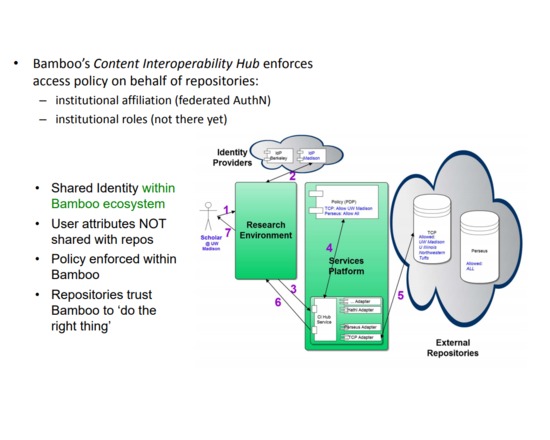
The Bamboo Content Interoperability Hub (CI gub) is an effort to largely automate the time-consuming process of downloading and compiling data from different repositories and archives and standardizing some of the format differences. When scholars browse the repositories whose content they want (and have rights to) use, they can bookmark it at the proper level of granularity in Zotero, and import those Zotero bookmarks into a workspace integrated with the CI hub. The CI hub then retrieves the data, and normalizes it to a certain extent so that data from different sources can be used together. The CI hub also offers a "preview" tool to see what data has been ingested, before that data is handed off to the environment where the scholar will use it. The CI hub currently has adaptors to draw data from TCP-EEBO/ECO, Hathi Trust, Perseus, and AustLit.
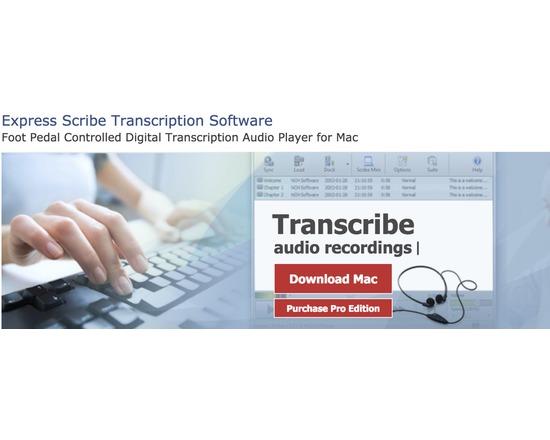
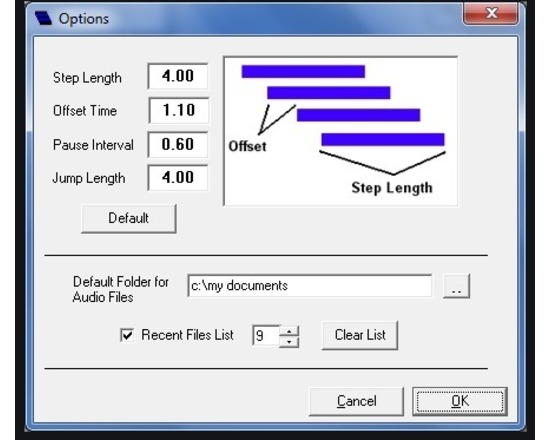
VoiceWalker is a transcriber's tool, designed to help you transcribe audio or video recordings. VoiceWalker lets you play back the sound in a controlled way, with the benefit of being able to systematically step (or "walk") through a recording, repeating short segments for a specified number of repetitions, then moving on to the next segment. The segments overlap, so that the transcriber does not become disoriented. VoiceWalker assumes that you have digitized your recordings as computer files to work with them more easily (for information on how to digitize, see the VoiceWalker manual). VoiceWalker is free, available for Windows only.