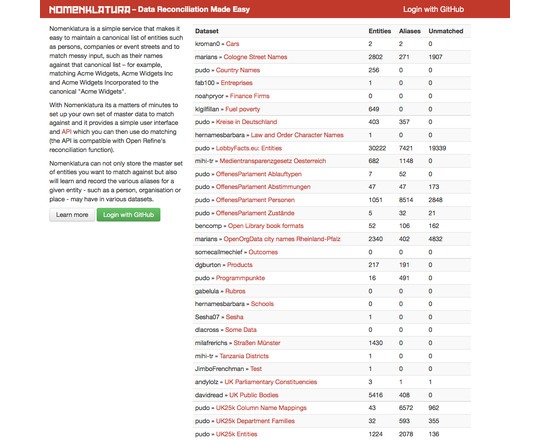
Nomenklatura is a reference data recon server. It is a service that allows users to define and manage manage lists of canonical entities (e.g. person or organization names) and aliases that connect to one of the canonical entities. This helps to clean up messy data in which a single entity may be referred to by many names.It includes a user interface, an API, and a reconciliation endpoint for OpenRefine for matching data from data sets with the canonical entries. By submitting data to Nomenklatura, users agree to license it under the terms of the Open Database License.
Slack is a team-based communication and archiving platform. It allows for both synchronous and asynchronous communications, channels for managing specific streams, full user management and integration with a wide variety of social media and storage providers. It is free for limited (rather generous) use and provides one the best means to allow for individual communication patterns within a managed project to be facilitated. Allowing for the quick and informal communications, hashtagged for quick scanning and searching as well as targeted messaging makes it a very compelling project tool. The addition of specific mobile clients with notifications makes it a very effective project management tool.
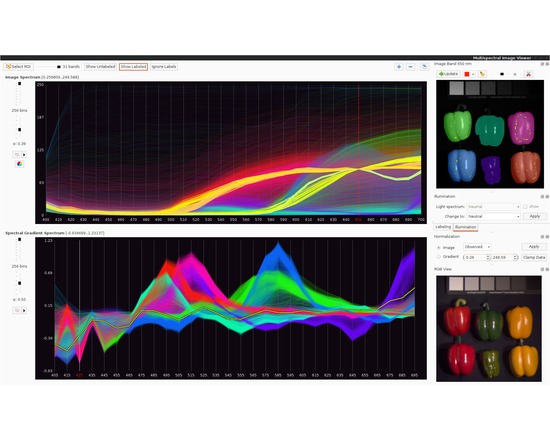
Gerbil is a generic framework for visualization and analysis of multispectral and hyperspectral data that strives to both bring new innovations in analysis capabilities and be of use in a wide range of hyperspectral data applications. In a nutshell, Gerbil lets you… explore a multispectral or hyperspectral image before processing it, apply common computer vision algorithms adapted to hyperspectral data, cluster and label image pixels for your application scenario, assess your own algorithms via high-dimensional data visualization, use an intuitive interface for teaching multispectral imaging and reflectance analysis. One example application for Gerbil is finding hidden information in multispectral scans of old manuscripts or art pieces.
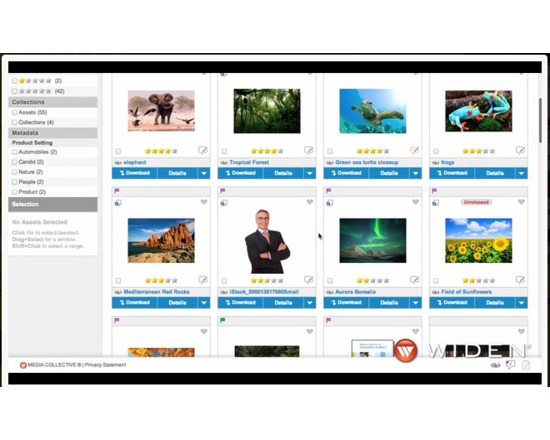
A marketing technology company offering cloud-based digital asset management that facilitates finding/organizing/sharing images, and media files (video, etc.) Although pricing is custom built based on required features and users, they do offer discounts for non-profit and education institutions. Features include: On-the-fly file conversions for images, audio & video, Image watermarking, Unlimited user roles with configurable permissions, Fully configurable metadata schema with read/write ability, Asset group level security for lifecycle management.
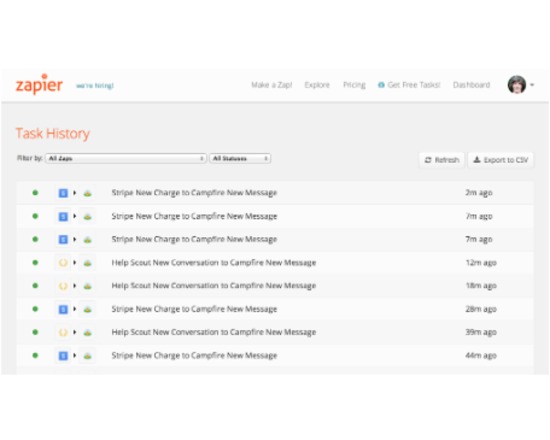
Zapier provides a means to create on-the-fly data connections between applications which may not have open API's. Zapier works with a wide range of popular applications - a list of current ones is available at: https://zapier.com/zapbook/apps/. The creation of Zaps (specific trigger -action definitions) is done using a simply graphical interface and can perform and wide variety of tasks. Examples include: receive a tweet and add it to a row in a google spreadsheet; add a card to trello from an email; post to Facebook from an RSS feed.
Share a project action board in real time, see milestones and upcoming goals. Easy-to-use features allows for edits in the project timeline, and the tracker predicts timeline for next goal achievement based on previously entered data. You can create individual project lines, or stories, that come together to create an epic, or larger project. There are charts showing your historical trends and anything else you'd like to monitor. This tool works with various other apps, listed here: http://www.pivotaltracker.com/community/app-bazaar
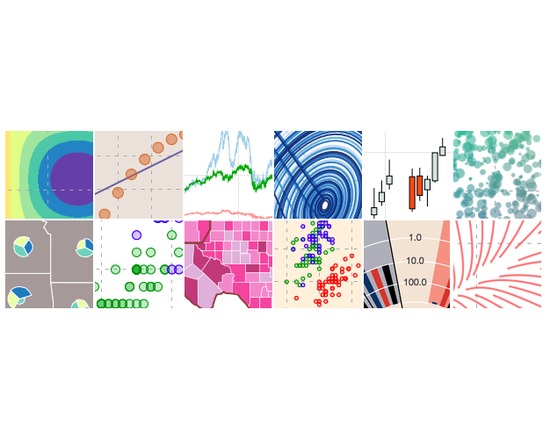
Bokeh is a Python interactive visualization library for large datasets that natively uses the latest web technologies. Its goal is to provide elegant, concise construction of novel graphics in the style of Protovis/D3, while delivering high-performance interactivity over large data to thin clients.
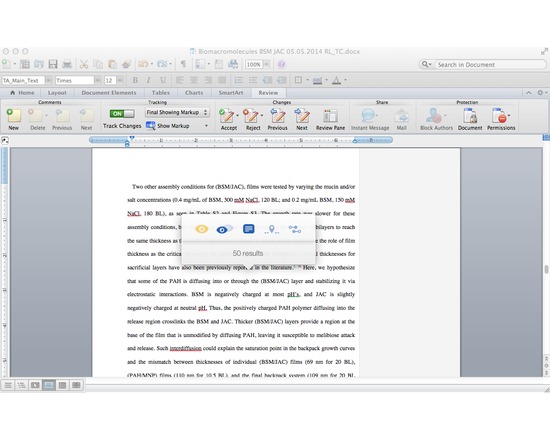
Writefull is a light-weight app that uses data from Google Books (5+ million books) and the Web to improve your writing, It compares small sections of your text to a large data set of writing found online and in Google Books. All you need to do is select a chunk of your text in your browser or text editing software, activate the Writefull popover, and choose one of its five options: 1) check the number of results (how often the chunk appears in Google Books or the Web); 2) compare the number of results (if your selected chunk appears more or less frequently than suggestions from online); 3) see examples in context (display several examples of how your selected chunk is used in different texts); 4) find words in context (see which words are used most often in your context, which you specify in your text by a star. For example, 'research should * this issue' will give you a list with 'research should address this issue', 'research should explore this issue', 'research should examine this issue', etc.); 5) find synonyms in context (see which synonyms of a word are used most often in your context, with you specifying the word you want synonyms for by two stars. For example: 'a *difficult* situation' will suggest 'an awkward situation', 'a serious situation', 'an embarrassing situation', etc). The app works with a small popover which mean you can activate it from whatever writing tool you're using. No need to change windows - no interruption of your workflow. N.B. Writefull 2.0 will be launching soon and will eliminate the need to purchase queries in the Web version. The $5 membership fee still applies.
With ediarum researchers can comfortably transcribe, encode and edit manuscripts in TEI-XML, as well as publish their results in an online or print edition. The solution, developed by TELOTA, is based on three software components: exist-db, Oxygen XML Author, and ConTeXt. These are combined, supplemented with additional functions, and tailored to fit a project's needs.
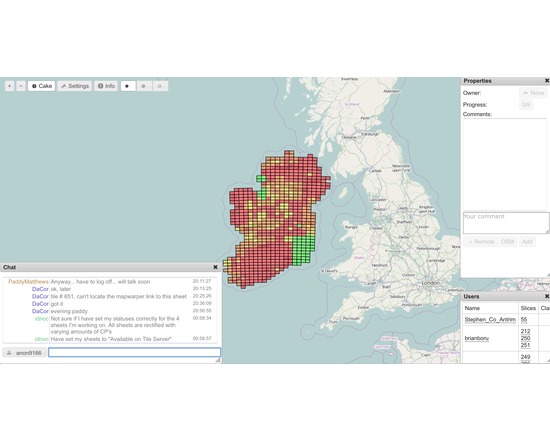
MapCraft is a tool for tracking mapping progress during a mapping party or other coordinated project taking place in a concentrated area. It shows a cake diagram as a bunch of clickable areas, with the ability to take ownership of cake slices, as well as commenting on them, and chatting to eachother about it. It takes the concept of a "cake diagram" and makes it more dynamic. The tool also allows rating the cake slices by progress, which is then shown prominently as different colourisation. This was designed for realtime collaboration on sketching aerial imagery. It was conceived by and for the Russian OpenStreetMap community. It provides a means to self-manage a community, crowdsourced mapping project.