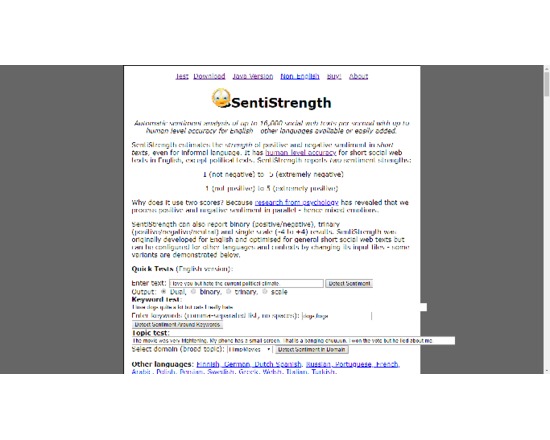
SentiStrength is a sentiment analysis (opinion mining) program. SentiStrength estimates the strength of positive and negative sentiment in short texts. It is ideal for short texts like tweets. There is an online version and a downloadable Java version which has more options. It is stated to be able to analyse 16,000 tweets per second. To enter multiply short test, each text has to be put on a new line. SentiStrength will give a rating of the positive and negative sentiment strength for each line in a generated text file.
Manifold Scholarship is an open-source publishing platform that enables authors and publishers a means to showcase and enhance the electronic content they already produce in their existing workflows: texts are displayed in a responsive, elegant reader crafted for all modern browsers and devices—desktop and mobile. Powerful built-in annotation and commenting systems allow readers to annotate, highlight, discuss, cite, and share passages from any Manifold text. Resources that are foundational to a particular discussion but that are often tabled because of physical, technical, logistic, or legal limitations can be layered dynamically and directly onto the digital text. And with Manifold, a new kind of publication is possible, one where authors create projects that grow iteratively and that are published online as they are created and then later in print, when they have been codified as versions of record. In short, Manifold transforms scholarly publications into living digital works.
WebLicht is an execution environment for automatic annotation of text corpora. Linguistic tools such as tokenizers, part of speech taggers, and parsers are encapsulated as web services, which can be combined by the user into custom processing chains. The resulting annotations can then be visualized in an appropriate way, such as in a table or tree format. It is often the case that a tool relies on one or more annotation layers to exist in the input data before it can begin processing. WebLicht can assist the user in building a processing chain by determining which tools are able to operate on the data at any given point and offering only those tools as options to add to the chain. There are 2 modes for building tool chains: Easy Mode lets you choose pre-defined processing chains Advanced Mode allows you to build customized tool chains. Login is required to use the tools and corpora. Login with email addresses from most recognized European universities will be automatically accepted. Individuals with a Non-European email address need to create an account with clarin.eu Developed by the German language resource infrastructure (D-SPIN) and Common language resources and technology infrastructure (CLARIN)
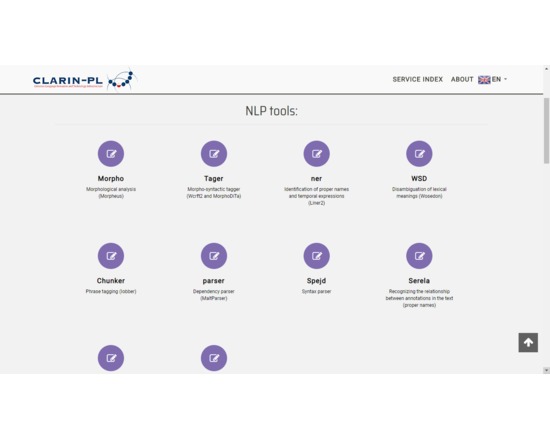
It is a set of tools created by the Polish branch of Common the Language Resource and Technology Infrastructure (CLARIN) mainly for the analysis of Polish text. It has many Natural Language Processing (NLP) tools among which are verb annotations, named entity recognition, phrase parser, and spacial expression recognition. Some of the tools can be used for German and English.
The PDB-trained dependency parsing models for Polish is a parsing tool trained on the Polish Dependency Bank (which consists of 22,208 trees and 351,406 tokens). It does part-of-speech tagging, lemmatisation, dependency parsing, and semantic role labeling.
UDPipe is a trainable pipeline for tokenization, tagging, lemmatization and dependency parsing of CoNLL-U files. UDPipe is language-agnostic and can be trained given annotated data in CoNLL-U format. Trained models are provided for nearly all UD treebanks. UDPipe is available as a binary for Linux/Windows/OS X, as a library for C++, Python, Perl, Java, C#, and as a web service. Third-party R CRAN package also exists.
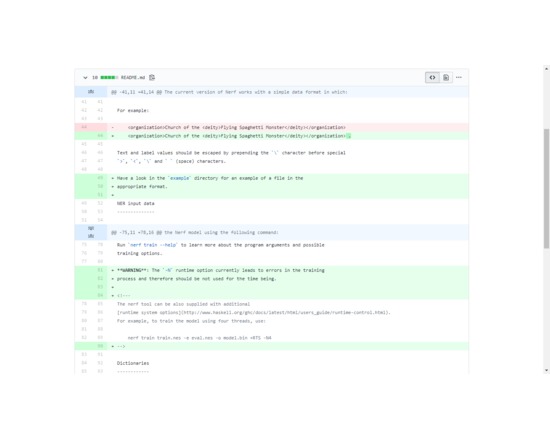
Nerf is a statistical named entity recognition (NER) tool based on linear-chain conditional random fields (CRFs). It has been adapted to recognize tree-like structures of NEs (i.e., with recursively embedded NEs) by using the joined label tagging method which -- for a particular sentence -- works as follows: CRF model is used to determine the most probable sequence of labels, Extended IOB method is used to decode the sequence into a forerst of NEs. The extended IOB method also provides the inverse encoding function which is needed during the model training.
Concraft-pl, a morphosyntactic tagger for the Polish language based on conditional random fields. The tool is coupled with Morfeusz, a morphosyntactic analyzer for Polish, which represents both morphosyntactic and segmentation ambiguities in the form of a directed acyclic graph (DAG). As for now, the tagger doesn't provide any lemmatisation capabilities. As a result, it may output multiple interpretations (all related to the same morphosyntactic tag, but with different lemmas) for some known words, while for the out-of-vocabulary words it just outputs orthographic forms as lemmas.
Software for corpus linguists and text/data mining enthusiasts. The CorpusExplorer combines over 50 interactive visualizations under a user-friendly interface. Routine tasks such as text acquisition, cleaning or tagging are completely automated. The simple interface supports the use in university teaching and leads users/students to fast and substantial results. The CorpusExplorer is open for many standards (XML, CSV, JSON, R, etc.) and also offers its own software development kit (SDK)