Skip to content
TAPoR Text Analysis Portal for Research

Tools

Sort by Name Rating ↓ Date

Collaboration

Kubity

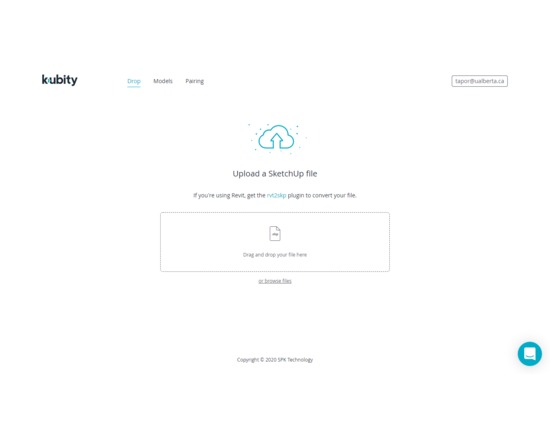
Kubity is a cloud-based 3D communication tool that works on desktop computers, the web, smartphones, tablets, augmented reality gear, and virtual reality glasses. Kubity is powered by several proprietary 3D processing engines including "Paragone" and "Etna" that prepare the 3D file for transfer over mobile devices. 3D images can be uploaded and enhanced and used in an artificial reality environment. It also has augmented reality features. It can be used in architecture, interior design, engineering, product design, film and video games among others. The majority of its users create 3D models using SketchUp or Autodesk Revit software.
Rated 0.0 out of 5.

Creation

A-frame

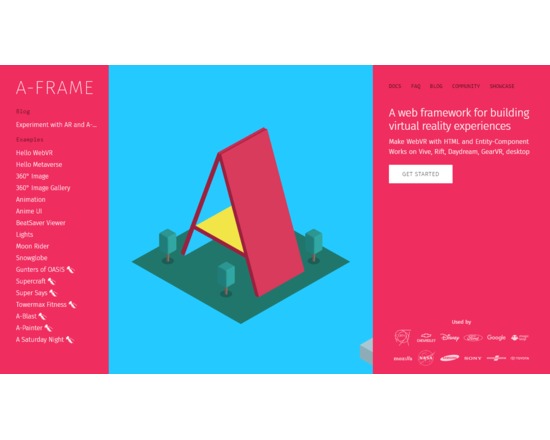
a-Frame is a web framework for building virtual reality (VR) experiences. A-Frame is based on top of HTML, making it simple to get started. But A-Frame is not just a 3D scene graph or a markup language; the core is a powerful entity-component framework that provides a declarative, extensible, and composable structure to three.js.

Rated 0.0 out of 5.

Collaboration

Thinglink

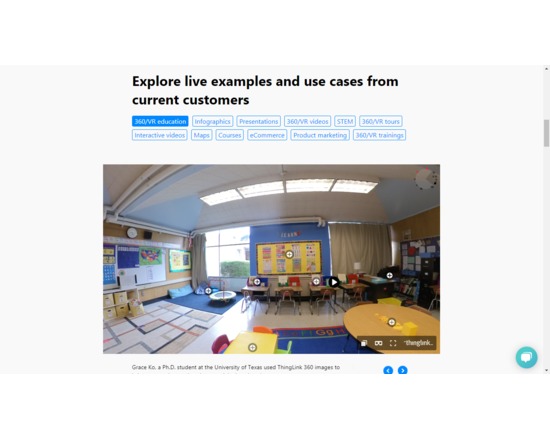
ThingLink is a free and user -friendly digital tool that provides users the ability to turn any image into an interactive graphic. It allows you to make your images, videos, and 360 content interactive with text, links, images, videos and over 70 call to actions, creating memorable experiences for audiences. The web tool and the app allow for teachers and students to provide information in a visual format. It can be considered as a form of annotation of visual multimedia content.

Rated 0.0 out of 5.

Visualization

bl.ock

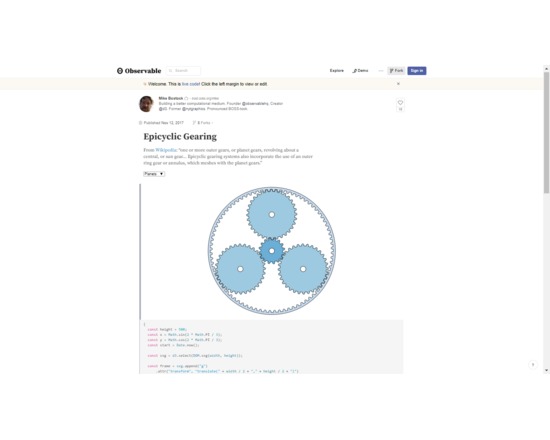
Bl.ock is a simple viewer for sharing code examples hosted on GitHub Gist. For example, if your Gist URL is: https://gist.github.com/mbostock/1353700 Replace “gist.github.com” with “bl.ocks.org” in the URL to view it: https://bl.ocks.org/mbostock/1353700 It has configurations to determine how your block will be displayed. Bl.ock runs your visualization code (usually is d3) and displays it, unlike github that only displays the code.

Rated 0.0 out of 5.

Natural Language Processing

TextBlob

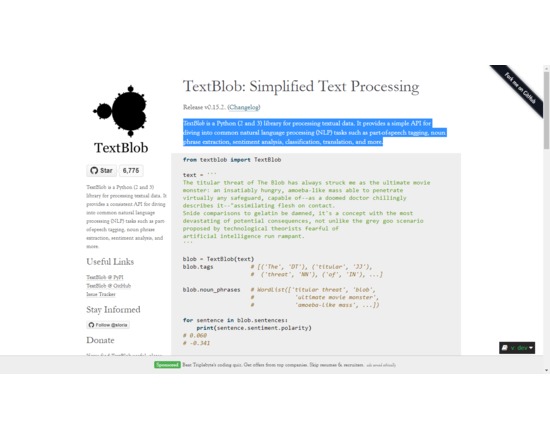
TextBlob is a Python (2 and 3) library for processing textual data. It provides a simple API for diving into common natural language processing (NLP) tasks such as part-of-speech tagging, noun phrase extraction, sentiment analysis, classification, translation, and more.

Rated 0.0 out of 5.

Visualization

Data-illustrator

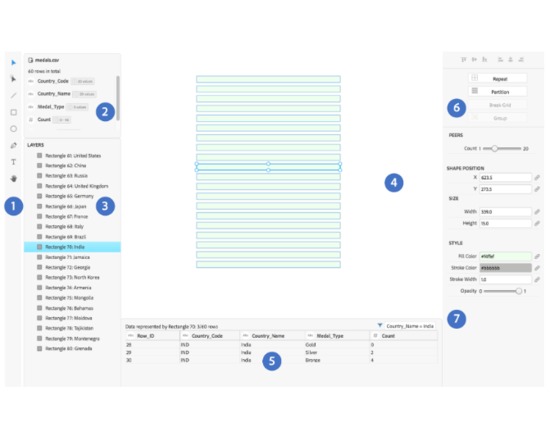
Data Illustrator aims to make visualization creation as easy as creating an illustration in a design tool like Adobe Experience Design or Bohemian Sketch. Visualizations are created without programming. It was created from a research collaboration between Adobe Systems Inc. and Georgia Institute of Technology.

Rated 0.0 out of 5.

Visualization

spaCy

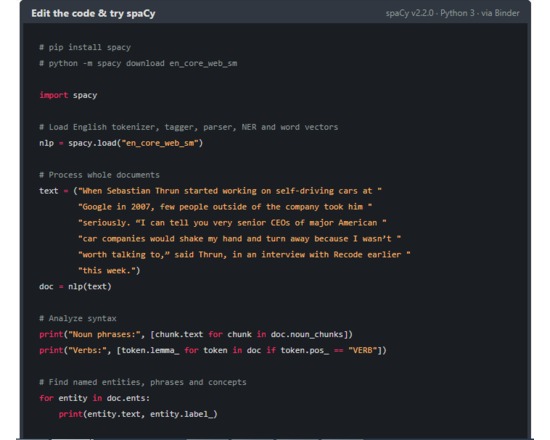
spaCy is an open-source software library for advanced natural language processing, written in the programming languages Python and Cython. The library is published under the MIT license and currently offers statistical neural network models for English, German, Spanish, Portuguese, French, Italian, Dutch and multi-language NER, as well as tokenization for various other languages. Unlike NLTK, which is widely used for teaching and research, spaCy focuses on providing software for production usage. As of version 1.0, spaCy also supports deep learning workflows that allow connecting statistical models trained by popular machine learning libraries like TensorFlow, Keras, Scikit-learn or PyTorch. spaCy's machine learning library, Thinc, is also available as a separate open-source Python library. It features convolutional neural network models for part-of-speech tagging, dependency parsing and named entity recognition, as well as API improvements around training and updating models, and constructing custom processing pipelines.

Rated 0.0 out of 5.

Annotating

Intelligent Archive

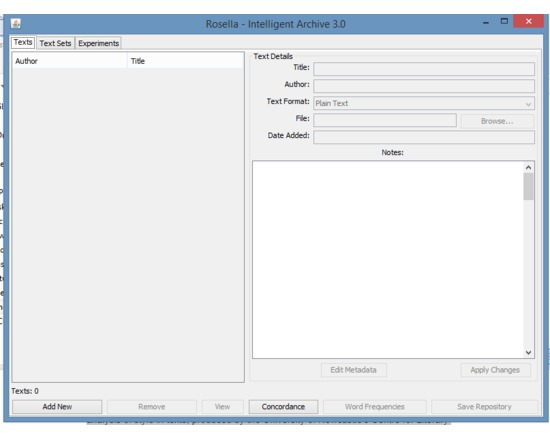
Intelligent Archive is a Java application for stylometry, or computational and statistical analysis of style in texts, produced by the University of Newcastle's Centre for Literary and Linguistic Computing (CLLC). It can handle corpora of plain text, HTML, XML and TEI texts. IA enables you to easily organise texts into sets, manage metadata, generate word frequencies, handle XML tags, and split texts in various ways to generate results that can be exported for further analysis in statistical software. It includes some experimental stylometry techniques developed at the CLLC and special features for handling literary texts such as generating word frequencies for speaking characters in plays.

Rated 0.0 out of 5.

Creation

congree

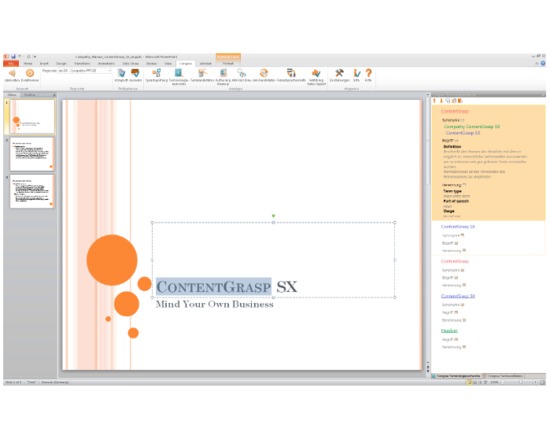
Congree provides linguistic tools which act as assistants to authors in business. It provides assistance for authors of technical and marketing documentation to ensure correct use of corporate language. It is installed as an add on to popular word editing programs like Microsoft Excel, Word, PowerPoint, oxygen XML editor, among others.

Rated 0.0 out of 5.

Natural Language Processing

gensim

Gensim is an open-source library for unsupervised topic modeling and natural language processing, using modern statistical machine learning. Gensim is implemented in Python and Cython. Gensim is designed to handle large text collections using data streaming and incremental online algorithms, which differentiates it from most other machine learning software packages that target only in-memory processing. Gensim includes streamed parallelized implementations of fastText, word2vec and doc2vec algorithms, as well as latent semantic analysis (LSA, LSI, SVD), non-negative matrix factorization (NMF), latent Dirichlet allocation (LDA), tf-idf and random projections.

Rated 0.0 out of 5.