Pundit is a cloud service that allows users to 'take notes' on web documents, like a web page or a PDF file. It consists of a set of components, amongst them the Annotator, a free extension for the Google Chrome browser used by users to create the annotations. Annotations can be highlights of text parts or comments, applied either on a selection of the text or on the whole document. It is also possible to create annotations to tag a selected text or an entire web page. Pundit supports semantic annotations, real RDF triples (subject - predicate -> object) to specify formal, structured and reusable statements associated to the annotated content.
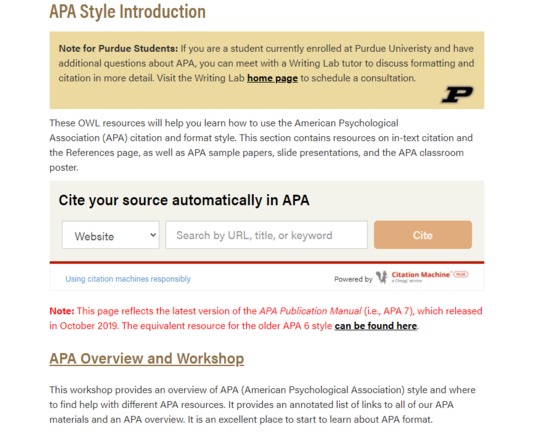
The Online Writing Lab (OWL) at Purdue University houses writing resources and instructional material. As a member of the Writing Lab community, you can find information to assist with various writing projects. Teachers and trainers can also use this material for in-class and out-of-class instruction. No commercial use of the Purdue OWL is permitted.
PyBossa is a free, open-source, platform for creating and running crowd-sourcing applications that utilise online assistance in performing tasks that require human cognition, knowledge or intelligence such as image classification, transcription, geocoding and more.
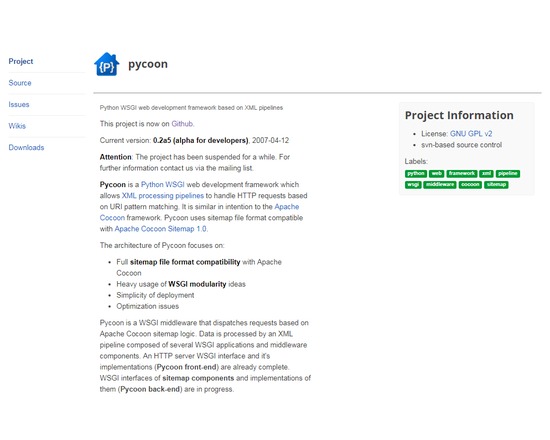
A Python-based XML web publishing framework which enables dynamic pipelining of XSLT transformations. Data is processed by an XML pipeline composed of several WSGI applications and middleware components. Features: Apache Cocoon Sitemap 1.0 compatible WSGI modularity URI pattern matching
A general-purpose high-level programming language that places an emphasis upon code readability. Python supports a number of development models, including object oriented, imperative, and functional design. It provides automatic memory management and a fully dynamic type system. Features: Very clear, readable syntax Strong introspection capabilities Intuitive object orientation Natural expression of procedural code Full modularity, supporting hierarchical packages Exception-based error handling Very high level dynamic data types Extensive standard libraries and third party modules for virtually every task Extensions and modules easily written in C, C++ (or Java for Jython, or .NET languages for IronPython) Embeddable within applications as a scripting interface
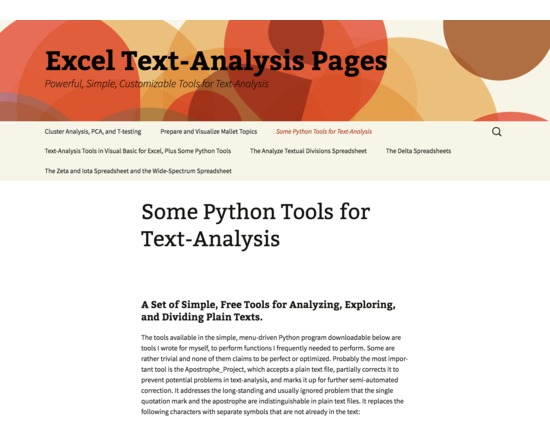
This is a set of simple, free tools for analyzing, exploring, and dividing plain texts. The tools are available in the simple, menu-driven, downloadable Python program. Some are rather trivial and none of them claims to be perfect or optimized. Probably the most important tool is the Apostrophe_Project, which accepts a plain text file, partially corrects it to prevent potential problems in text-analysis, and marks it up for further semi-automated correction. It addresses the long-standing and usually ignored problem that the single quotation mark and the apostrophe are indistinguishable in plain text files. It replaces the following characters with separate symbols that are not already in the text: •Internal apostrophes: presumably real apostrophes •Non-internal apostrophes preceding capital letters: usually scare quotes or dialogue marked with single quotation marks •Non-internal apostrophes following a word-final “s”: usually plural possessives •Non-internal apostrophes in very commonly used contracted forms: ’em, an’, ’twas, and so forth •Non-internal apostrophes between other breaking characters: essentially never anything but single quotation marks
Rated 0.0 out of 5.★★★★★0.0
QDA Miner - Qualitative Data Analysis Software for Qualitative Research
QDA Miner is an easy-to-use mixed-methods qualitative data analysis software package for coding, annotating, retrieving and analyzing small and large collections of documents and images. QDA Miner may be used to analyze interview or focus-group transcripts, legal documents, journal articles, even entire books, as well as drawing, photographs, paintings, and other types of visual documents. Its seamless integration with SimStat, a statistical data analysis tool, and WordStat, a content analysis and text-mining module, gives you unprecedented flexibility for analyzing text and relating its content to structured information, including numerical and categorical data. For more information, visit http://provalisresearch.com/products/qualitative-data-analysis-software/
QGIS is a user-friendly Open Source Geographic Information System (GIS) licensed under the GNU General Public License. QGIS is an official project of the Open Source Geospatial Foundation (OSGeo). It runs on Linux, Unix, Mac OSX, Windows and Android and supports numerous vector, raster, and database formats and functionalities.
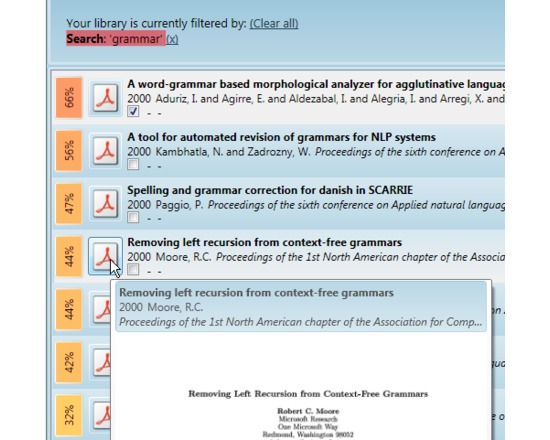
Qiqqa is a research management software that allows you to organize large numbers of papers; find new papers to read and new information about papers you already have; review materials and create annotation reports. Qiqqa has several PDF tools that also allow you to convert from PDFs to text, and use a clipboard function to cut and paste text into your document.
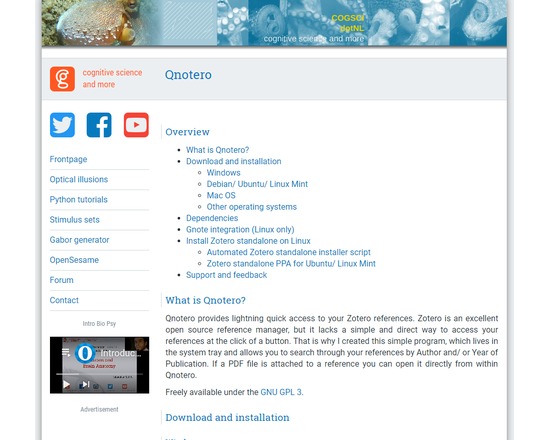
Qnotero provides lightning quick access to users' Zotero references. It lives in the system tray and allows users to search through their references by author and/ or year of publication. If a PDF file is attached to a reference, users can open it directly from within Qnotero.