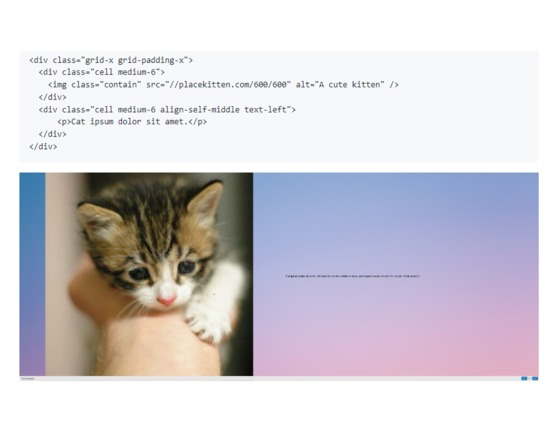
Vast is an open source tool that that is used to assist in the creation of web content to fit on very large displays. It helps the developer design web page while taking into consideration display aspect ratio, display size, content fit and viewing distance. The aim of this tool is to make design for large displays accessible for everyone. Examples and demos can be found in the tools GitHub webpage.
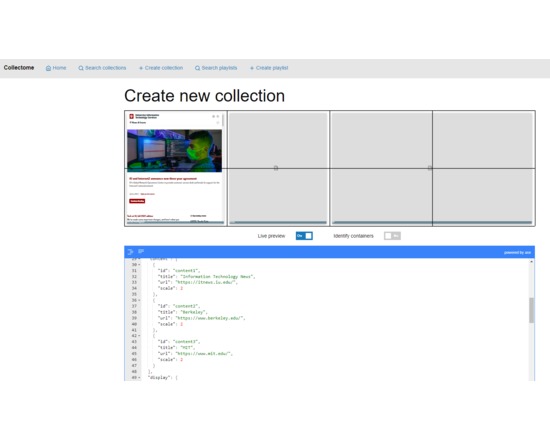
Collectme is a content sharing platform that can be use to build content for large displays like data walls. It was developed under the immersive scholars project. It is a free to use service available online. You can curate and create a media collection that fits your display and share it with others. You can also use templates created by other users. Through your browser you can make an immersive exhibit of your collection by presenting it on a data wall.
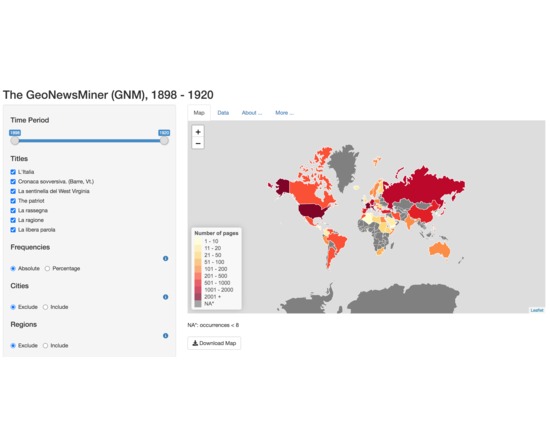
This is a project that had as goal to show on a map the references to geographical location from the text of publications from Italian language newspapers published in the United States between 1898 and 1920. They have made the code and dataset publicly available on GitHub and hence can be used by scholars with a similar project. A review of this project is available here https://utrecht-university.shinyapps.io/GeoNewsMiner/
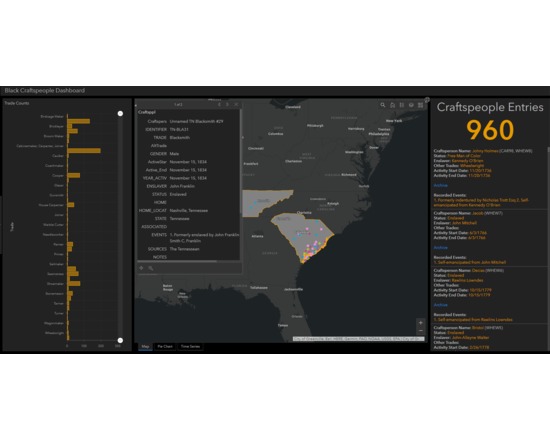
This is a digital archive that keeps a record of black people both free and enslaved involved in producing the valued architecture, handcrafts, and decorative arts of the American South. The archive starts in 1619. There are currently hundreds of records of blacks involved in 45 trades. The website has an interactive and searchable map.
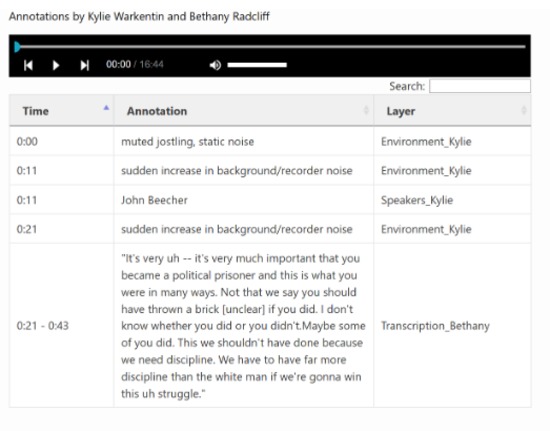
AUdiAnnotate is a web applications that is used to create IIIF file of audios and videos but adding annotations and/metadata. This makes the audiovisual material more accessible to users since the file can be queried using the metadata. Users will need a GitHub account to access the AudiAnnotate application and to host the files generated. The resulting IIIF object will be made available through an HTML link. The HTML files produced are hosted on GitHib and can be edited to change the way it if displayed. The AudiAnnotate is still active and the applications is constantly being updated. A review of AudiAnnotate can be found at https://reviewsindh.pubpub.org/pub/audiannotate/release/3
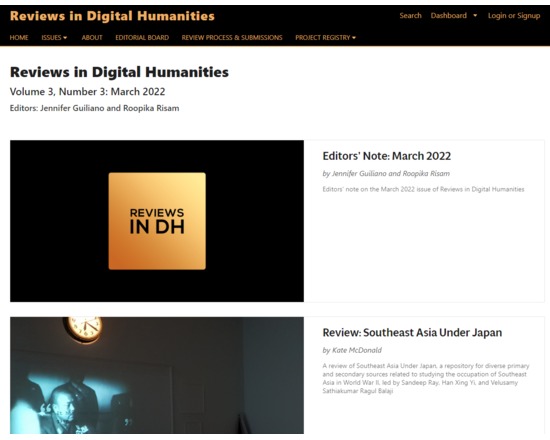
Reviews in Digital Humanities is a pilot of a peer-reviewed journal that facilitates scholarly evaluation of digital humanities work and its outputs. This may include, but is not limited to: digital archives, multimedia or multimodal scholarship, digital exhibits, visualizations, digital games, digital tools, and digital projects. The journal is hosted by PubPub. The journal responds to the challenge of the growth of the number and scale of digital projects outpacing review opportunities in existing journals. As such, it intervenes by bridging a gap in the evaluation of digital projects by arranging for peer review of digital scholarship. Project creators can submit their projects for review. RDH publishes monthly issues with an average of 5 reviews per issue. It also contains a registry of projects, some of which have not yet been reviewed. As of June 2022, Reviews in Digital Humanities has more than 76,800 page views, with 17,350+ unique users from 124 countries. Among fields of study for the projects we have reviewed, 30% of projects are in African diaspora studies, 21% are in Latinx studies, 9% are in Global Indigenous studies, and 19% are in Queer studies. The remaining 21% come from a variety of fields.
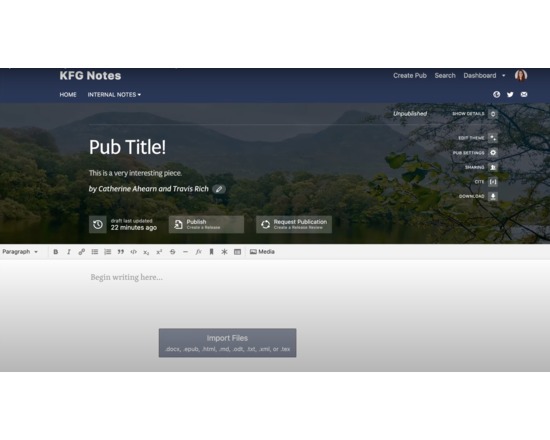
PubPub is a free open source publishing website. Its aim is to facilitate the creation and publishing of knowledge. It is an open-source, hosted, free-to-use content management system designed to help knowledge communities of all types collaboratively create and share knowledge online. PubPub’s flexible, extensible system allows communities to create the dynamic content that best represents their work, whether it’s a traditional academic journal, a book, a repository of interactive documents, a blog, all of the above, or something in between. If needed, PubPub then helps communities integrate their work into academic infrastructure like Crossref and Google Scholar without the need to remake it to conform to legacy expectations of how academic outputs are structured.
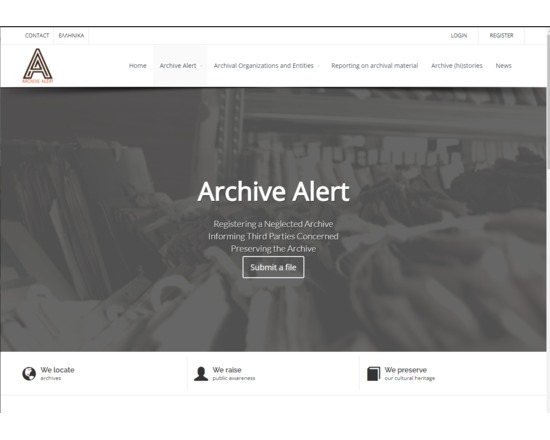
Archive Alert is an online platform that allows individuals, entities, groups, and organizations to report on archives and/or other cultural material which promotes cultural heritage (audiovisual material, maps, photographs, printed material, newspapers, posters, etc.). The users may report material they are in possession of, or material threatened by ignorance, negligence, or due to lack of expert human resources. Registered users can report on their own historical documents either to inform archival organizations, or to invite specialized staff to archive, file, preserve and utilize the material. The platform allows for anonymous or eponymous/public registration, and then, depending on the material reported, it automatically informs all organizations/entities that may be concerned. The platform is free for users-informants and archival organizations; any kind of buying and selling of archival and cultural material is strictly forbidden. The homepage and introduction pages are in English while the archive report section is only available in Greek. There are currently only two reports of archives in the website.
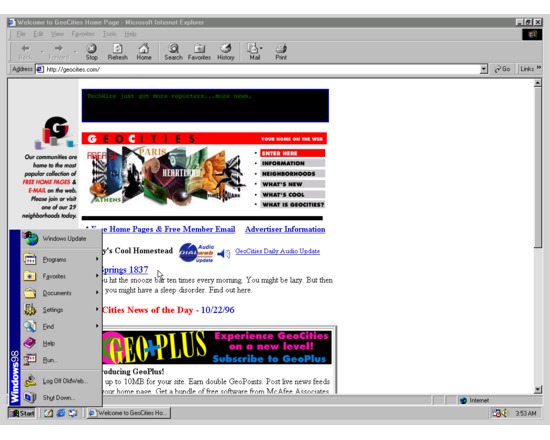
oldweb.today (OWT) is a system that connects emulated web browsers to web archives, allowing users to browse the old web, today, as it was! On the home page, you can choose what browser you want to run. It has browsers as early as the Mosaic browser.