Skip to content
TAPoR Text Analysis Portal for Research

Tools

Sort by Name Rating ↓ Date

Natural Language Processing

TUSTEP

TUSTEP (Tubingen System of Text Processing Tools) is a free, open source, widely-used toolbox for text processing. It is aimed at scholarly audiences, can work with texts in both latin and non-latin scripts, and is primarily designed for humanites applications. Its modules include data capture, information retrieval, text collation, text analysis, sorting and ordering, rule-based textual manipulation, data export and typesetting. The user manual is only available in German at this time. This tool has been in continuous development since the 1960s.

Rated 5.0 out of 5.

Visualization

Heurist Data Manager / Visualiser / Publisher

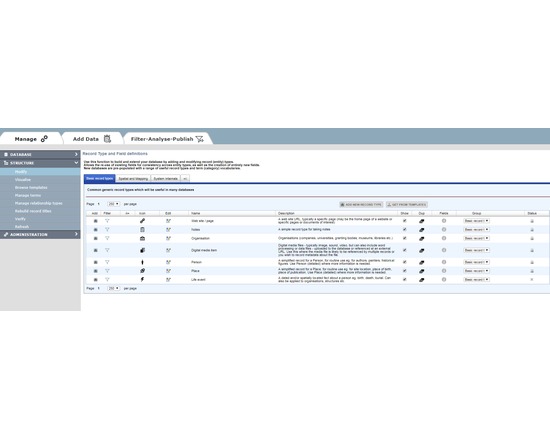
HEURIST (http://HeuristNetwork.org) is an extremely flexible, end-user oriented, web-based data management system designed specifically for Humanities data. Developed since 2005, it has been in active use across many projects since 2009. It is available both as a free web service for researchers (hosted at the University of Sydney Data Centre) or for installation on a physical or virtual server (Open Source on gitHub). Researchers can design, create, manage, analyse, visualise and publish their own richly-structured database(s) through a simple web interface, without the need for programmer(s). Quite complex databases can be built in a few hours by borrowing structures and vocabularies published by other users. Databases can be designed and built incrementally, as existing data are not affected by changes in structure. Databases created by Heurist are stored in MySQL with a repeatable structure facilitating sustainability and independent access by other software. Advanced features include record linking, graph structure, drill-down facet searches, rule-based queries, custom reports, linked map-timelines, network visualisation, normalised spreadsheet import, crosstabulation, XML feeds, XSLT transforms. The team provides initial email and skype assistance for project setup at no cost, and special customisations at modest cost. Heurist is applicable in many domains including History, Archaeology, Anthropology, Cultural Research, Linguistics, Media Studies etc. It handles everything from text, tags and categories, through networks of rich relationships and offset annotations, to images, video, spatial data and dating (including non-western systems and dating uncertainty). Sophisticated searches (including faceted and rule-based) can be saved, organised and rendered as layered interactive maps, timelines, network visualisations, crosstabulations, lists, custom reports, XML and XSLT transforms, all of which can easily be printed or embedded (live) in a website - Heurist provides the html code required to embed results in a web page or CMS. Databases can easily be migrated later to a personal or institutional server. Since the data are stored in a standard MySQL database with a fixed and well-documented structure, the data can be accessed directly via SQL from most programming languages independently of Heurist. Version 4.2 (Jan 2016 onwards) is available as a service via the Heurist website. Version 4 delivers a user-customisable interface of widgets, along with better mapping and visualisation. Existing version 3 databases are bidirectionally compatible with version 4.

Rated 5.0 out of 5.

Enrichment

Zotero

Zotero is a free tool that collects, manages and cites research sources. It stays on your web browser where you do your work and it's easy to use. It's being downloaded as a firefox extension, used with the chrome and safari browsers or used as a standalone tool. It allows you to attach pdfs, notes and images to your citations, organise them into easily searchable collections for different projects, and open office using any of over 2800 citation styles. references can be added to a zotero library in many different ways: directly from databases, journal websites, google scholar or the library catalogue, by referencing file import ( for example from an Endnote library), by dragging in pdfs from your hard drive, and by entering them manually.

Rated 5.0 out of 5.

Search

Voyant Tools 2.0 (Corpus View)

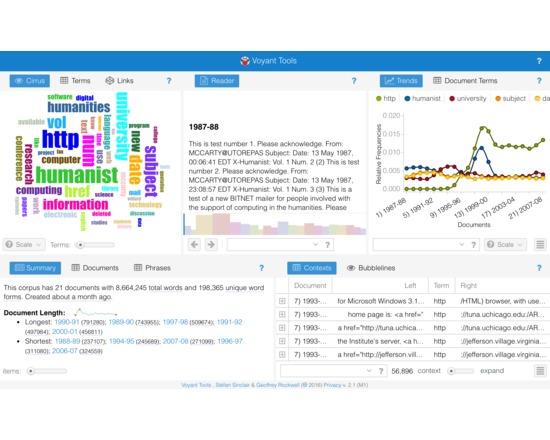
Voyant 2.0 is a complete rewrite of Voyant. It provides a suite of text analysis tools that will work with most texts you can upload or find on the web. These tools are combined in skins. For documentation see Documentation for Voyant 2.0

Rated 5.0 out of 5.

Search

TextGrid

TextGrid is a virtual research environment for text-based humanities scholarship. It offers a variety of tools and services for collaboratively creating, analyzing, editing and publishing texts. The TextGrid environment is split into two components, the Laboratory housing the tools and services, and the Repository for preserving reserach data and making it available to other scholars.

Rated 4.0 out of 5.

Visualization

R

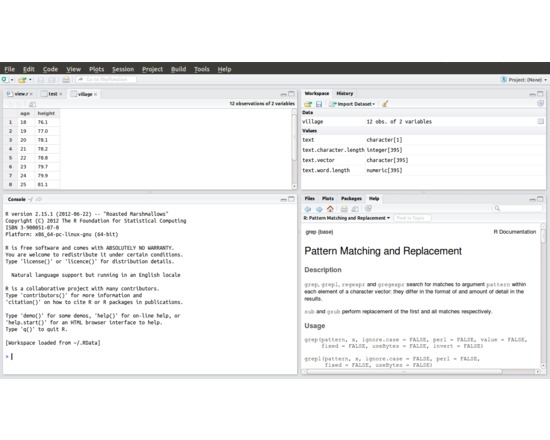
R is an open source programing language designed for statistical analysis and parallel computing. R began its life as a research project at the University of Aukland, but has since expanded to become a collaborativly run open source project run by the GNU. R has libraries for data import, regular expression data splitting, and visualization of data. R can be run as either a script or as a working environment.

Rated 4.0 out of 5.

Collaboration

Sophie

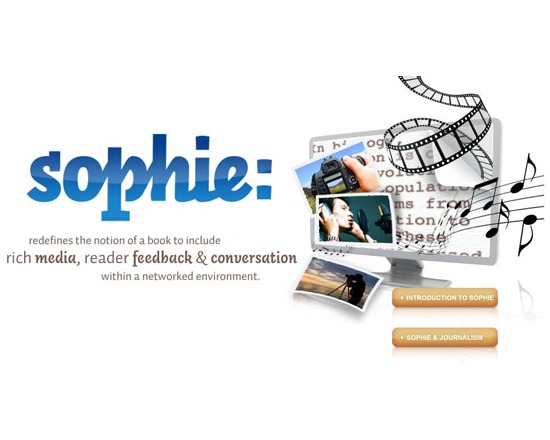
Sophie is a free, creative commons authoring tool from the Institute for the Future of the Book and the University of Southern California's School of Cinematic Arts that enables collaboration, reading and publication. Its highlights include an authoring environment that allows users to create complex networked multimedia documents, a reader than opens books in a browser without downloading additional software, comment frames for adding discussions within books, digital libraries compatible with the Sophe iPad app, timeline creation and collaborative book creation. As of version 2.1, Sophie includes HTML5 export for data integrating multimedia content and for use on a wide variety of devices.

Rated 3.0 out of 5.

Analysis

SimpleTCT

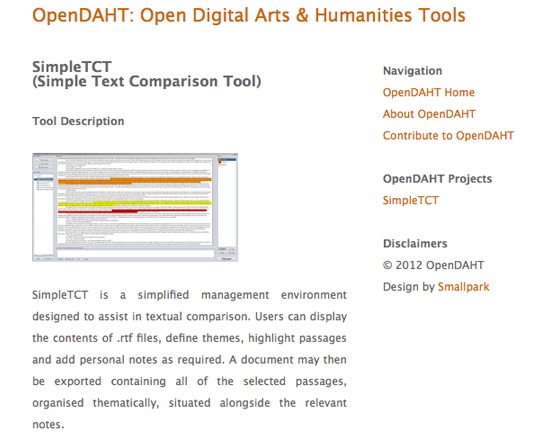
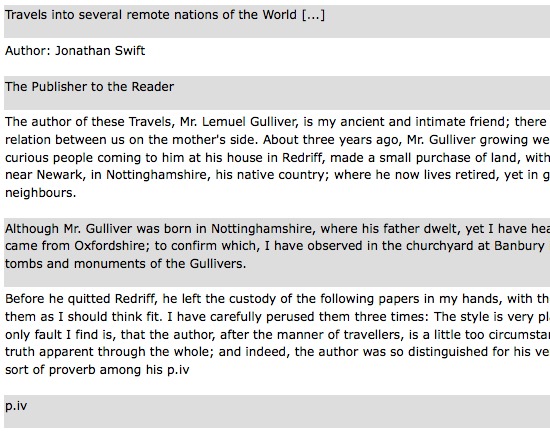
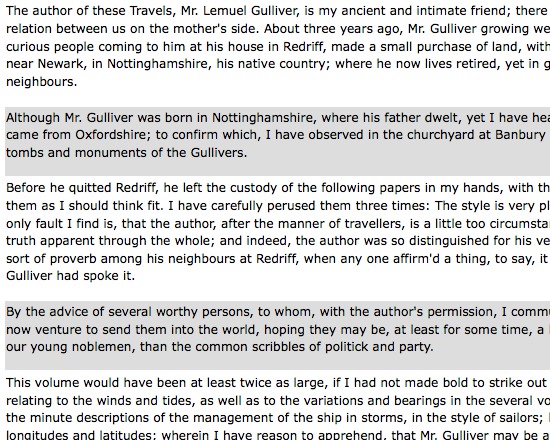
SimpleTCT (Simple Text Comparison Tool) is a free Java-based text comparison tool offered by Open Digital Arts & Humanities Tools (OpenDAHT). It offers a simplified management environment that enables users to display .rtf files, in which they may define themes, highlight passages and add researcher notes. The modified document can then be exported for later use.

Rated 3.0 out of 5.

Enrichment

Extract Text - HTML (TAPoRware)

This tool extracts text found within specific tags in an HTML document. It is part of the TAPoRware toolset; an XML version is also available. This tool’s functionality has been incorporated into Voyant available online at www.voyant-tools.org.

Rated 1.0 out of 5.

Enrichment

Extract Text - XML (TAPoRware)

This tool extracts text found within specific tags in an XML document. It is part of the TAPoRware toolset; an HTML version is also available. This tool’s functionality has been incorporated into Voyant available online at www.voyant-tools.org.

Rated 0.0 out of 5.