Skip to content
TAPoR Text Analysis Portal for Research

Tools

Sort by Name Rating ↓ Date

Search

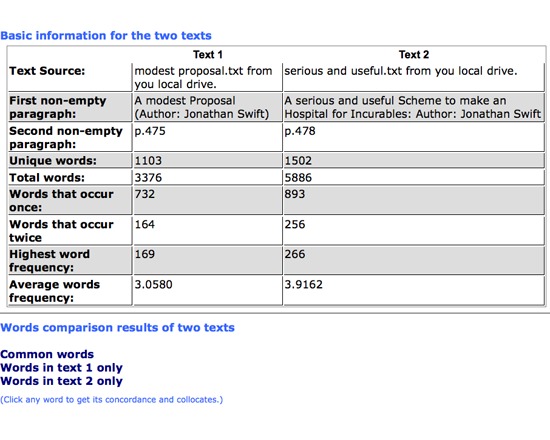
Comparator - Plain Text (TAPoRware)

This tool compares two documents by comparing the words in each according to user specifications. HTML and XML versions are also available in the TAPoRware toolsets. This tool’s functionality has been incorporated into Voyant available online at www.voyant-tools.org

Rated 5.0 out of 5.

Search

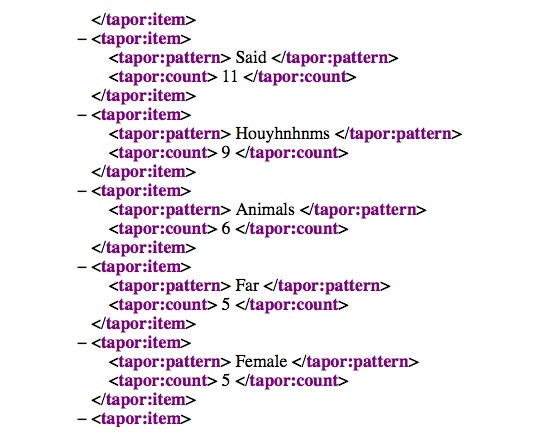
Collocation - XML (TAPoRware)

This tool provides all words directly before and after a user-specified word, based on the desired context of words, lines or sentences. The results can be sorted alphabetically, by frequency, or by Z-score (an indication of how far and in what direction that item deviates from its distribution's mean, expressed in units of its distribution's standard deviation). HTML and plain text versions are also available within the TAPoRware toolsets. This tool’s functionality has been incorporated into Voyant available online at www.voyant-tools.org.

Rated 5.0 out of 5.

Visualization

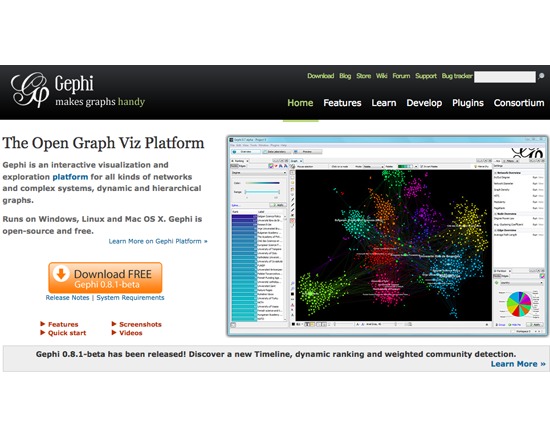
Gephi

Gephi is a free, open source interactive visualization and data exploration tool. Users can manipulate the display to uncover new facets of the data, enabling intutive exploration.

Rated 5.0 out of 5.

Visualization

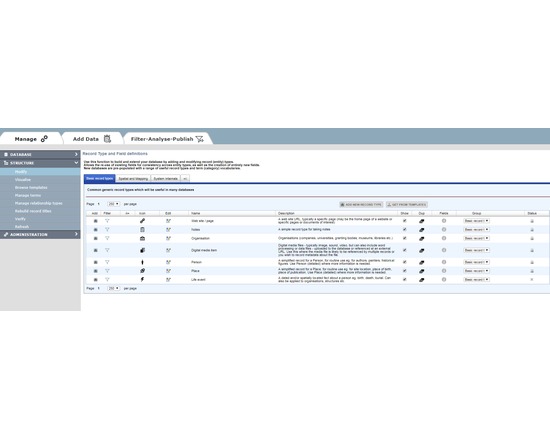
Heurist Data Manager / Visualiser / Publisher

HEURIST (http://HeuristNetwork.org) is an extremely flexible, end-user oriented, web-based data management system designed specifically for Humanities data. Developed since 2005, it has been in active use across many projects since 2009. It is available both as a free web service for researchers (hosted at the University of Sydney Data Centre) or for installation on a physical or virtual server (Open Source on gitHub). Researchers can design, create, manage, analyse, visualise and publish their own richly-structured database(s) through a simple web interface, without the need for programmer(s). Quite complex databases can be built in a few hours by borrowing structures and vocabularies published by other users. Databases can be designed and built incrementally, as existing data are not affected by changes in structure. Databases created by Heurist are stored in MySQL with a repeatable structure facilitating sustainability and independent access by other software. Advanced features include record linking, graph structure, drill-down facet searches, rule-based queries, custom reports, linked map-timelines, network visualisation, normalised spreadsheet import, crosstabulation, XML feeds, XSLT transforms. The team provides initial email and skype assistance for project setup at no cost, and special customisations at modest cost. Heurist is applicable in many domains including History, Archaeology, Anthropology, Cultural Research, Linguistics, Media Studies etc. It handles everything from text, tags and categories, through networks of rich relationships and offset annotations, to images, video, spatial data and dating (including non-western systems and dating uncertainty). Sophisticated searches (including faceted and rule-based) can be saved, organised and rendered as layered interactive maps, timelines, network visualisations, crosstabulations, lists, custom reports, XML and XSLT transforms, all of which can easily be printed or embedded (live) in a website - Heurist provides the html code required to embed results in a web page or CMS. Databases can easily be migrated later to a personal or institutional server. Since the data are stored in a standard MySQL database with a fixed and well-documented structure, the data can be accessed directly via SQL from most programming languages independently of Heurist. Version 4.2 (Jan 2016 onwards) is available as a service via the Heurist website. Version 4 delivers a user-customisable interface of widgets, along with better mapping and visualisation. Existing version 3 databases are bidirectionally compatible with version 4.

Rated 5.0 out of 5.

Search

Voyant Tools 2.0 (Corpus View)

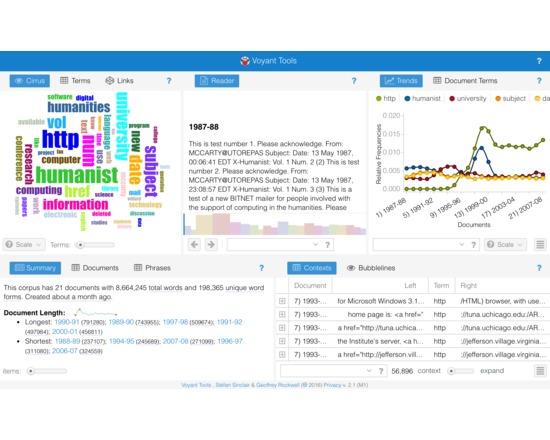
Voyant 2.0 is a complete rewrite of Voyant. It provides a suite of text analysis tools that will work with most texts you can upload or find on the web. These tools are combined in skins. For documentation see Documentation for Voyant 2.0

Rated 5.0 out of 5.

Search

Word and Phrase

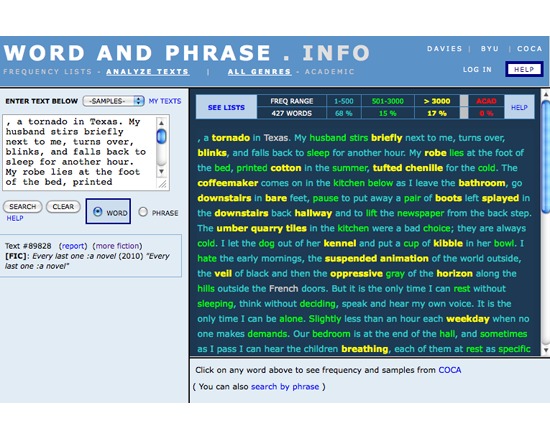
Word and Phrase is a free, web-based text analysis tool created by Dr. Mark Davies of Brigham Young University. Users can paste texts directly into the box provided. The tool provides a range of detailed information on a text's words and phrases, on one screen with a single search.

Rated 4.0 out of 5.

Search

TextGrid

TextGrid is a virtual research environment for text-based humanities scholarship. It offers a variety of tools and services for collaboratively creating, analyzing, editing and publishing texts. The TextGrid environment is split into two components, the Laboratory housing the tools and services, and the Repository for preserving reserach data and making it available to other scholars.

Rated 4.0 out of 5.

Search

BookLamp

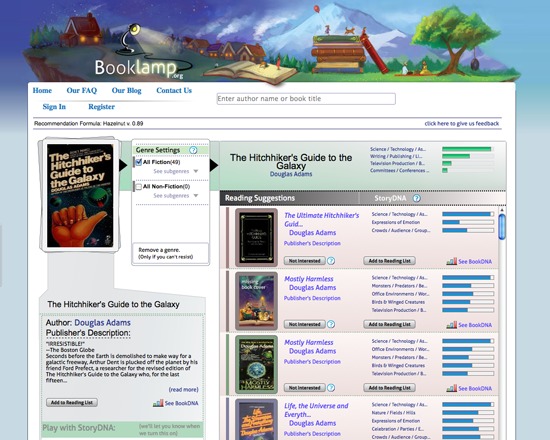
BookLamp, part of the Book Genome Project, is a tool and a resource for finding books. It offers an alternative to social recommendation engines reliant on author popularity by treating its books as equal regardless of number of copies sold. BookLamp's goal is to match users to the books relevant to their interests as accurately as possible. Rather than genres, it uses 'StoryDNA', which identifies the thematic ingredients important to a book's narrative, in addition to how prominent that ingredient is within the text. BookLamp has been retired as of April 2014 and the website is no longer available. The site has been captured by the Internet Archive, and may still be viewed there via the Wayback Machine.

Rated 4.0 out of 5.

Search

Old Bailey Data Warehousing Interface

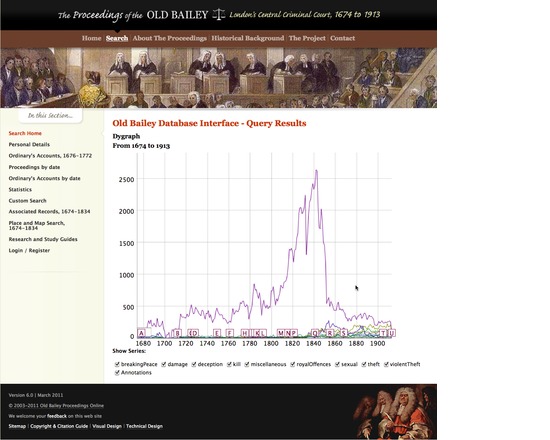
This prototype was produced as a proof-of-concept for the Criminal Intent project. It allows the records of the Old Bailey Online project to be searched such that the returned results can be viewed as either a timeline or a concordance of terms. The tool allows for reasonably complex queries to be placed and a range of different formats for the returned charts to be selected. The tool is primarily built with Python and SQLite and makes use of the Google Chart API for some output options.

Rated 3.0 out of 5.

Search

GATE (General Architecture for Text Engineering)

GATE (General Architecture for Text Engineering) is free, open source software offered by the University of Sheffield since 1995. It provides a framework for users to gather a corpus, apply an ontology to it, develop markup, automate the application of the markup to the corpus and add tools such as knowledge facet search, ontology browsing or graphing.

Rated 3.0 out of 5.