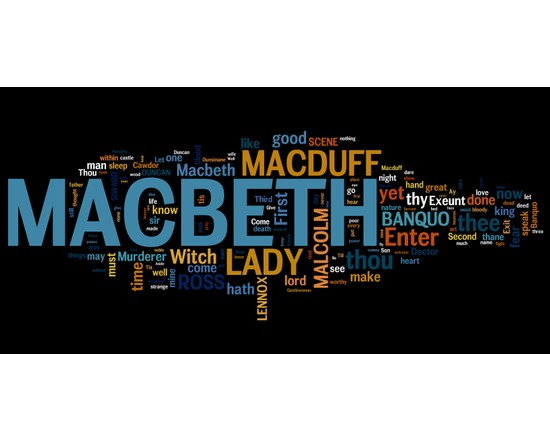
Wordle is an online toy for generating word clouds using the text you provide. Text can be submitted by providing an URL or by pasting raw text into an input. The most frequent words from the text are then used as the source for the resulting visualization, where frequency is used to determine the size of each word. You may customize the output by choosing from a variety of display options (layout, font, colours) or use the randomize feature to get a random visualization. Additionally, there is built-in stop word support for many common languages, and the option to change the word case.
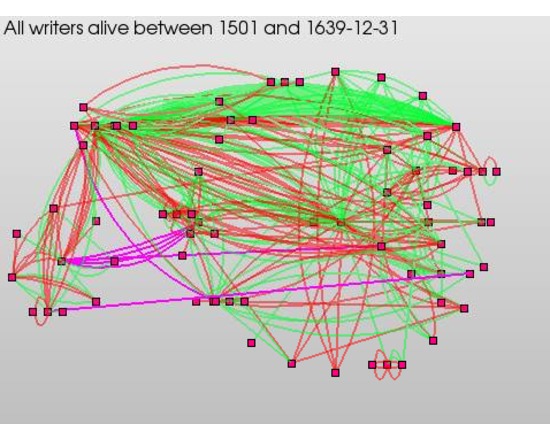
An application for visualizing a specific collection of authors, and the links or associations between them. Links are determined by co-occurrence in the Orlando dataset. The current dataset consists of authors, other people associated with them, and the text entries upon which these associations are based. The application is designed in such a way that it could be extended to use other datasets as well. The display can be customized in the several ways. Node colours, shapes and sizes can be altered. More significantly, the layout of the graph can be chosen from amongst several different algorithms. As the collection is quite large, there are many filtering options available. In terms of author, the following categories can be specified: gender, author/non-author, and author nationality. The user can create complex search queries of the authors and the text, and specify a date restriction for the authors' life span. Each association in the text has been tagged with one or more semantic attributes, i.e. the type or meaning of the relation between the people. These tags have been organized into a tree, moving from general to more specific relations. Each tag in the tree can be checked/unchecked, further filtering the results. Finally, a data set and customizations can be saved as a session which can then be loaded at a later time. In addition, screenshots of the current layout can be saved to an image file.
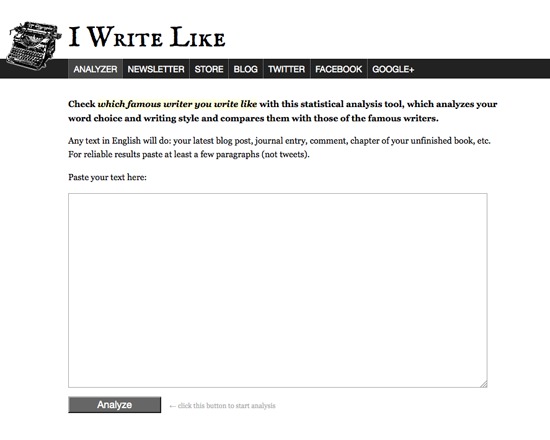
I Write Like is a free, web-based text analysis tool that compares a user-provided text to the prose of well-known writers using statistics, word choice and writing style analysis. It then reports on which writer the text most resembles. The tool requires at least two paragraphs of text for best results. At this time, the results are limited to the name of a writer, without offering more detailed insight into the analysis; the tool appears to be offered primarily to promote the Memoires journaling software.
Rated 1.5 out of 5.★★★★★1.5
GRIPHOS (General Retrieval and Information Processor for Humanities Oriented Studies)
GRIPHOS (General Retrieval and Information Processor for Humanities Oriented Studies) is a historically important suite of programs used extensively within the Museum Computer Network, a shared information management system developed jointly by fifteen New York area museums. Designed by Dr. Jack Heller of New York University's Institute for Computer Research in the Humanities (ICRH) and debuting in 1967, GRIPHOS enabled museums to store, retrieve and apply textual markup to their records.
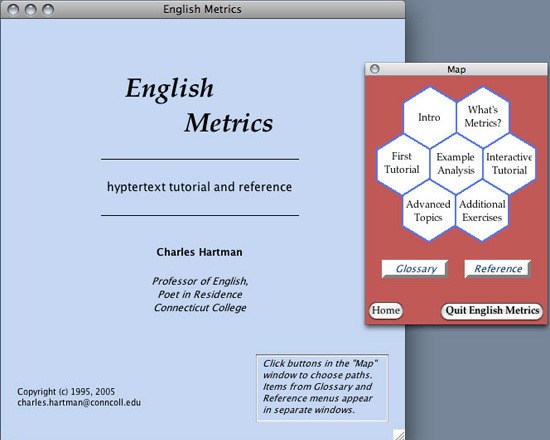
English Metrics is a free tutorial on English metrics, first written in Hypercard and maintained in a StackRunner version for both OS X and Windows environments. It traces the process of scanning iambic pentameter, and includes reference and exercise material for a range of metrical patterns.
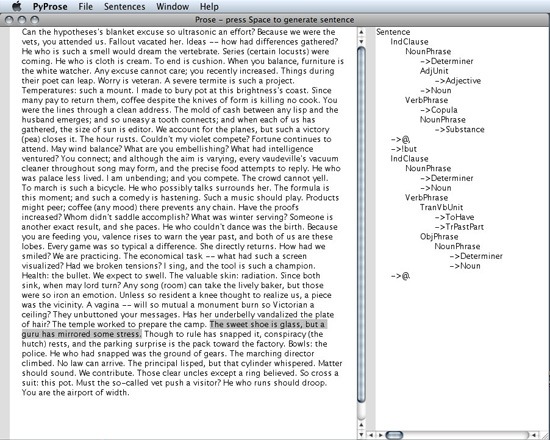
Prose is a free program for OS X and Windows written in Python and designed to generate random sentences. Originally described in Charles O. Hartman's book Virtual Muse: Experiments in Computer Poetry , it illustrates one approach to using computer programs as adjuncts to the process of composing poetry.
JEUDEMO was an information retrieval program developed at the University of Montreal in the 1970s. It built on and extended the functionality of COCOA by including Boolean search functions to search for patterns within a text such as co-occurences, but saw limited adoption as it required texts to be supplied on punched cards or paper tape and was programmed in a language exclusive to the CDC Cyber 74 computer system.
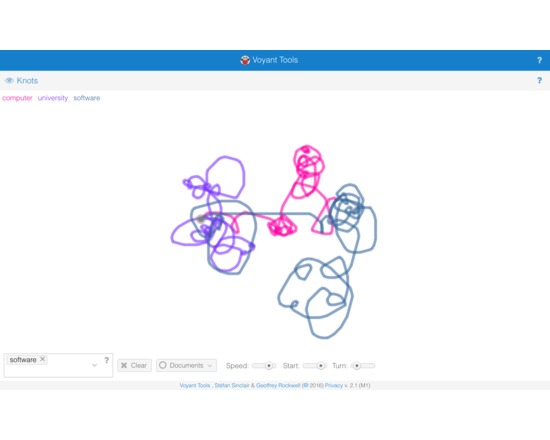
Voyant Knots is a visualization where a line is bent at every instance of a word forming knots. If you visualize multiple terms you will get multiple twisted lines. The Documentation can be found here.
Rated 0.0 out of 5.★★★★★0.0
McGill Characterization Process - Alias Identifier
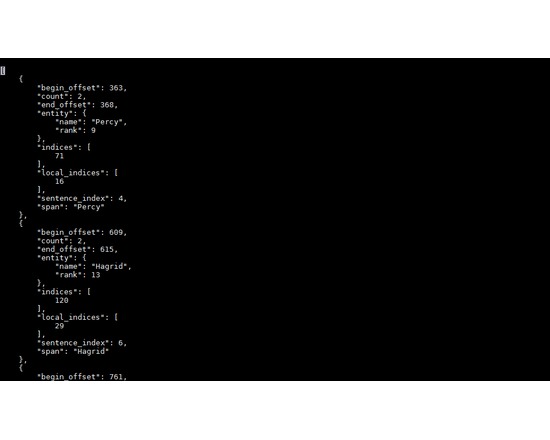
Part of the McGill Characterization Process family. Examines all the texts in a data directory and uses the output from the Character Parser to pick out all the aliases for the characters in the aforementioned texts. Output is in JSON format and is required for the rest of the tools in this family. Extensive setup required. Please consult the readme on github for setup instructions.
Rated 0.0 out of 5.★★★★★0.0
McGill Characterization Process - Calculate Character Centrality
Part of the McGill Characterization Process family. Examines all the texts in a data directory, and using the analysis already done by the Collocate Parser, Alias Identifier, and Character Parser, gives data for the centrality of characters for each text, allowing the texts to be ranked against each other based on this. Extensive setup required. Please consult the readme on github for setup instructions.