Amazon Comprehend is a natural language processing (NLP) service that uses machine learning to find insights and relationships in text. No machine learning experience required. There is a treasure trove of potential sitting in your unstructured data. Customer emails, support tickets, product reviews, social media, even advertising copy represents insights into customer sentiment that can be put to work for your business. The question is how to get at it? As it turns out, Machine learning is particularly good at accurately identifying specific items of interest inside vast swathes of text (such as finding company names in analyst reports), and can learn the sentiment hidden inside language (identifying negative reviews, or positive customer interactions with customer service agents), at almost limitless scale. Amazon Comprehend uses machine learning to help you uncover the insights and relationships in your unstructured data. The service identifies the language of the text; extracts key phrases, places, people, brands, or events; understands how positive or negative the text is; analyzes text using tokenization and parts of speech; and automatically organizes a collection of text files by topic. You can also use AutoML capabilities in Amazon Comprehend to build a custom set of entities or text classification models that are tailored uniquely to your organization’s needs.
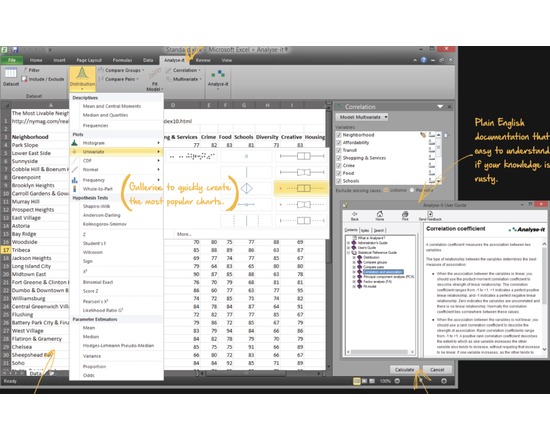
A set of dataset management and statistical plugins which is only available for Microsoft Windows including single and multiple linear regression, polynomial regression, and scatter plot with fit, fit confidence and prediction bands. The program can be used to generate visualizations and data reports. Requires Microsoft Excel.
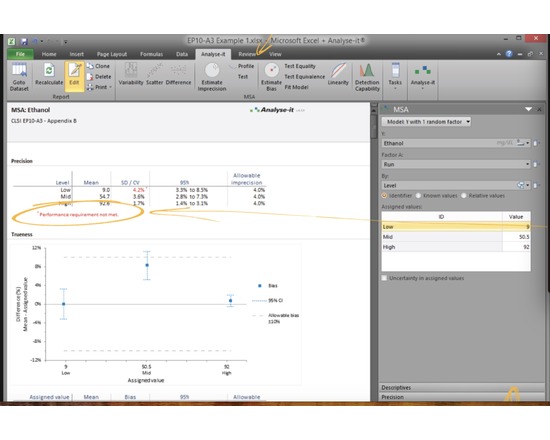
Analyse-it Method Validation Edition provides the statistical analysis you need to validate and verify analytical and diagnostic methods to meet the demands of regulatory compliance. With support for 11 CLSI protocols, it lets you: • Validate or verify analytical performance characteristics (precision, trueness, linearity, interferences, detection capability) of a measurement procedure to ensure they meet requirements for intended use or manufacturer's claims. • Compare methods to establish the real-world performance of a method against a reference method, or ensure comparability between two methods when making changes. Includes Deming, Weighted Deming, and Passing-Bablok regression, plus Bland-Altman limits of agreement. • Evaluate the diagnostic ability of a test to discriminate between two outcomes and compare test performance to find the most effective one. Includes ROC curves and Delong-Delong Clarke Pearson curve comparisons. • Establish a reference interval for a population of healthy individuals, or verify that existing intervals are transferable between laboratories or measurement procedures. Includes normal, quantile, robust bi-weight quantile, bootstrapped quantile, & Harrell-Davis quantile reference ranges.
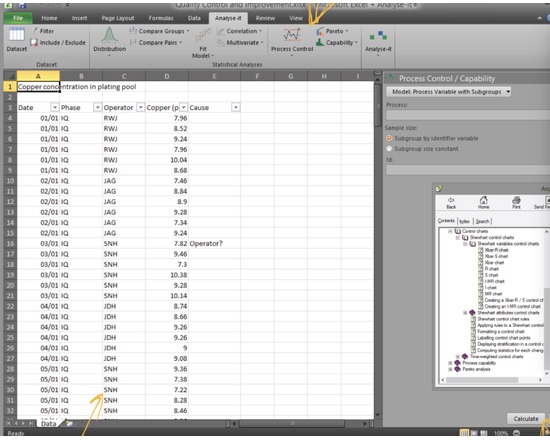
Analyse-it Quality Control & Improvement Edition provides the statistical analysis you need to understand processes, bring them under control, and find improvements that better your product. • Bring processes under statistical control so they are stable and predictable with powerful Shewhart, cumulative sum, and moving average control charts. Include Xbar-R, Xbar-S, R, S, I-MR, time weighted CUSUM, UWMA, EMA plots, and WECO, Nelson, Montomery or custom rulesets. • Ensure products are capable of meeting end-user specifications using capability indices to compare in-control process performance to your specification limits. • Improve processes and products by identifying solutions that really work using hypothesis tests and model fitting techniques. Includes ANOVA with multiple comparison, multiple linear and logistic regression, PCA and Factor analysis. • Identify actions that will reap the most rewards using Pareto analysis to identify commonly occurring defects and monitor them during process improvement.
ANNIS (ANNotation of Information Structure), now in version 3.4.3, is an open source browser-based visualization architecture designed to annotate complex multilevel linguistic corpora. Now in its second version, ANNIS enables users to concurrently annotate, query and visualize data for syntax, semantics, morphology, prosody, referntiality, lexis and so forth. It also offers support for spoken language and audio and visual annotation.
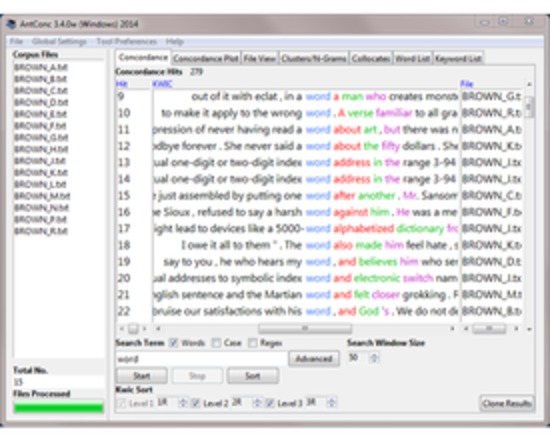
AntConc is free concordance software. It is multi-platform and easy to deploy and use. AntConc is part of a suite of related tools for text processing and analysis, including applications for parallel corpus analysis, word profiling, PDF to text conversion, text structure analysis, detecting and converting character encodings, Japanese and Chinese segmenter and tokenizer, wordclass tagger, and spelling variant anaysis. The developer is currently drafting a more explicit licence for the use of the software.
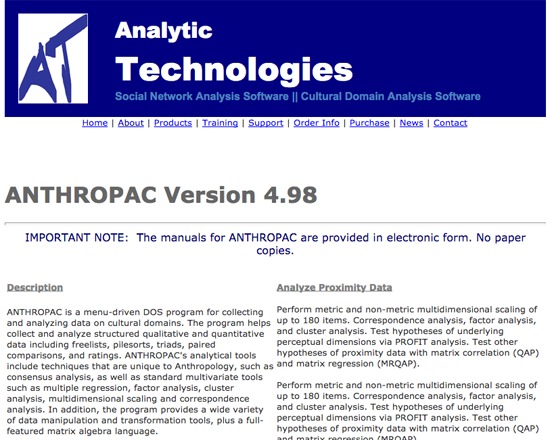
ANTHROPAC, now in version 4.98, is a long-standing menu-driven DOS program developed for working with anthropological and other cultural data. It assists both the collection and analysis of datasets, and can accommodate both qualitiative and quantitative information. ANTHROPAC includes analytic tools such as consensus analysis, factor analysis, cluster analysis and correspondance analysis, in addition to data manipulation and transformation functions. It imports and exports data via ASCII formats, and includes an extensive reference manual, a user's guide and a methods guide tailored for cultural domain analysis.
Apache OpenNLP is a free, open source toolkit for processing natural language text, based on machine learning. It includes common natural language processing functions such as tokenization, sentence segmentation, part-of-speech tagging, named entity extraction, chunking, parsing, and coreference resolution.
Apache UIMA (Unstructured Information Management application) is a software system for analyzing large amounts of unstructured data, such as a plain text document, and identifying entities, such as persons, places, organizations, or relations between entities. Discrete components (written in Java or C++) may be used within the application, such as language identification or entitiy detection. Each component provides self-describing metadata via XML descriptor files.
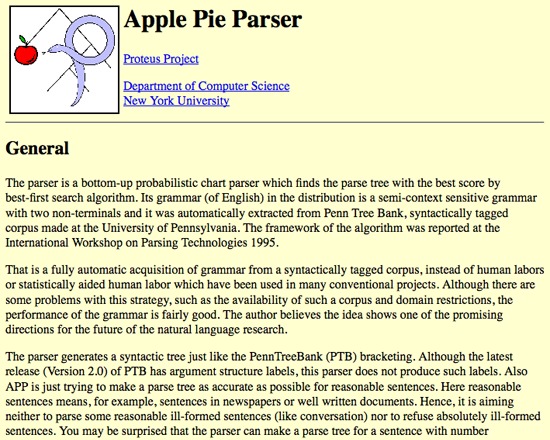
The Apple Pie Parser is a free tool from the 1990s for generating a grammar from a syntactially tagged corpus offered by the Department of Computer Science at New York University. It generates a syntactic tree like those of the Penn Tree Bank, and is still available for download.