
Analysis
CONCORD
CONCORD was a concordance program developed in 1968 to identify and sort collocating words or phrases. Notably, it allowed users to sort words ending in one of several suffixes (such as -er or -est) to be grouped together.
For researchers who work with text
TAPoR catalogues concordancers, annotators, topic models, stylometry packages, and visualization environments. Every record notes the platform, the license, and what the tool is actually good for.
Filter by the type of analysis.
Analysis
CONCORD was a concordance program developed in 1968 to identify and sort collocating words or phrases. Notably, it allowed users to sort words ending in one of several suffixes (such as -er or -est) to be grouped together.
Analysis
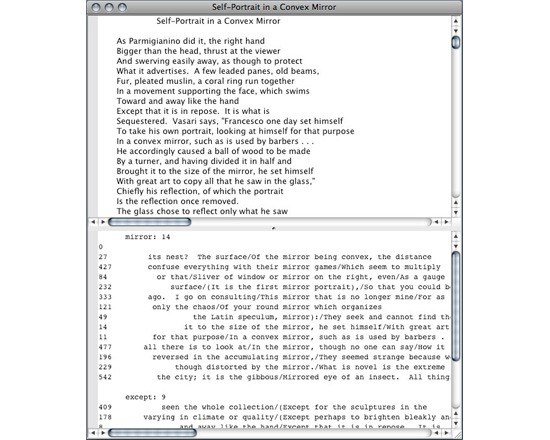
Concord is a free concordance generator written in Python for OS X and Windows XP (a new Windows version is forthcoming). It generates a KWIC concordance entry from a plain-text file for any word or phrase and permits sorting in a variety of ways. Concord can handle large text files, and preliminary testing with the modern Greek alphabet shows it supports non-Latin alphabets. This tool is described in Chris O. Hartman's book Virtual Muse: Experiments in Computer Poetry .
Analysis
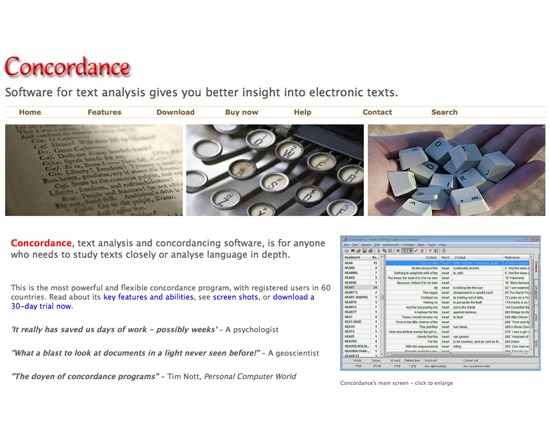
Concordance is a commerical text analysis and concordance tool originally developed for the Humanities (formerly available via the University of Dundee School of Humanities). It offers features for text analysis, word lists, indexes, full concordances, word frequencies and more. A free trial version is available.
Analysis
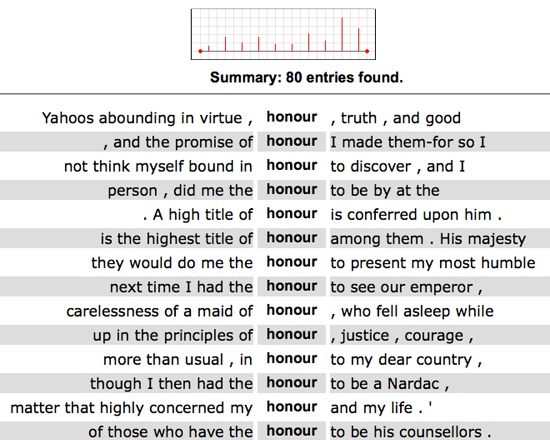
This tool finds the context for a specified word or pattern anywhere in a plain text document. Users may specify the context length, and whether the tool returns the context length in words, sentences, lines or paragraphs. It is also available for XML and HTML documents, and is a part of the TAPoRware toolset. This tool’s functionality has been incorporated into Voyant available online at www.voyant-tools.org.
Analysis
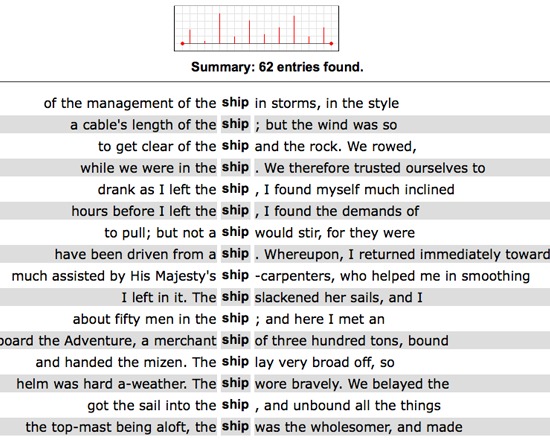
This tool finds the context for a specified word or pattern anywhere in an XML document, and can be narrowed to only the text within specified tags. Users may specify the context length, and whether the tool returns the context length in words, sentences, lines or paragraphs. It is also available for HTML and plain text documents, and is a part of the TAPoRware toolset. This tool’s functionality has been incorporated into Voyant available online at www.voyant-tools.org.
Analysis
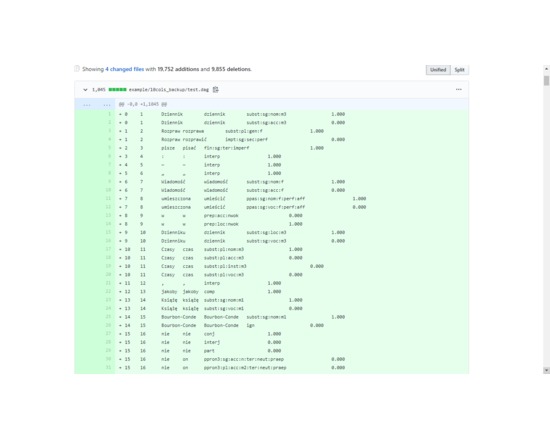
Concraft-pl, a morphosyntactic tagger for the Polish language based on conditional random fields. The tool is coupled with Morfeusz, a morphosyntactic analyzer for Polish, which represents both morphosyntactic and segmentation ambiguities in the form of a directed acyclic graph (DAG). As for now, the tagger doesn't provide any lemmatisation capabilities. As a result, it may output multiple interpretations (all related to the same morphosyntactic tag, but with different lemmas) for some known words, while for the out-of-vocabulary words it just outputs orthographic forms as lemmas.
Week of 1 Nov – 7 Nov
Three tools from the catalogue, each rated at least 3 stars. A new set appears each Sunday.
Curated list created by experience authors in the fields.

Geoffrey Rockwell
Not all Voyant tools show up in the default view or skin. Here is a list of some of the other tools worth trying.
4 tools
View list
Holly Pickering
Interested in audio production and editing? Here are a few programs that can help you get on your way. Some of them are free, some not, but all are helpful and useful.
3 tools
View list
Jason Bradshaw
This list compiles a suite of tools that make up Kynan Ly's Text Analysis for Twitter Research (TATR) Library. Recipes to these notebooks can be found on methodi.ca
6 tools
View list1321
Tools catalogued
15
Curated lists
22
Analysis types
671
Community reviews
Researchers, power users, and students will soon be able to contribute tools, share reviews, and curate lists around their own work.