Skip to content
TAPoR Text Analysis Portal for Research

For researchers who work with text

Find a text analysis tool that fits the work.

TAPoR catalogues concordancers, annotators, topic models, stylometry packages, and visualization environments. Every record notes the platform, the license, and what the tool is actually good for.

  • Platform, license, and method on every record
  • Reviews from people who teach with the tools
  • Lists assembled around a course or a corpus

Browse tools

Filter by the type of analysis.

View all tools
‹

Analysis

FRANTEXT / Stella

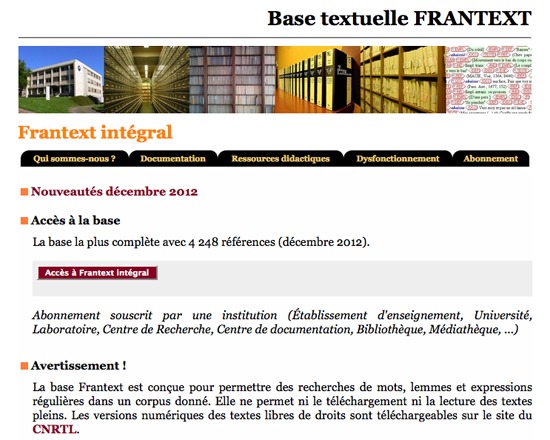
FRANTEXT is a historically and culturally important database of French literary, philosophical and technical texts with an emphasis on diversity and representation, spanning the Middle Ages to the present, and offered on a subscription basis. This resource is aimed at linguists and literary scholars in the humanities and social sciences, and is notable for its inclusion of a powerful search engine called Stella. Stella is a sophisticated NLP search suite, and includes regular expression search, lemmatization, vocabulary list and entity categorization functions.

Rated 0.0 out of 5.

Analysis

FUNES

FUNES was an NLP system for analyzing short newspaper stories. It was written in Prolog and conducted syntactic parsing and semantic analysis on a text to create a case-based semantic representation.

Rated 0.0 out of 5.

Analysis

FusionCharts

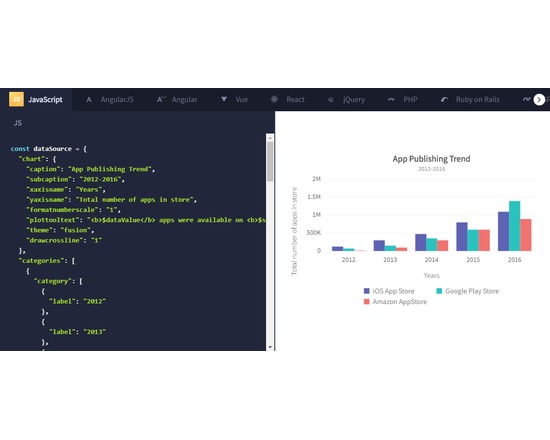
Enterprise-grade JavaScript charting library for web & mobile apps.

Rated 0.0 out of 5.

Analysis

GapVis

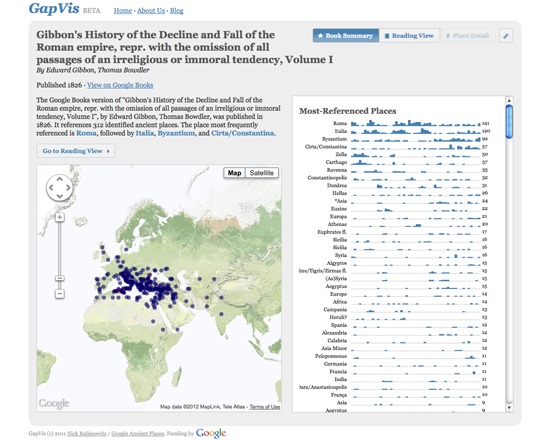
GapVis is a free tool developed in conjunction with Google Ancient Places to visualize the locations within and allow the exploration of books referencing ancient places within the Google Books collection. Users can view text summaries, use an enhanced reading interface and explore the location references through a place detail view. It is intended both to enable location-based text discovery, and to allow users to delve more deeply into a text based on the locations referenced within it. GapVis is currently in beta.

Rated 0.0 out of 5.

Analysis

General Inquirer

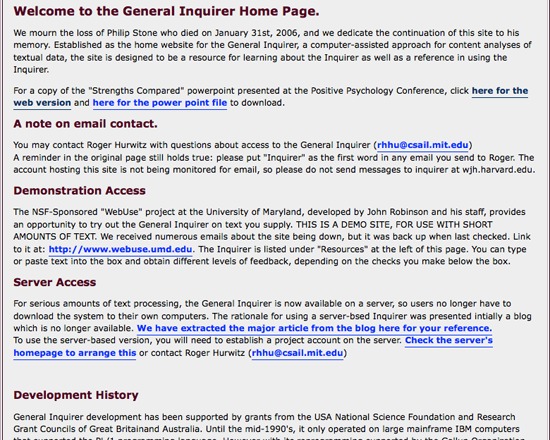
The General Inquirer is a historically important program for content analysis of textual data originally developed in the 1960s by Philip Stone and his colleagues at the Harvard Laboratory of Social Relations. Though the original release used punched cards, a version the program is available by request, and can be obtained by e-mailing Roger Hurwitz from an academic address. A minimalist web version capable of processing small files is also available. The General Inquirer's homepage is maintained in Philip Stone's memory.

Rated 0.0 out of 5.

Analysis

General Inquirer Category

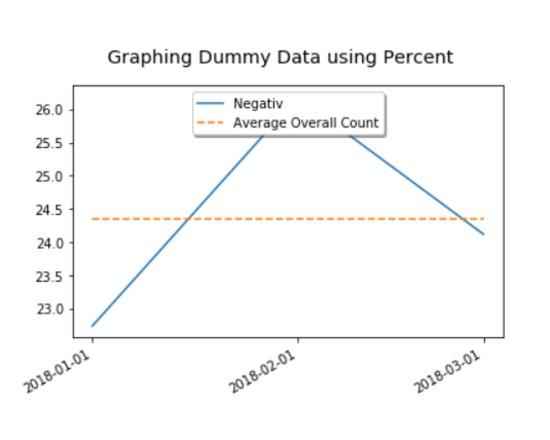
TATR: This notebook is part of a greater series of Juypter Notebook structured around Twitter Tweet analysis. This particular notebook will look at categorizing text using the General Inquirer Categories released by Harvard (http://www.wjh.harvard.edu/~inquirer/spreadsheet_guide.htm). This notebook will showcase how to break down the General Inquirer Category into a dictionary and how it can be tailored to fit your needs.

Rated 0.0 out of 5.

›

Curated lists

Curated list created by experience authors in the fields.

All curated lists

Geoffrey Rockwell

Cool Voyant Tools

Not all Voyant tools show up in the default view or skin. Here is a list of some of the other tools worth trying.

4 tools

View list

Holly Pickering

Audio Production Software

Interested in audio production and editing? Here are a few programs that can help you get on your way. Some of them are free, some not, but all are helpful and useful.

3 tools

View list

Jason Bradshaw

TATR: Text Analysis for Twitter Research

This list compiles a suite of tools that make up Kynan Ly's Text Analysis for Twitter Research (TATR) Library. Recipes to these notebooks can be found on methodi.ca

6 tools

View list

The catalogue

  • 1321

    Tools catalogued

  • 15

    Curated lists

  • 22

    Analysis types

  • 671

    Community reviews

More is coming

Researchers, power users, and students will soon be able to contribute tools, share reviews, and curate lists around their own work.