Skip to content
TAPoR Text Analysis Portal for Research

For researchers who work with text

Find a text analysis tool that fits the work.

TAPoR catalogues concordancers, annotators, topic models, stylometry packages, and visualization environments. Every record notes the platform, the license, and what the tool is actually good for.

  • Platform, license, and method on every record
  • Reviews from people who teach with the tools
  • Lists assembled around a course or a corpus

Browse tools

Filter by the type of analysis.

View all tools
‹

Analysis

gensim

Gensim is an open-source library for unsupervised topic modeling and natural language processing, using modern statistical machine learning. Gensim is implemented in Python and Cython. Gensim is designed to handle large text collections using data streaming and incremental online algorithms, which differentiates it from most other machine learning software packages that target only in-memory processing. Gensim includes streamed parallelized implementations of fastText, word2vec and doc2vec algorithms, as well as latent semantic analysis (LSA, LSI, SVD), non-negative matrix factorization (NMF), latent Dirichlet allocation (LDA), tf-idf and random projections.
Rated 0.0 out of 5.

Analysis

GeoTime

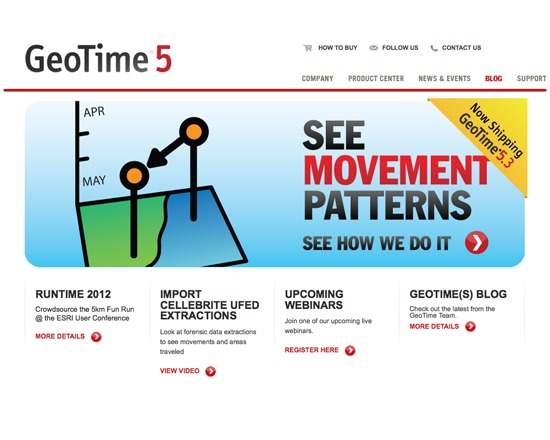
GeoTime is a tool for visualizing complex event-related data available for purchase. It can simultaneously visualize geospatial, temporal and link data to display activities and events. Data can be imported from ArcGIS or Microsoft Excel.

Rated 0.0 out of 5.

Analysis

GERTWOL

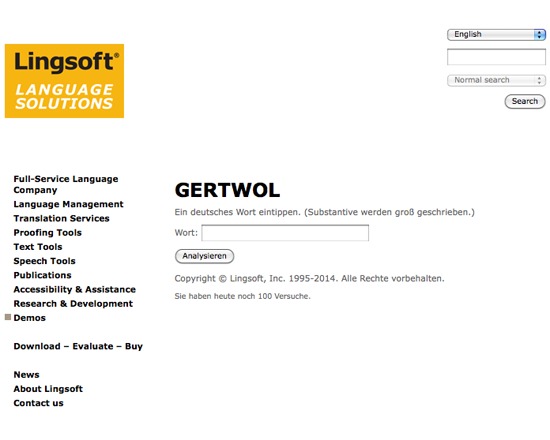
GERTWOL is a tool for the morphological analysis of German texts. A limited version for analyzing single words is now available for free through the developer's website.

Rated 0.0 out of 5.

Analysis

gFacet

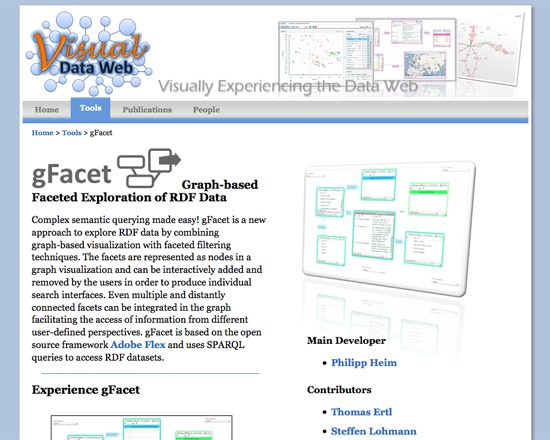
gFacet is a tool for graph-based visualization of RDF data developed as part of the Visual Data Web toolset and based on the Adobe Flex open source framework. Using SPARQL to access the user's dataset, it integrates filtering based on facets represented as nodes within the visualization to enable users to select which they wish to work with and create custom search interfaces.

Rated 0.0 out of 5.

Analysis

GINGER II

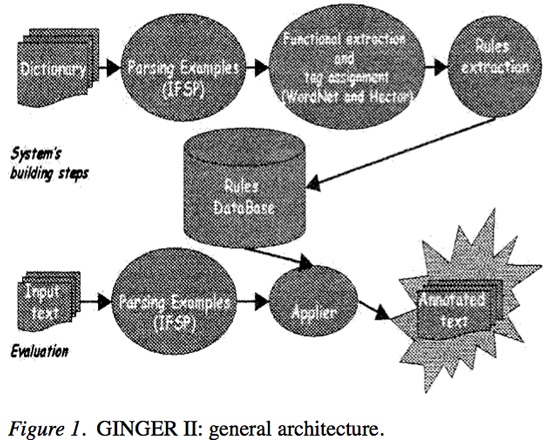
GINGER II is a word-sense disambiguator for English, offering a new approach to the algorithm developed for GINGER I. It directly extracts semantic disambiguation rules from dictionary example phrases, and semantically tags, syntactically parses and disambiguates those examples. This legacy tool has no affiliated web site and is no longer available.

Rated 0.0 out of 5.

Analysis

Gliffy

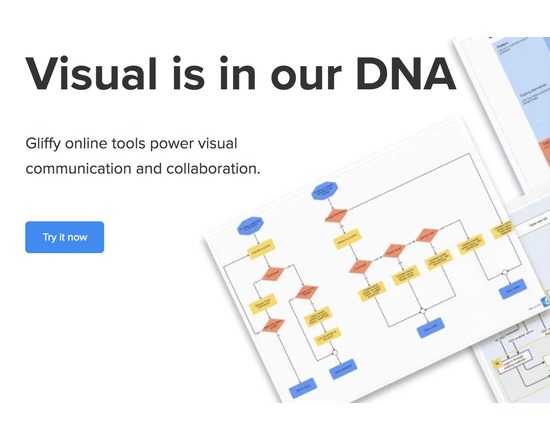
Gliffy is a tool that makes it easy to create, share, and collaborate on a wide range of diagrams. Gliffy works directly in your browser and can be used to build flow charts, organization charts, network diagrams, workflows, technical drawings, and wireframes.

Rated 0.0 out of 5.

›

Curated lists

Curated list created by experience authors in the fields.

All curated lists

Geoffrey Rockwell

Cool Voyant Tools

Not all Voyant tools show up in the default view or skin. Here is a list of some of the other tools worth trying.

4 tools

View list

Holly Pickering

Audio Production Software

Interested in audio production and editing? Here are a few programs that can help you get on your way. Some of them are free, some not, but all are helpful and useful.

3 tools

View list

Jason Bradshaw

TATR: Text Analysis for Twitter Research

This list compiles a suite of tools that make up Kynan Ly's Text Analysis for Twitter Research (TATR) Library. Recipes to these notebooks can be found on methodi.ca

6 tools

View list

The catalogue

  • 1321

    Tools catalogued

  • 15

    Curated lists

  • 22

    Analysis types

  • 671

    Community reviews

More is coming

Researchers, power users, and students will soon be able to contribute tools, share reviews, and curate lists around their own work.