Skip to content
TAPoR Text Analysis Portal for Research

For researchers who work with text

Find a text analysis tool that fits the work.

TAPoR catalogues concordancers, annotators, topic models, stylometry packages, and visualization environments. Every record notes the platform, the license, and what the tool is actually good for.

  • Platform, license, and method on every record
  • Reviews from people who teach with the tools
  • Lists assembled around a course or a corpus

Browse tools

Filter by the type of analysis.

View all tools
‹

Analysis

Prospéro (PROgramme de Sociologie Pragmatique, Expérimentale et Réflexive sur Ordinateur)

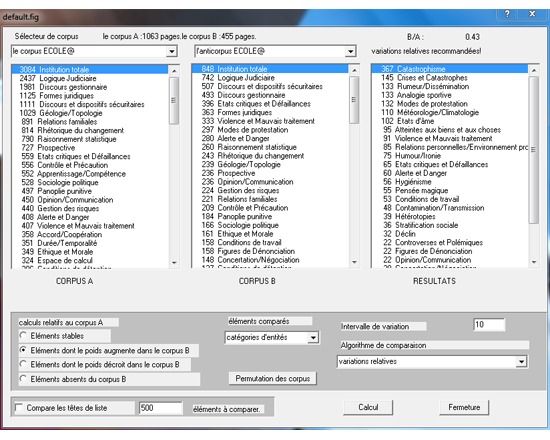
Prospéro (PROgramme de Sociologie Pragmatique, Expérimentale et Réflexive sur Ordinateur) is a free text analysis tool aimed at scholars in the Humanities capable of complex analysis on natural language. It permits users to classify and track records or thematic sets within a text or corpus for the purpose of exploration, analysis and comparison. It identifies places in a text that display uncertainty, controversy, criticism, and enables the user to establish rule and meta-rules to separate factual statements from views and interpretations. Prospéro is particularly designed for complex cases composed of large texts containing heterogenous discourse.

Rated 0.0 out of 5.

Analysis

Protovis

Protovis composes custom views of data with simple marks such as bars and dots. Unlike low-level graphics libraries that quickly become tedious for visualization, Protovis defines marks through dynamic properties that encode data, allowing inheritance, scales and layouts to simplify construction. Protovis is free and open-source, provided under the BSD License. It uses JavaScript and SVG for web-native visualizations; no plugin required (though you will need a modern web browser)! Although programming experience is helpful, Protovis is mostly declarative and designed to be learned by example. Protovis is no longer being developed. The developers have moved on to a new visualization library, D3.

Rated 0.0 out of 5.

Analysis

Python Tools for Text-Analysis

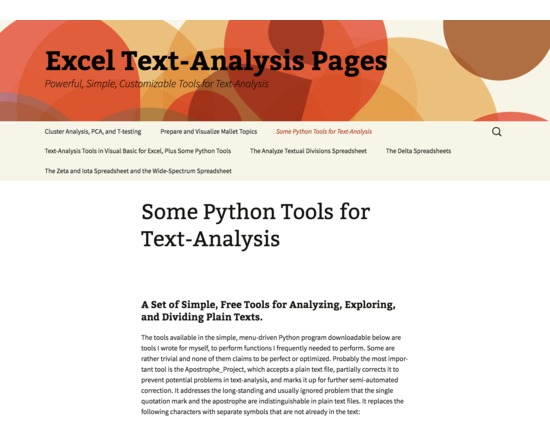
This is a set of simple, free tools for analyzing, exploring, and dividing plain texts. The tools are available in the simple, menu-driven, downloadable Python program. Some are rather trivial and none of them claims to be perfect or optimized. Probably the most important tool is the Apostrophe_Project, which accepts a plain text file, partially corrects it to prevent potential problems in text-analysis, and marks it up for further semi-automated correction. It addresses the long-standing and usually ignored problem that the single quotation mark and the apostrophe are indistinguishable in plain text files. It replaces the following characters with separate symbols that are not already in the text: •Internal apostrophes: presumably real apostrophes •Non-internal apostrophes preceding capital letters: usually scare quotes or dialogue marked with single quotation marks •Non-internal apostrophes following a word-final “s”: usually plural possessives •Non-internal apostrophes in very commonly used contracted forms: ’em, an’, ’twas, and so forth •Non-internal apostrophes between other breaking characters: essentially never anything but single quotation marks

Rated 0.0 out of 5.

Analysis

Qigga

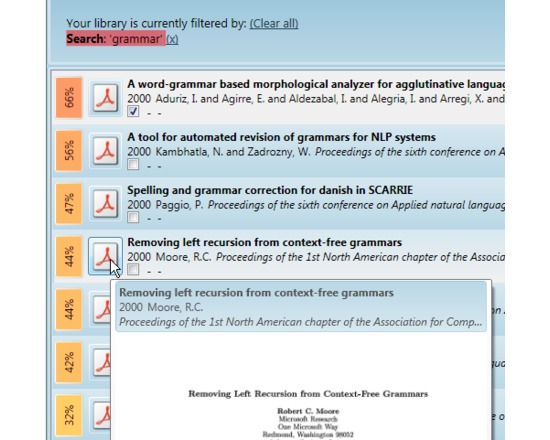
Qiqqa is a research management software that allows you to organize large numbers of papers; find new papers to read and new information about papers you already have; review materials and create annotation reports. Qiqqa has several PDF tools that also allow you to convert from PDFs to text, and use a clipboard function to cut and paste text into your document.

Rated 0.0 out of 5.

Analysis

Quadrigram

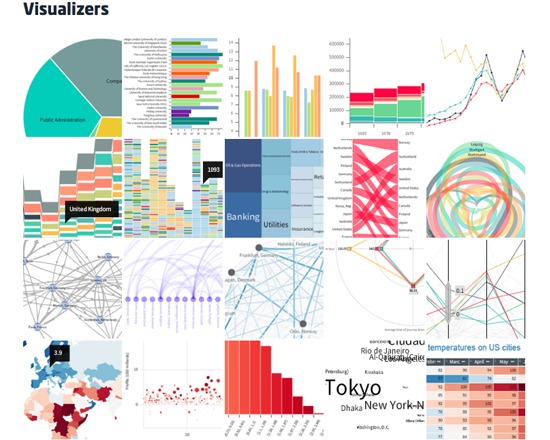
Quadrigram is an environment for data gathering, query and visualization, based on a visual programming language and intended for users with no experience programming or creating visualizations. At present, it contains 50 different visualizers.

Rated 0.0 out of 5.

Analysis

Qualrus

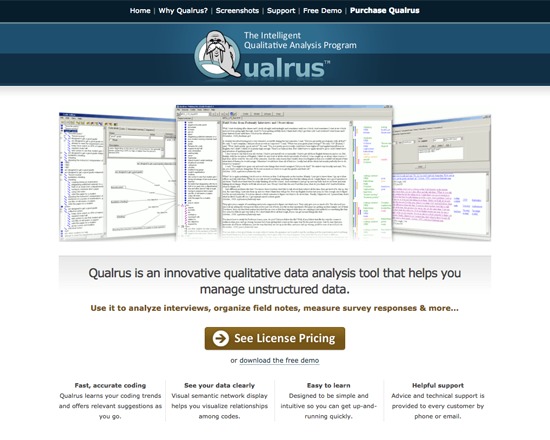
Qualrus is a commercial application for qualitative data analysis, including data coding and statistics functions. It can analyze data from a wide variety of sources, including common text, web, image, video and audio files. The data coding functions are supplemented by machine learning processes to assist data processing and analysis. In terms of analysis, it offers a number of common text analysis functions including tokenization, co-occurences, and Boolean search, and can visualize a network view of interrelationships. It is particularly aimed at academic and institutional applications, and both student and free trial versions are avaiable.

Rated 0.0 out of 5.

›

Curated lists

Curated list created by experience authors in the fields.

All curated lists

Geoffrey Rockwell

Cool Voyant Tools

Not all Voyant tools show up in the default view or skin. Here is a list of some of the other tools worth trying.

4 tools

View list

Holly Pickering

Audio Production Software

Interested in audio production and editing? Here are a few programs that can help you get on your way. Some of them are free, some not, but all are helpful and useful.

3 tools

View list

Jason Bradshaw

TATR: Text Analysis for Twitter Research

This list compiles a suite of tools that make up Kynan Ly's Text Analysis for Twitter Research (TATR) Library. Recipes to these notebooks can be found on methodi.ca

6 tools

View list

The catalogue

  • 1321

    Tools catalogued

  • 15

    Curated lists

  • 22

    Analysis types

  • 671

    Community reviews

More is coming

Researchers, power users, and students will soon be able to contribute tools, share reviews, and curate lists around their own work.