Skip to content
TAPoR Text Analysis Portal for Research

For researchers who work with text

Find a text analysis tool that fits the work.

TAPoR catalogues concordancers, annotators, topic models, stylometry packages, and visualization environments. Every record notes the platform, the license, and what the tool is actually good for.

  • Platform, license, and method on every record
  • Reviews from people who teach with the tools
  • Lists assembled around a course or a corpus

Browse tools

Filter by the type of analysis.

View all tools
‹

Analysis

tFacet

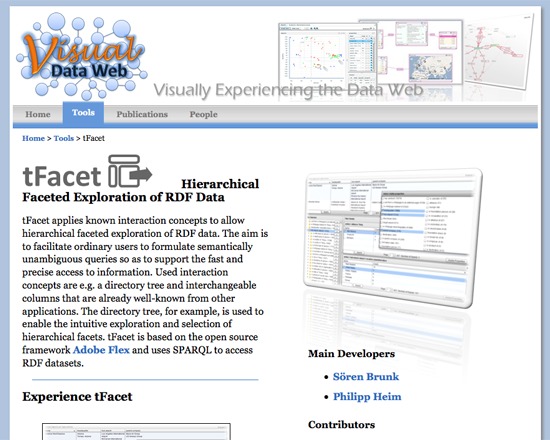
tFacet applies known interaction concepts to allow hierarchical faceted exploration of RDF data. The aim is to facilitate ordinary users to formulate semantically unambiguous queries so as to support the fast and precise access to information. Used interaction concepts are e.g. a directory tree and interchangeable columns that are already well-known from other applications. The directory tree, for example, is used to enable the intuitive exploration and selection of hierarchical facets. tFacet is based on the open source framework Adobe Flex and uses SPARQL to access RDF datasets.

Rated 0.0 out of 5.

Analysis

The Chicago Homer

The Chicago Homer is a multilingual database that uses the search and display capabilities of electronic texts to make the distinctive features of Early Greek epic accessible to readers with and without Greek. Except for fragments, it contains all the texts of these poems in the original Greek. In addition, the Chicago Homer includes English and German translations, in particular Lattimore's Iliad, James Huddleston's Odyssey, Daryl Hine's translations of Hesiod and the Homeric Hymns, and the German translations of the Iliad and Odyssey by Johan Heinrich Voss. Through the associated web site Eumaios users of the Chicago Homer can also from each line of the poem access pertinent Iliad Scholia and papyrus readings.

Rated 0.0 out of 5.

Analysis

The Field Linguist’s Toolbox

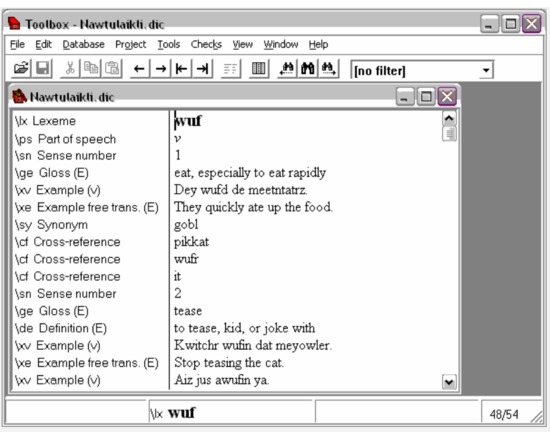
Toolbox is a data management and analysis tool for field linguists. It is especially useful for maintaining lexical data, and for parsing and interlinearizing text, but it can be used to manage virtually any kind of data. Toolbox is free to download and use. Toolbox is especially powerful for handling large corpora and dictionaries. It can handle a corpus of over a million words, and a dictionary of hundreds of thousands of words At heart, Toolbox is a text-oriented database management system (DBMS) with added functionality designed to meet the needs of a field linguist. The underlying DBMS offers full user flexibility in the design of any type of database. But for ease of use, the Toolbox package includes prepared database definitions for a typical dictionary and text corpus. Toolbox also has powerful linguistic functionality. It includes a morphological parser that can handle almost all types of morphophonemic processes. It has a word formula component that allows the linguist to describe all the possible affix patterns that occur in words. It has a user-definable interlinear text generation system which uses the morphological parser and lexicon to generate annotated text

Rated 0.0 out of 5.

Analysis

The GeoNewsMiner (GNM)

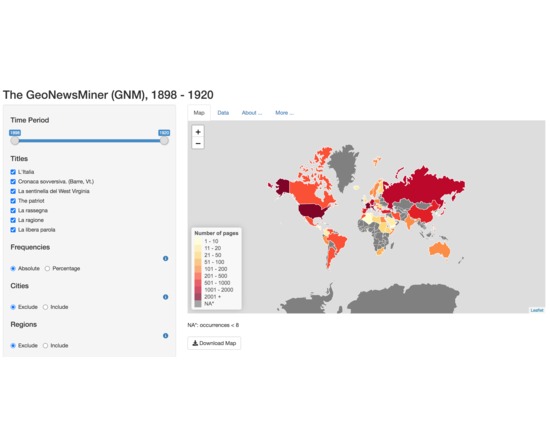
This is a project that had as goal to show on a map the references to geographical location from the text of publications from Italian language newspapers published in the United States between 1898 and 1920. They have made the code and dataset publicly available on GitHub and hence can be used by scholars with a similar project. A review of this project is available here https://utrecht-university.shinyapps.io/GeoNewsMiner/

Rated 0.0 out of 5.

Analysis

The Literary Field Guide

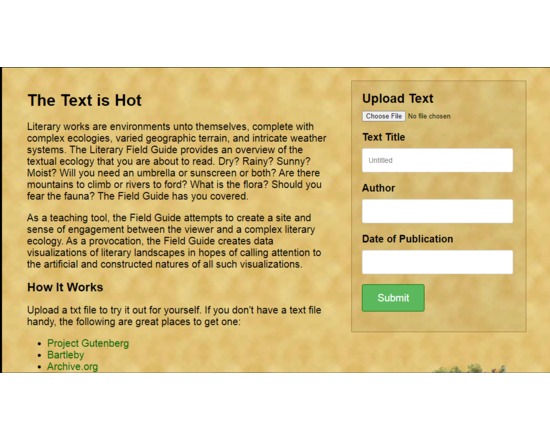
The Literary Field Guide provides an overview of the textual ecology of the text that you are about to read. It identifies mentions of ecological terms in the text and outputs an image that represents the environment the ecological terms of the text suggest. It also outputs the mentions and their frequencies under specific headings (for example: fauna, flora, amphibians, trees, landscapes, etc )

Rated 0.0 out of 5.

Analysis

The Networked Corpus

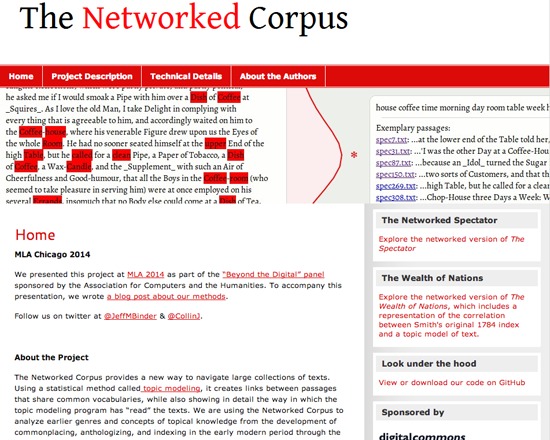
The Networked Corpus is a free, open source tool for navigating a corpus of plain text files via topic modelling using MALLET. The tool consistes of a Python script, and generates a collection of HTML files that can be explored further via the user's web browser. To use The Networked Corpus, users must have a minimum of Python 2.7.x, NumPy, SciPy and MALLET 2.0.7 installed on their system.

Rated 0.0 out of 5.

›

Curated lists

Curated list created by experience authors in the fields.

All curated lists

Geoffrey Rockwell

Cool Voyant Tools

Not all Voyant tools show up in the default view or skin. Here is a list of some of the other tools worth trying.

4 tools

View list

Holly Pickering

Audio Production Software

Interested in audio production and editing? Here are a few programs that can help you get on your way. Some of them are free, some not, but all are helpful and useful.

3 tools

View list

Jason Bradshaw

TATR: Text Analysis for Twitter Research

This list compiles a suite of tools that make up Kynan Ly's Text Analysis for Twitter Research (TATR) Library. Recipes to these notebooks can be found on methodi.ca

6 tools

View list

The catalogue

  • 1321

    Tools catalogued

  • 15

    Curated lists

  • 22

    Analysis types

  • 671

    Community reviews

More is coming

Researchers, power users, and students will soon be able to contribute tools, share reviews, and curate lists around their own work.