
Analysis
TOSCA
TOSCA was a syntactic analysis system available in the 1990s. It required users to apply word class tags and syntactic markers, which it then used for syntactic parsing.
For researchers who work with text
TAPoR catalogues concordancers, annotators, topic models, stylometry packages, and visualization environments. Every record notes the platform, the license, and what the tool is actually good for.
Filter by the type of analysis.
Analysis
TOSCA was a syntactic analysis system available in the 1990s. It required users to apply word class tags and syntactic markers, which it then used for syntactic parsing.
Analysis
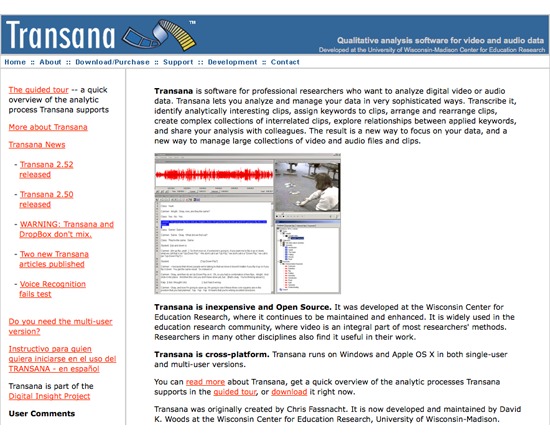
Transana is a free, open source program offered by the University of Wisconsin-Madison Center for Education Research for transcribing and analyzing large collections of video and audio data aimed at academic researchers. It enables users to manually transcribe in a variety of levels of detail, identify and access analytically significant sections of their data, manage collections, organize video clips into categories, apply keywords to sections or clips, generate graphical or textual reports, data mine and share markup.
Analysis
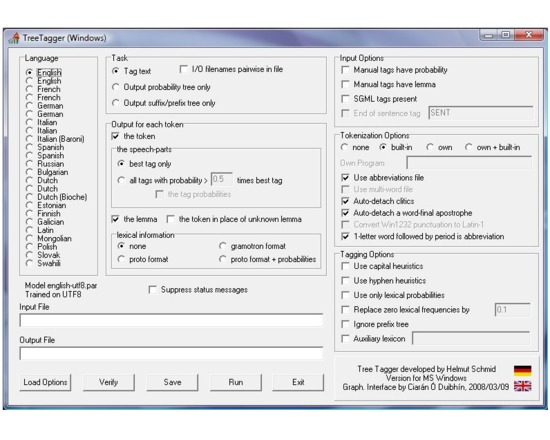
The TreeTagger is a program developed by Helmut Schmid at the University of Stuttgart (now at the University of München), for part-of-speech tagging and lemmatization. Language models (known as “parameters”, file extension .par) are supplied on the TreeTagger webpage for using the program with texts in English, French, German, Italian, Spanish, Russian, Bulgarian, Dutch, Estonian, Finnish, Galician, Latin, Mongolian, Polish, Slovak and Swahili, and models for some other languages are available from sites linked to the TreeTagger webpage. For a language for which no model exists, it is necessary to hand-tag some text, and then run a training program (provided with the TreeTagger) to create the model.
Analysis
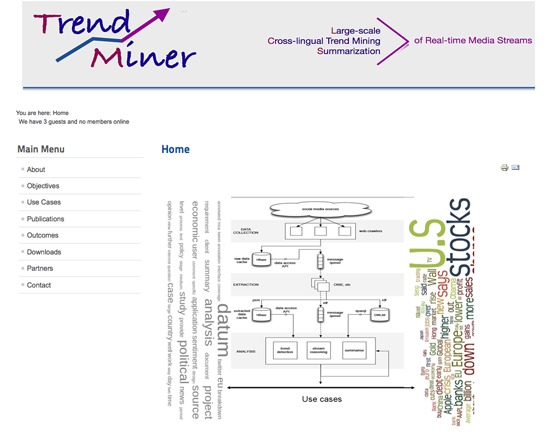
Trend Miner is a tool designed to enable portable open-source real-time methods for cross-lingual mining and summarizing of large-scale stream media. It combines elements from natural language processing, knowledge-based reasoning, machine learning, economics and political science. It is designed to access and interpret data from sources such as blogs, Facebook and Twitter.

Analysis
TRICON was a concordance program developed in the 1960s for the Berkeley Machine Translation Project. The program was designed to work with texts in languages written in non-Roman alphabets, such as Russian (original version) or Judeo Arabic texts (as of 1967). It was developed in FORTRAN G and ran on IBM 360/70 computers.
Analysis
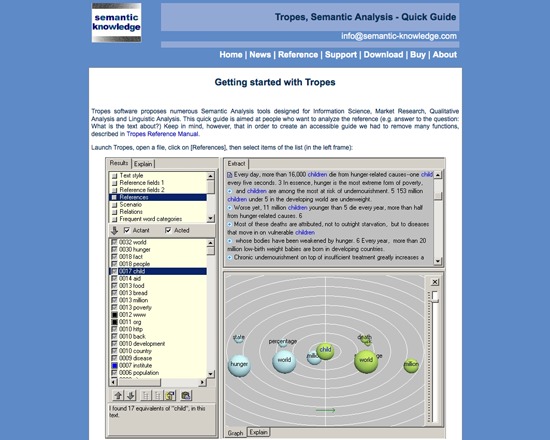
Tropes is a legacy commercial text analysis tool now available for free. It is designed for natural language processing and semantic classification, including chronological analysis of sequential pieces of text and summarization. It includes a graphical interface and can generate a variety of hypertext-based graphs.
Week of 1 Nov – 7 Nov
Three tools from the catalogue, each rated at least 3 stars. A new set appears each Sunday.
Curated list created by experience authors in the fields.

Geoffrey Rockwell
Not all Voyant tools show up in the default view or skin. Here is a list of some of the other tools worth trying.
4 tools
View list
Holly Pickering
Interested in audio production and editing? Here are a few programs that can help you get on your way. Some of them are free, some not, but all are helpful and useful.
3 tools
View list
Jason Bradshaw
This list compiles a suite of tools that make up Kynan Ly's Text Analysis for Twitter Research (TATR) Library. Recipes to these notebooks can be found on methodi.ca
6 tools
View list1321
Tools catalogued
15
Curated lists
22
Analysis types
671
Community reviews
Researchers, power users, and students will soon be able to contribute tools, share reviews, and curate lists around their own work.