Skip to content
TAPoR Text Analysis Portal for Research

For researchers who work with text

Find a text analysis tool that fits the work.

TAPoR catalogues concordancers, annotators, topic models, stylometry packages, and visualization environments. Every record notes the platform, the license, and what the tool is actually good for.

  • Platform, license, and method on every record
  • Reviews from people who teach with the tools
  • Lists assembled around a course or a corpus

Browse tools

Filter by the type of analysis.

View all tools
‹

Analysis

UDPipe

UDPipe is a trainable pipeline for tokenization, tagging, lemmatization and dependency parsing of CoNLL-U files. UDPipe is language-agnostic and can be trained given annotated data in CoNLL-U format. Trained models are provided for nearly all UD treebanks. UDPipe is available as a binary for Linux/Windows/OS X, as a library for C++, Python, Perl, Java, C#, and as a web service. Third-party R CRAN package also exists.
Rated 0.0 out of 5.

Analysis

UMDHMM: Hidden Markov Model Toolkit

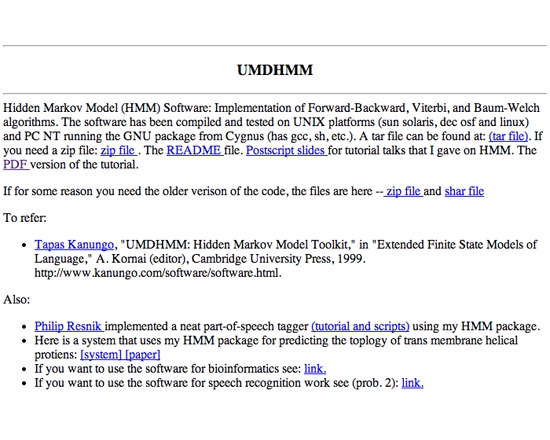
The UMDHMM: Hidden Markov Model Toolkit is a free UNIX implementation of hidden Markov models useful for speech recognition from Tapas Kanungo. It includes implementations of the Forward-Backward, Viterbi and Baum-Welch algorithms.

Rated 0.0 out of 5.

Analysis

Umigon

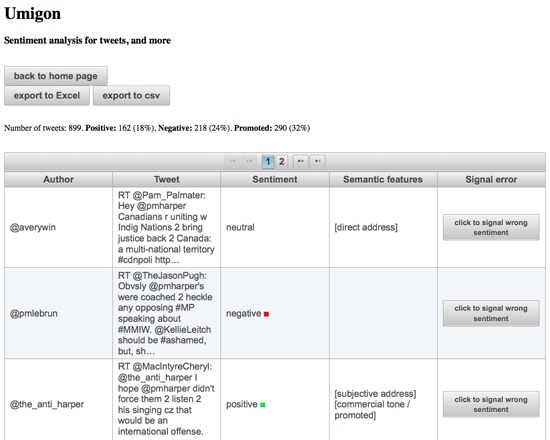
Umigon is a tool used for the sentiment analysis of texts. It is one of the tools of the Nocode app which is a suite of text analysis tools. Results can be exported in Excel or CSV format for further analysis. It was formerly a stand alone web-based and open-source tool for the sentiment analysis of tweets. From a person's Twitter handle, Umigon retrieved that account's tweets and processed them for sentiment while accounting for factual statements (ex: "I hate war" will be classified has negative, and "war in Syria" will be classified as neutral). Tweets could also be pasted manually in the entry box provided. Beyond sentiment analysis, Umigon could identify characteristics such as whether the tweet contains a question, whether it contains possible promotional/commercial subject matter, or temporal indicators based on tense. The developer of this application can be reached on Twitter. As of April 2022, Umigon has been archived after a long period without new developments.

Rated 0.0 out of 5.

Analysis

UNICON

UNICON was a concordance generator written in FORTRAN IV and available in the 1960s. It was available first for the IBM 7094, and for IBM 1410/7090 computers after 1970.

Rated 0.0 out of 5.

Analysis

UNICORN

UNICORN was a concording system developed in the 1970s. It was developed in FORTRAN IV to replace more restricted programs at at the University of Colorado at Boulder, and could process most machine-readable texts.

Rated 0.0 out of 5.

Analysis

University of Maryland HCI Group: FeatureLens

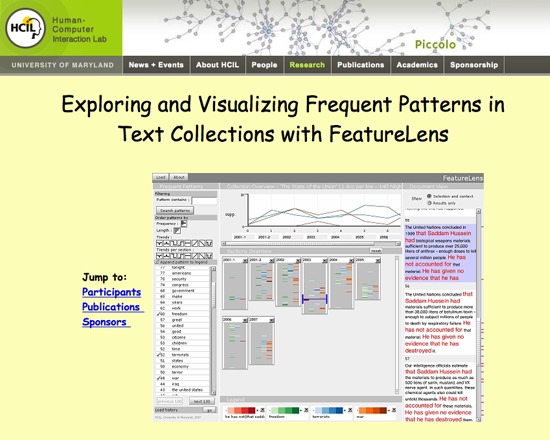
FeatureLens is a free tool for visualizing and exploring patterns in text collections. This tool integrates the results of text-mining algorithms, and can assist in finding frequent words or ngrams, enabling the discovery of fuzzy repetition patterns. In addition, the tool will recommend features based on particular pattern types identified in the text.

Rated 0.0 out of 5.

›

Curated lists

Curated list created by experience authors in the fields.

All curated lists

Geoffrey Rockwell

Cool Voyant Tools

Not all Voyant tools show up in the default view or skin. Here is a list of some of the other tools worth trying.

4 tools

View list

Holly Pickering

Audio Production Software

Interested in audio production and editing? Here are a few programs that can help you get on your way. Some of them are free, some not, but all are helpful and useful.

3 tools

View list

Jason Bradshaw

TATR: Text Analysis for Twitter Research

This list compiles a suite of tools that make up Kynan Ly's Text Analysis for Twitter Research (TATR) Library. Recipes to these notebooks can be found on methodi.ca

6 tools

View list

The catalogue

  • 1321

    Tools catalogued

  • 15

    Curated lists

  • 22

    Analysis types

  • 671

    Community reviews

More is coming

Researchers, power users, and students will soon be able to contribute tools, share reviews, and curate lists around their own work.