Skip to content
TAPoR Text Analysis Portal for Research

For researchers who work with text

Find a text analysis tool that fits the work.

TAPoR catalogues concordancers, annotators, topic models, stylometry packages, and visualization environments. Every record notes the platform, the license, and what the tool is actually good for.

  • Platform, license, and method on every record
  • Reviews from people who teach with the tools
  • Lists assembled around a course or a corpus

Browse tools

Filter by the type of analysis.

View all tools
‹

Analysis

Voyant Translate Skin (beta)

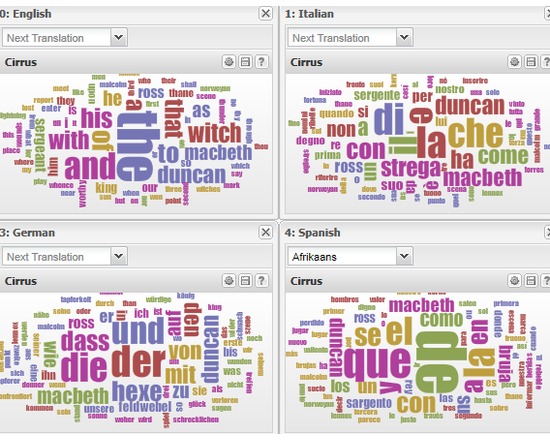
The translate skin is a custom skin for Voyeur Tools which offers multiple translations of the same document. Target languages for the translations are chosen from a comprehensive list and the Google Translate API is used to provide the resulting texts. These are used to populate the final view which consists of a series of Cirrus tools, one for each translation. Further translations can be produced for any of the texts by selecting one from the “Next Translation” drop-down. The Cirrus tools can be arranged in two layouts: tile, and circular. They can also be re-sized and moved to produce a custom layout.

Rated 0.0 out of 5.

Analysis

W3C RDF Validation Service

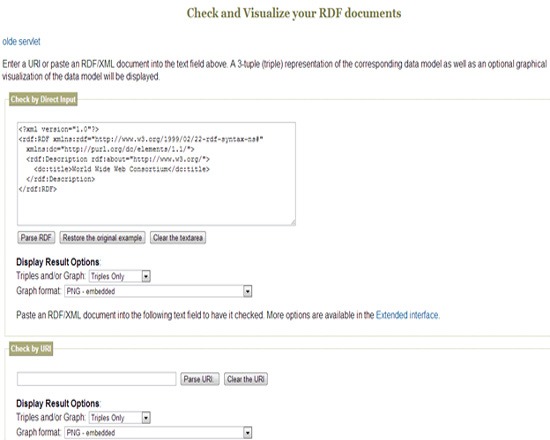
The W3C RDF Validation Service is a free, web-based tool for checking RDF documents for errors and displaying the results. It can display in triples, a graph, or a combination of the two, and can format the graph in a variety of file formats including PNG, SVG and GIF. Documents can be pasted directly into the provided form or from a provided URI.

Rated 0.0 out of 5.

Analysis

WATCON

WATCON was a program used extensively at the University of Waterloo for humanities research in the 1970s. It was developed by Philip H. Smith Jr. and WATCHUM (Waterloo Computing in the Humanities) as a text-handling package with concordance applications, and can be regarded as a descendent of the Scharfenberg-Smith Concordance Program.

Rated 0.0 out of 5.

Analysis

WEAVE (Web-based Analysis and Visualization Environment)

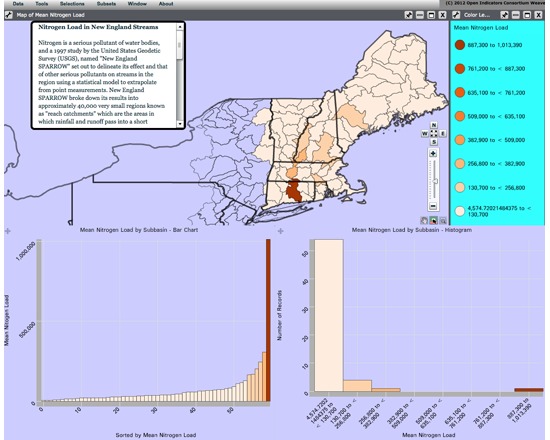
WEAVE (Web-based Analysis and Visualization Environment) is a web-based visualization platform offered by the Institute for Visualization and Perception Research at the University of Massachusetts Lowell. It is designed to visualize any data for any purpose, and to accommodate novice and advanced users alike. It includes the ability to integrate, disseminate and visualize data at nested levels of geography. WEAVE is currently in beta. Both a web-based demo and a download version are available.

Rated 0.0 out of 5.

Analysis

WebLicht

WebLicht is an execution environment for automatic annotation of text corpora. Linguistic tools such as tokenizers, part of speech taggers, and parsers are encapsulated as web services, which can be combined by the user into custom processing chains. The resulting annotations can then be visualized in an appropriate way, such as in a table or tree format. It is often the case that a tool relies on one or more annotation layers to exist in the input data before it can begin processing. WebLicht can assist the user in building a processing chain by determining which tools are able to operate on the data at any given point and offering only those tools as options to add to the chain. There are 2 modes for building tool chains: Easy Mode lets you choose pre-defined processing chains Advanced Mode allows you to build customized tool chains. Login is required to use the tools and corpora. Login with email addresses from most recognized European universities will be automatically accepted. Individuals with a Non-European email address need to create an account with clarin.eu Developed by the German language resource infrastructure (D-SPIN) and Common language resources and technology infrastructure (CLARIN)

Rated 0.0 out of 5.

Analysis

Weighted Centroid - Other (TAPoRware)

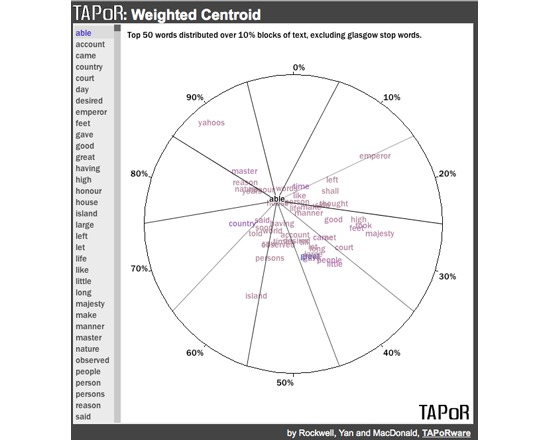
The Weighted Centroid is a java applet designed to display a circular graph based on word distribution data. The text is divided up into an arbitrary number of units, which are positioned around the circumference of the circle in a clockwise sequence. The more times a word appears in a particular text unit, the closer the word will be to that unit in the circle, and the more units it appears in, the closer it will appera to the centre.

Rated 0.0 out of 5.

›

Curated lists

Curated list created by experience authors in the fields.

All curated lists

Geoffrey Rockwell

Cool Voyant Tools

Not all Voyant tools show up in the default view or skin. Here is a list of some of the other tools worth trying.

4 tools

View list

Holly Pickering

Audio Production Software

Interested in audio production and editing? Here are a few programs that can help you get on your way. Some of them are free, some not, but all are helpful and useful.

3 tools

View list

Jason Bradshaw

TATR: Text Analysis for Twitter Research

This list compiles a suite of tools that make up Kynan Ly's Text Analysis for Twitter Research (TATR) Library. Recipes to these notebooks can be found on methodi.ca

6 tools

View list

The catalogue

  • 1321

    Tools catalogued

  • 15

    Curated lists

  • 22

    Analysis types

  • 671

    Community reviews

More is coming

Researchers, power users, and students will soon be able to contribute tools, share reviews, and curate lists around their own work.