Skip to content
TAPoR Text Analysis Portal for Research

For researchers who work with text

Find a text analysis tool that fits the work.

TAPoR catalogues concordancers, annotators, topic models, stylometry packages, and visualization environments. Every record notes the platform, the license, and what the tool is actually good for.

  • Platform, license, and method on every record
  • Reviews from people who teach with the tools
  • Lists assembled around a course or a corpus

Browse tools

Filter by the type of analysis.

View all tools
‹

Annotating

Heurist Data Manager / Visualiser / Publisher

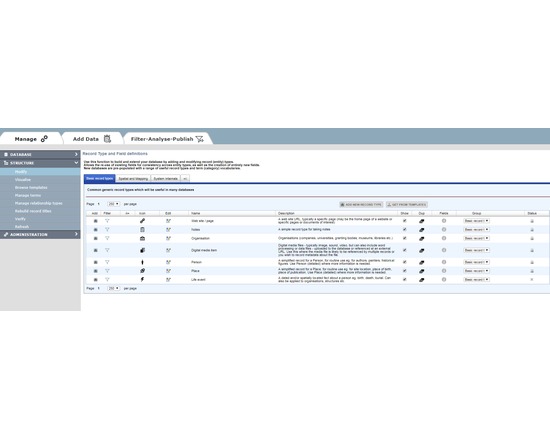
HEURIST (http://HeuristNetwork.org) is an extremely flexible, end-user oriented, web-based data management system designed specifically for Humanities data. Developed since 2005, it has been in active use across many projects since 2009. It is available both as a free web service for researchers (hosted at the University of Sydney Data Centre) or for installation on a physical or virtual server (Open Source on gitHub). Researchers can design, create, manage, analyse, visualise and publish their own richly-structured database(s) through a simple web interface, without the need for programmer(s). Quite complex databases can be built in a few hours by borrowing structures and vocabularies published by other users. Databases can be designed and built incrementally, as existing data are not affected by changes in structure. Databases created by Heurist are stored in MySQL with a repeatable structure facilitating sustainability and independent access by other software. Advanced features include record linking, graph structure, drill-down facet searches, rule-based queries, custom reports, linked map-timelines, network visualisation, normalised spreadsheet import, crosstabulation, XML feeds, XSLT transforms. The team provides initial email and skype assistance for project setup at no cost, and special customisations at modest cost. Heurist is applicable in many domains including History, Archaeology, Anthropology, Cultural Research, Linguistics, Media Studies etc. It handles everything from text, tags and categories, through networks of rich relationships and offset annotations, to images, video, spatial data and dating (including non-western systems and dating uncertainty). Sophisticated searches (including faceted and rule-based) can be saved, organised and rendered as layered interactive maps, timelines, network visualisations, crosstabulations, lists, custom reports, XML and XSLT transforms, all of which can easily be printed or embedded (live) in a website - Heurist provides the html code required to embed results in a web page or CMS. Databases can easily be migrated later to a personal or institutional server. Since the data are stored in a standard MySQL database with a fixed and well-documented structure, the data can be accessed directly via SQL from most programming languages independently of Heurist. Version 4.2 (Jan 2016 onwards) is available as a service via the Heurist website. Version 4 delivers a user-customisable interface of widgets, along with better mapping and visualisation. Existing version 3 databases are bidirectionally compatible with version 4.

Rated 5.0 out of 5.

Annotating

Omeka

Omeka is a content management system designed for the display of library, museum, archives, and scholarly collections and exhibitions. Omeka falls at a crossroads of Web Content Management, Collections Management, and Archival Digital Collections Systems. Omeka is designed with non-IT specialists in mind, allowing users to focus on content and interpretation rather than programming. It brings Web 2.0 technologies and approaches to academic and cultural websites to foster user interaction and participation. It makes top-shelf design easy with a simple and flexible templating system. Its robust open-source developer and user communities underwrite Omeka’s stability and sustainability. Omeka allows users to publish cultural heritage objects, extend its functionality with themes and plugins, and curate online exhibits with digital objects.

Rated 5.0 out of 5.

Annotating

Omeka.net

Omeka.net provides a web-publishing platform to curate collections and create exhibitions of digitized content. Omeka.net has grown out of the Omeka project. Omeka.net provides some of the same functionality as Omeka, but does not require the user to provide hosting or to maintain their installation in any way. However, use of Omeka.net limits customization, and hosting more than 500MB of content requires a paid account. Objects in the collection can be cataloged with Dublin core metadata fields and georeferenced for display on a map. Omeka.net includes several plugins, including COinS (which makes objects in Omeka accessible to citations management software, like Zotero), HTML5 Media (to play audio and video), and Library of Congress Suggest (which will auto-populate fields with LoC authority and subject headings).

Rated 4.0 out of 5.

Annotating

A.nnotate

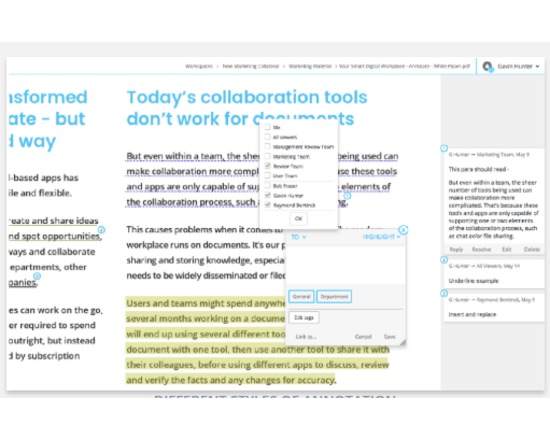
A.nnotate is the flagship product of Textensor Limited which was incorporated in Edinburgh, Scotland in 2005.Today A.nnotate is used online by thousands of individuals and groups who need to store or share comments on documents, web pages or images.

Rated 0.0 out of 5.

Annotating

Advene

The cross-platform Advene application allows users to easily create comments and analyses of video documents, through the definition of time-aligned annotations and their mobilisation into automatically-generated or user-written comment views (HTML documents). Annotations can also be used to modify the rendition of the audiovisual document, thus providing virtual montage, captioning, navigation... capabilities. Users can exchange their comments/analyses in the form of Advene packages, independently from the video itself. The Advene framework provides models and tools allowing to design and reuse annotations schemas; annotate video streams according to these schemas; generate and create Stream-Time Based (mainly video-centred) or User-Time Based (mainly text-centred) visualisations of the annotations. Schemas (annotation- and relation-types), annotations and relations, queries and views can be clustered and shared in units called packages. Hypervideo documents are generated when needed, both from packages (for annotation and view description) and DVDs (audiovisual streams).

Rated 0.0 out of 5.

Annotating

ANNIS (ANNotation of Information Structure)

ANNIS (ANNotation of Information Structure), now in version 3.4.3, is an open source browser-based visualization architecture designed to annotate complex multilevel linguistic corpora. Now in its second version, ANNIS enables users to concurrently annotate, query and visualize data for syntax, semantics, morphology, prosody, referntiality, lexis and so forth. It also offers support for spoken language and audio and visual annotation.

Rated 0.0 out of 5.

›

Curated lists

Curated list created by experience authors in the fields.

All curated lists

Geoffrey Rockwell

Cool Voyant Tools

Not all Voyant tools show up in the default view or skin. Here is a list of some of the other tools worth trying.

4 tools

View list

Holly Pickering

Audio Production Software

Interested in audio production and editing? Here are a few programs that can help you get on your way. Some of them are free, some not, but all are helpful and useful.

3 tools

View list

Jason Bradshaw

TATR: Text Analysis for Twitter Research

This list compiles a suite of tools that make up Kynan Ly's Text Analysis for Twitter Research (TATR) Library. Recipes to these notebooks can be found on methodi.ca

6 tools

View list

The catalogue

  • 1321

    Tools catalogued

  • 15

    Curated lists

  • 22

    Analysis types

  • 671

    Community reviews

More is coming

Researchers, power users, and students will soon be able to contribute tools, share reviews, and curate lists around their own work.