Skip to content
TAPoR Text Analysis Portal for Research

For researchers who work with text

Find a text analysis tool that fits the work.

TAPoR catalogues concordancers, annotators, topic models, stylometry packages, and visualization environments. Every record notes the platform, the license, and what the tool is actually good for.

  • Platform, license, and method on every record
  • Reviews from people who teach with the tools
  • Lists assembled around a course or a corpus

Browse tools

Filter by the type of analysis.

View all tools
‹

Annotating

Intelligent Archive

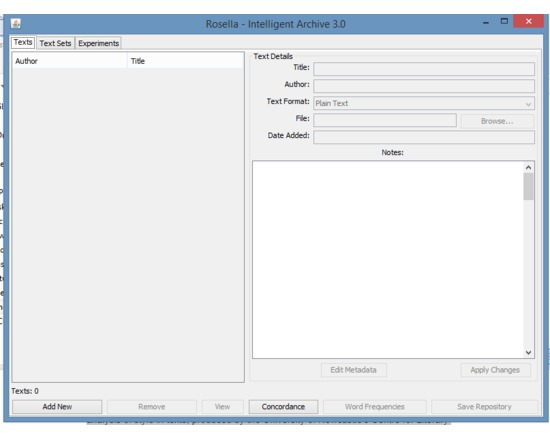
Intelligent Archive is a Java application for stylometry, or computational and statistical analysis of style in texts, produced by the University of Newcastle's Centre for Literary and Linguistic Computing (CLLC). It can handle corpora of plain text, HTML, XML and TEI texts. IA enables you to easily organise texts into sets, manage metadata, generate word frequencies, handle XML tags, and split texts in various ways to generate results that can be exported for further analysis in statistical software. It includes some experimental stylometry techniques developed at the CLLC and special features for handling literary texts such as generating word frequencies for speaking characters in plays.
Rated 0.0 out of 5.

Annotating

JuxtaEditions (HumEdit)

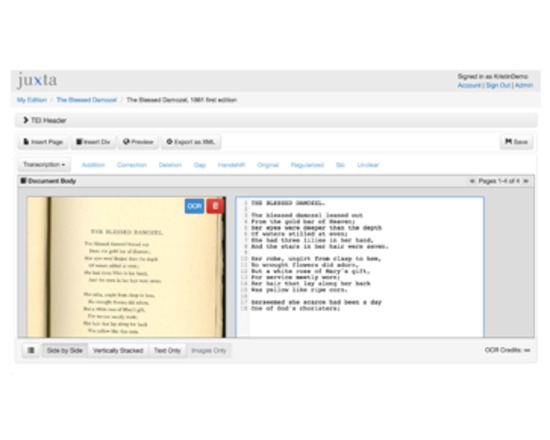
Built inside Juxta Editions is the HumEdit editor. HumEdit provides an easy to learn environment for transcribing, editing, and marking up text. Whether you are working with a printed page or a manuscript leaf, you will find that you spend more time to focused on your objects of study with HumEdit.

Rated 0.0 out of 5.

Annotating

LitBlitz Literature Notes Manager

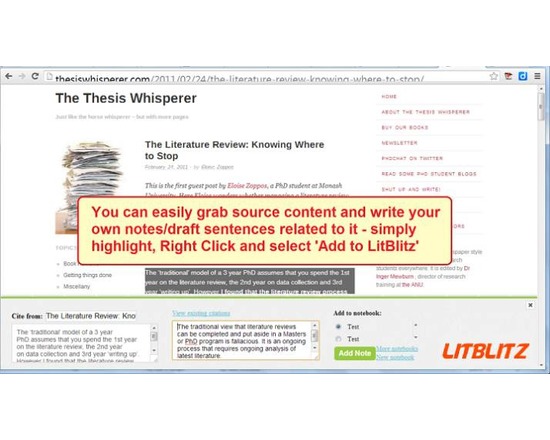
LitBlitz is free beta Chrome extension that aims to improve how students and researchers manage their notes for literature reviews, assignment research and more by simplifying pdf management, allowing capture and annotation of document snippets LitBlitz v1.0 is currently available as a Google Chrome extension. LitBlitz, while still available on the Google Chrome store (https://chrome.google.com/webstore/detail/litblitz-speed-up-your-li/ohmfdhillclkchlgoifgokmdjhonmgao?authuser=4&hl=en) no longer appears to be under development, and the company url redirects to a Japanese language web page.

Rated 0.0 out of 5.

Annotating

Manifold

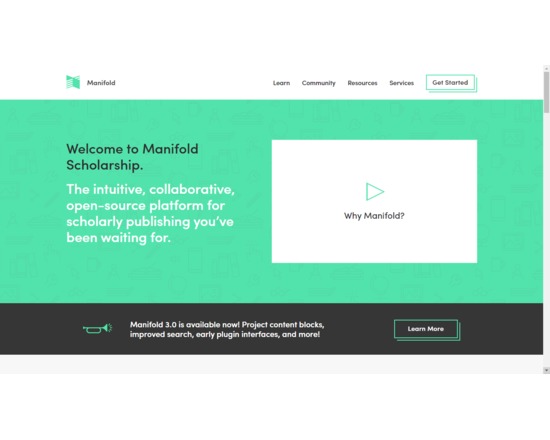
Manifold Scholarship is an open-source publishing platform that enables authors and publishers a means to showcase and enhance the electronic content they already produce in their existing workflows: texts are displayed in a responsive, elegant reader crafted for all modern browsers and devices—desktop and mobile. Powerful built-in annotation and commenting systems allow readers to annotate, highlight, discuss, cite, and share passages from any Manifold text. Resources that are foundational to a particular discussion but that are often tabled because of physical, technical, logistic, or legal limitations can be layered dynamically and directly onto the digital text. And with Manifold, a new kind of publication is possible, one where authors create projects that grow iteratively and that are published online as they are created and then later in print, when they have been codified as versions of record. In short, Manifold transforms scholarly publications into living digital works.

Rated 0.0 out of 5.

Annotating

Map Warper

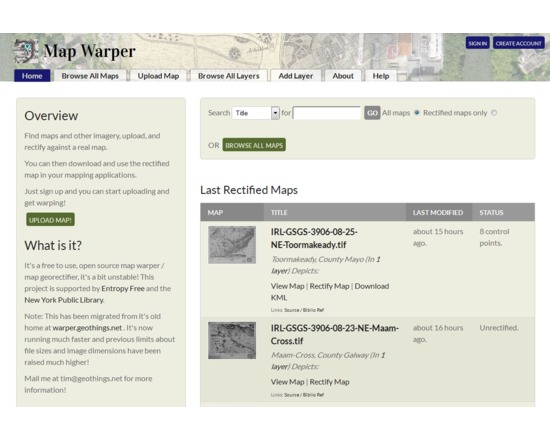
This is an open source platform for georectifying scanned images of maps, so that they can be displayed in web maps or used in GIS applications. It could be particularly useful for creating map overlays for Google Earth or similar applications, without using specialized desktop software. Map images must first be uploaded and made publicly available, and then by aligning with Open Street Map reference data, the maps are warped into georeferenced images. Georectified images are downloadable as GeoTIFF, PNG, or KML files, along with map tiles or WMS capabilities. The same platform was used for NYPL Map Warper and WorldMap Warp.

Rated 0.0 out of 5.

Annotating

MapHub

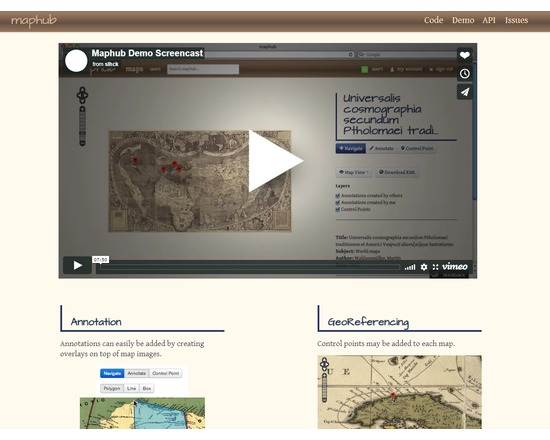
Maphub is a web portal for georeferencing and annotating digitized historic maps. Georeferencing transforms the map image to align with real world geographic coordinates, while the annotations are overlaps plus notes. Maphub suggests possible tags for the annotation based on its text and location; tags link to related Wikipedia articles. Once created, user-contributed annotations are shared via the Maphub Open Annotation API. A first prototype of Maphub, using digitized maps from the Library of Congress’ Map Division, can be found at http://maphub.herokuapp.com/.

Rated 0.0 out of 5.

›

Curated lists

Curated list created by experience authors in the fields.

All curated lists

Geoffrey Rockwell

Cool Voyant Tools

Not all Voyant tools show up in the default view or skin. Here is a list of some of the other tools worth trying.

4 tools

View list

Holly Pickering

Audio Production Software

Interested in audio production and editing? Here are a few programs that can help you get on your way. Some of them are free, some not, but all are helpful and useful.

3 tools

View list

Jason Bradshaw

TATR: Text Analysis for Twitter Research

This list compiles a suite of tools that make up Kynan Ly's Text Analysis for Twitter Research (TATR) Library. Recipes to these notebooks can be found on methodi.ca

6 tools

View list

The catalogue

  • 1321

    Tools catalogued

  • 15

    Curated lists

  • 22

    Analysis types

  • 671

    Community reviews

More is coming

Researchers, power users, and students will soon be able to contribute tools, share reviews, and curate lists around their own work.