Skip to content
TAPoR Text Analysis Portal for Research

For researchers who work with text

Find a text analysis tool that fits the work.

TAPoR catalogues concordancers, annotators, topic models, stylometry packages, and visualization environments. Every record notes the platform, the license, and what the tool is actually good for.

  • Platform, license, and method on every record
  • Reviews from people who teach with the tools
  • Lists assembled around a course or a corpus

Browse tools

Filter by the type of analysis.

View all tools
‹

Natural Language Processing

Quanteda

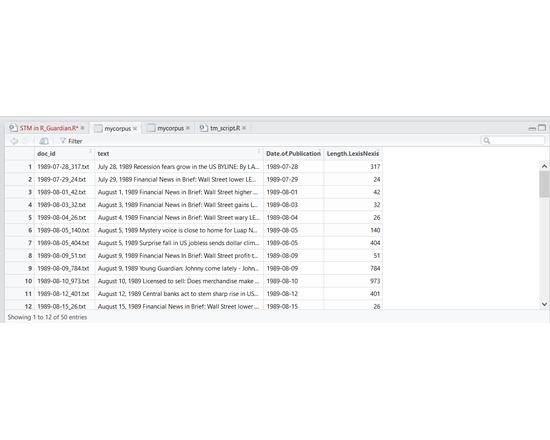
quanteda is an R package for managing and analyzing textual data. The package is designed for R users needing to apply natural language processing to texts, from documents to final analysis. It is free and open source. Some of its functions are: Tokenizing, corpus building, topic modeling, visualizations, text similarity measures.
Rated 0.0 out of 5.

Natural Language Processing

REDUX

REDUX was a natural language processing program for making generalizations from cases such as case studies, legal cases, case histories and so forth. It searched for repeated patterns, and was presented as a metalanguage for the analysis of the behavior of types.

Rated 0.0 out of 5.

Natural Language Processing

RiTa

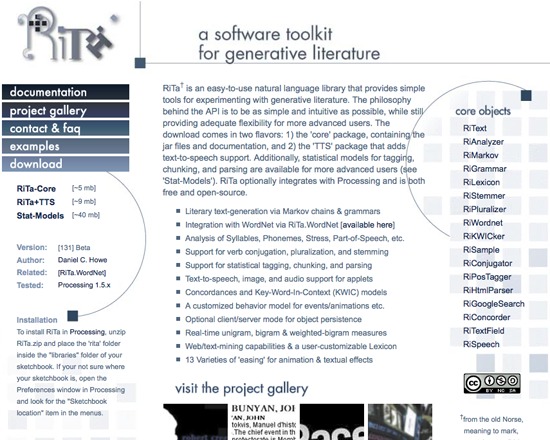
RiTa is a free, open-source natural language library for work with generative literature, offered as both a 'core' package of jar files and documentation, and a text-to-speech package. It is designed to be simple and intuitive while still offering flexibility to advanced users via statistical models for tagging, chunking and parsing. RiTa may also be integrated with Processing.

Rated 0.0 out of 5.

Natural Language Processing

RQDA

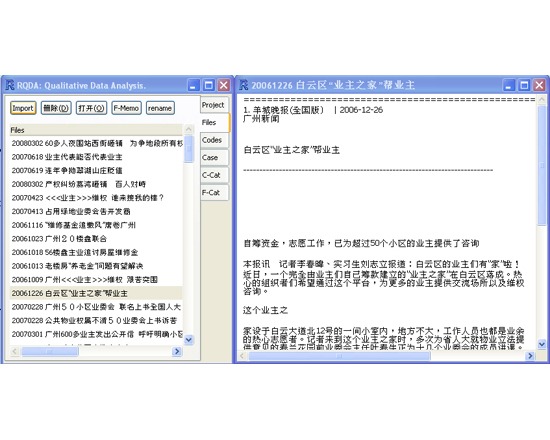
RQDA is a free R package for qualitative analysis, developed specifically to analyze textual data. It is available for Windows, Linux/FreeBSD and Mac OS X. It currently requires texts to be in plain text format. RQDA supports non-English texts, and has been tested with Simplified Chinese in particular.

Rated 0.0 out of 5.

Natural Language Processing

SALEM

SALEM was a system for natural language processing developed in the 1970s. It was written in standard FORTRAN, and automated lemmatization of German texts. Its main component was a program known as SATAN (Saarbrucker Automatische Text-analyse).

Rated 0.0 out of 5.

Natural Language Processing

SALT (Statistic Analysis of Language Transcripts)

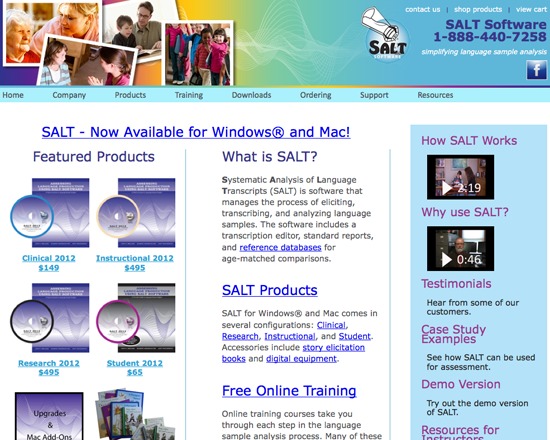
SALT (Systemic Analysis of Language Transcripts) is a commercial software package for working with large datasets derived from transcripts. It includes transcription tools, text analysis based on natural language processing, content analysis, classification, and statistics. The Research version includes expanded search and metadata functions, and common text analysis functions such as word lists. A trial version is available.

Rated 0.0 out of 5.

›

Curated lists

Curated list created by experience authors in the fields.

All curated lists

Geoffrey Rockwell

Cool Voyant Tools

Not all Voyant tools show up in the default view or skin. Here is a list of some of the other tools worth trying.

4 tools

View list

Holly Pickering

Audio Production Software

Interested in audio production and editing? Here are a few programs that can help you get on your way. Some of them are free, some not, but all are helpful and useful.

3 tools

View list

Jason Bradshaw

TATR: Text Analysis for Twitter Research

This list compiles a suite of tools that make up Kynan Ly's Text Analysis for Twitter Research (TATR) Library. Recipes to these notebooks can be found on methodi.ca

6 tools

View list

The catalogue

  • 1321

    Tools catalogued

  • 15

    Curated lists

  • 22

    Analysis types

  • 671

    Community reviews

More is coming

Researchers, power users, and students will soon be able to contribute tools, share reviews, and curate lists around their own work.