Skip to content
TAPoR Text Analysis Portal for Research

For researchers who work with text

Find a text analysis tool that fits the work.

TAPoR catalogues concordancers, annotators, topic models, stylometry packages, and visualization environments. Every record notes the platform, the license, and what the tool is actually good for.

  • Platform, license, and method on every record
  • Reviews from people who teach with the tools
  • Lists assembled around a course or a corpus

Browse tools

Filter by the type of analysis.

View all tools
‹

Natural Language Processing

I Write Like

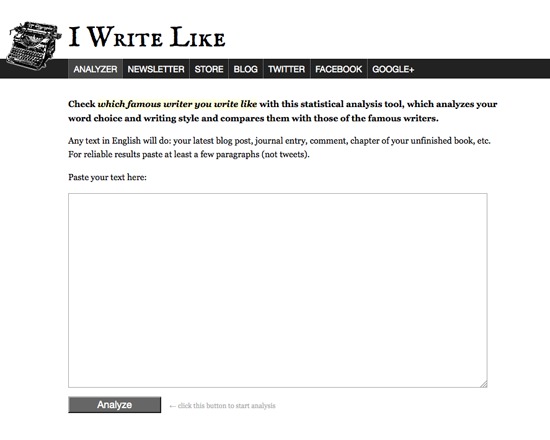
I Write Like is a free, web-based text analysis tool that compares a user-provided text to the prose of well-known writers using statistics, word choice and writing style analysis. It then reports on which writer the text most resembles. The tool requires at least two paragraphs of text for best results. At this time, the results are limited to the name of a writer, without offering more detailed insight into the analysis; the tool appears to be offered primarily to promote the Memoires journaling software.
Rated 1.5 out of 5.

Natural Language Processing

Alteryx

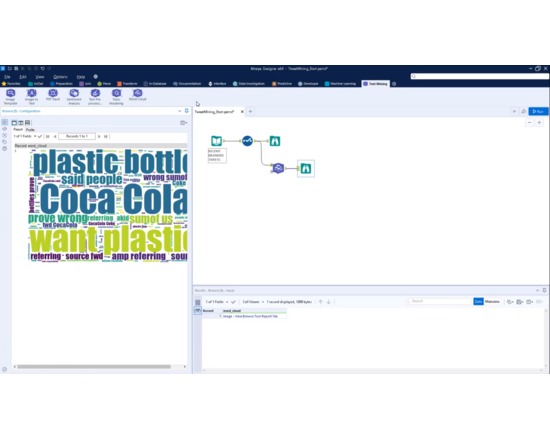
Alteryx is an online commercial data analysis service. Among its capabilities are optical character recognition, sentiment analysis, and topic modeling with Text Mining. You can quickly build predictive models without coding through its intuitive graphical user interface. It has many visualisation options among which is the word cloud.

Rated 0.0 out of 5.

Natural Language Processing

Alveo

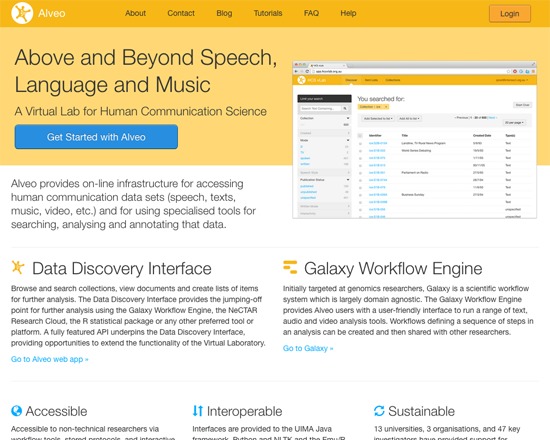
Alveo is a platform for data discovery and analysis focused on communication data such as speech, text or video. Developed by the University of Western Sydney, researchers can use the Alveo infrastructure to store data, create collections, develop workflows, and analyze datasets with Alveo's built-in tools. The tools available span multiple disciplines and include common functions such as tokenization and concordance, plus interfaces between Alveo and other common analysis tools such as Apache's UIMA for NLP, and with programming languages such as Python and Java. Users can segmented and recombined data from multiple collections into a new, focused dataset for close analysis. Collection creators can set their own license and access rights, and users of a collection must accept the creator's conditions in order to use data from it. User accounts are free, but must be requested from and approved by Alveo.

Rated 0.0 out of 5.

Natural Language Processing

Amazon Comprehend

Amazon Comprehend is a natural language processing (NLP) service that uses machine learning to find insights and relationships in text. No machine learning experience required. There is a treasure trove of potential sitting in your unstructured data. Customer emails, support tickets, product reviews, social media, even advertising copy represents insights into customer sentiment that can be put to work for your business. The question is how to get at it? As it turns out, Machine learning is particularly good at accurately identifying specific items of interest inside vast swathes of text (such as finding company names in analyst reports), and can learn the sentiment hidden inside language (identifying negative reviews, or positive customer interactions with customer service agents), at almost limitless scale. Amazon Comprehend uses machine learning to help you uncover the insights and relationships in your unstructured data. The service identifies the language of the text; extracts key phrases, places, people, brands, or events; understands how positive or negative the text is; analyzes text using tokenization and parts of speech; and automatically organizes a collection of text files by topic. You can also use AutoML capabilities in Amazon Comprehend to build a custom set of entities or text classification models that are tailored uniquely to your organization’s needs.

Rated 0.0 out of 5.

Natural Language Processing

Apache Open NLP

Apache OpenNLP is a free, open source toolkit for processing natural language text, based on machine learning. It includes common natural language processing functions such as tokenization, sentence segmentation, part-of-speech tagging, named entity extraction, chunking, parsing, and coreference resolution.

Rated 0.0 out of 5.

Natural Language Processing

Apache UIMA

Apache UIMA (Unstructured Information Management application) is a software system for analyzing large amounts of unstructured data, such as a plain text document, and identifying entities, such as persons, places, organizations, or relations between entities. Discrete components (written in Java or C++) may be used within the application, such as language identification or entitiy detection. Each component provides self-describing metadata via XML descriptor files.

Rated 0.0 out of 5.

›

Curated lists

Curated list created by experience authors in the fields.

All curated lists

Geoffrey Rockwell

Cool Voyant Tools

Not all Voyant tools show up in the default view or skin. Here is a list of some of the other tools worth trying.

4 tools

View list

Holly Pickering

Audio Production Software

Interested in audio production and editing? Here are a few programs that can help you get on your way. Some of them are free, some not, but all are helpful and useful.

3 tools

View list

Jason Bradshaw

TATR: Text Analysis for Twitter Research

This list compiles a suite of tools that make up Kynan Ly's Text Analysis for Twitter Research (TATR) Library. Recipes to these notebooks can be found on methodi.ca

6 tools

View list

The catalogue

  • 1321

    Tools catalogued

  • 15

    Curated lists

  • 22

    Analysis types

  • 671

    Community reviews

More is coming

Researchers, power users, and students will soon be able to contribute tools, share reviews, and curate lists around their own work.