Skip to content
TAPoR Text Analysis Portal for Research

For researchers who work with text

Find a text analysis tool that fits the work.

TAPoR catalogues concordancers, annotators, topic models, stylometry packages, and visualization environments. Every record notes the platform, the license, and what the tool is actually good for.

  • Platform, license, and method on every record
  • Reviews from people who teach with the tools
  • Lists assembled around a course or a corpus

Browse tools

Filter by the type of analysis.

View all tools
‹

Natural Language Processing

Stanford NLP Group: Stanford Phrasal

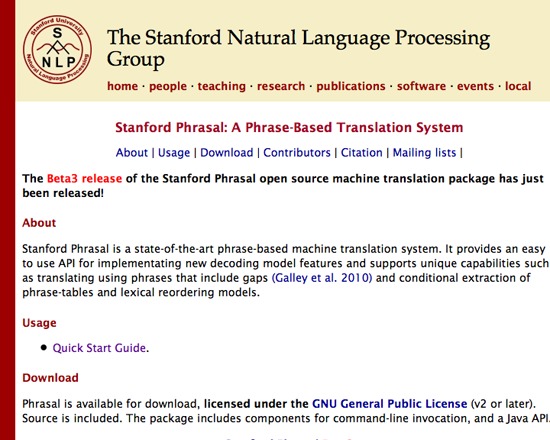
Stanford Phrasal is a a free Java implementation for phrase-based machine translation. It provides an easy to use API for implementating new decoding model features and supports unique capabilities such as translating using phrases that include gaps and conditional extraction of phrase-tables and lexical reordering models.
Rated 0.0 out of 5.

Natural Language Processing

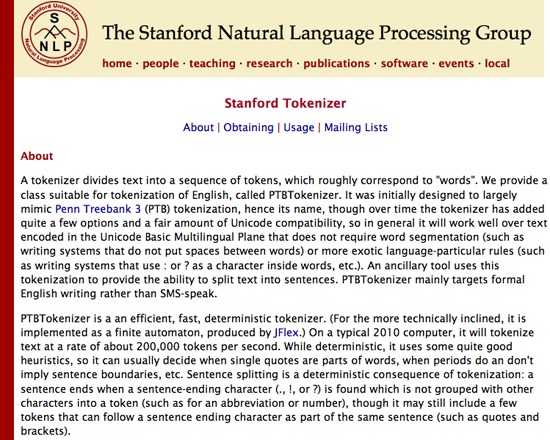
Stanford NLP Group: Stanford Tokenizer

Stanford Tokenizer is a free Java implementation for diving an English text into tokens such as words, and a part of the Stanford Natural Language Processing toolset. This tool is not available on its own, but is bundled with other tools in the same set, including Stanford Parser, Stanford Part-of-Speech Tagger, Stanford Named Entity Recognizer, and Stanford CoreNLP.

Rated 0.0 out of 5.

Natural Language Processing

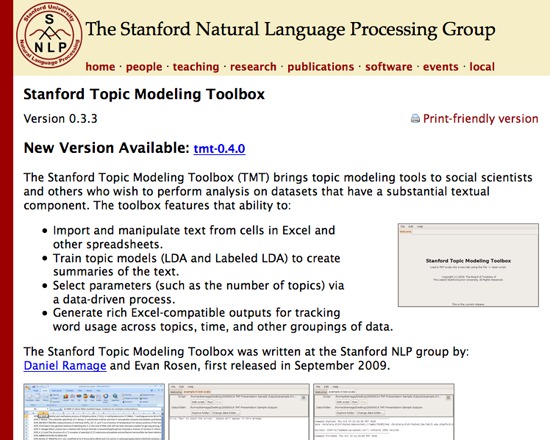
Stanford NLP Group: Stanford Topic Modelling Toolbox

Stanford Topic Modelling Toolbox is a free collection of topic modelling tools, and a part of the Stanford Natural Language Processing toolset. It is designed for social scientists and other users who need to analyze datasets with a substantial textual component. This tool can accept and generate tab-separated and comma-separated values, and is designed to work in combination with spreadsheet programs like Excel.

Rated 0.0 out of 5.

Natural Language Processing

Stanford NLP Group: Stanford Tregex and Tsurgeon

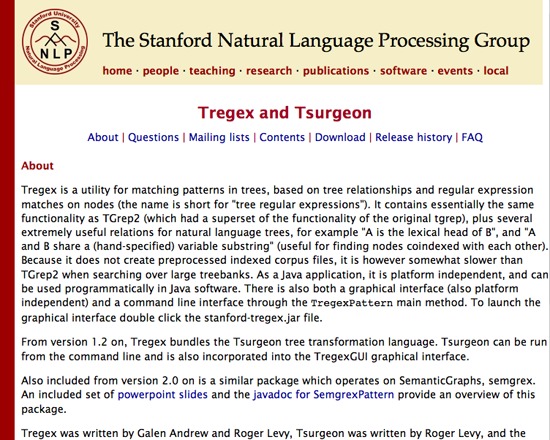
Stanford Tregex and Tsurgeon is a bundled pair of tools from the Stanford Natural Language Processing toolset. Tregex is a utility for using tree relationships and regular expressions to match patterns in trees, while Tsurgeon is a tree transformation language.

Rated 0.0 out of 5.

Natural Language Processing

Stanford NLP Group: Stanford Word Segmenter

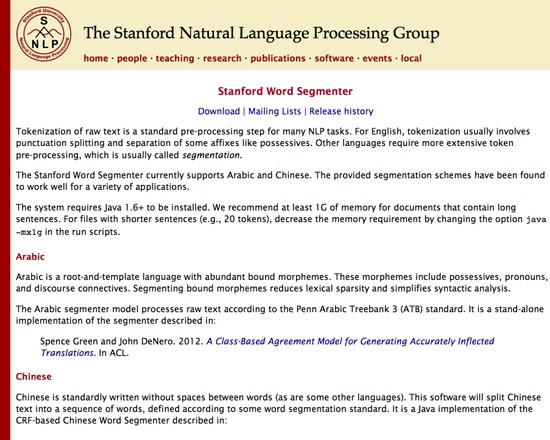
Stanford Word Segmenter is a free, open source Java-based tokenization tool for Chinese and Arabic text that integrates token pre-processing, or segmentation. For Arabic, the tool processes text according to the Penn Arabic Treebank 3 standard. For Chinese, users can choose between the Chinese Penn Treebank or Peking University standards.

Rated 0.0 out of 5.

Natural Language Processing

Stanford Sentiment Analysis

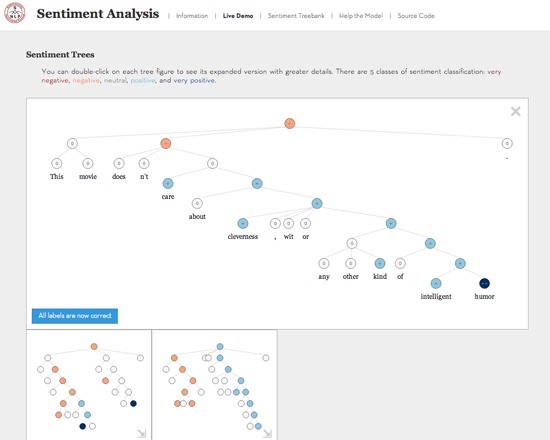
The Stanford NLP Group's Sentiment Analysis tool is a free, web based live demo based on a sentiment analysis treebank, trained to predict the sentiment in movie reviews. Users can test out the sentiment analysis model with their own text in the box provided. The dataset and code is available for download, and the sentiment analysis model is now integrated into Stanford CoreNLP.

Rated 0.0 out of 5.

›

Curated lists

Curated list created by experience authors in the fields.

All curated lists

Geoffrey Rockwell

Cool Voyant Tools

Not all Voyant tools show up in the default view or skin. Here is a list of some of the other tools worth trying.

4 tools

View list

Holly Pickering

Audio Production Software

Interested in audio production and editing? Here are a few programs that can help you get on your way. Some of them are free, some not, but all are helpful and useful.

3 tools

View list

Jason Bradshaw

TATR: Text Analysis for Twitter Research

This list compiles a suite of tools that make up Kynan Ly's Text Analysis for Twitter Research (TATR) Library. Recipes to these notebooks can be found on methodi.ca

6 tools

View list

The catalogue

  • 1321

    Tools catalogued

  • 15

    Curated lists

  • 22

    Analysis types

  • 671

    Community reviews

More is coming

Researchers, power users, and students will soon be able to contribute tools, share reviews, and curate lists around their own work.