Skip to content
TAPoR Text Analysis Portal for Research

For researchers who work with text

Find a text analysis tool that fits the work.

TAPoR catalogues concordancers, annotators, topic models, stylometry packages, and visualization environments. Every record notes the platform, the license, and what the tool is actually good for.

  • Platform, license, and method on every record
  • Reviews from people who teach with the tools
  • Lists assembled around a course or a corpus

Browse tools

Filter by the type of analysis.

View all tools
‹

Visualization

Prospect

Prospect is a free, open-source data curation and visualization plugin for WordPress, developed by the Digital Innovation Lab at UNC Chapel Hill. Data can be entered into Prospect by importing a formatted CSV file or entering it via a form created automatically by Prospect. Data collections can be inserted into WordPress pages or displayed in visualizations that allow users to explore information space, interpret patterns and access materials.
Rated 0.0 out of 5.

Search

Prospéro (PROgramme de Sociologie Pragmatique, Expérimentale et Réflexive sur Ordinateur)

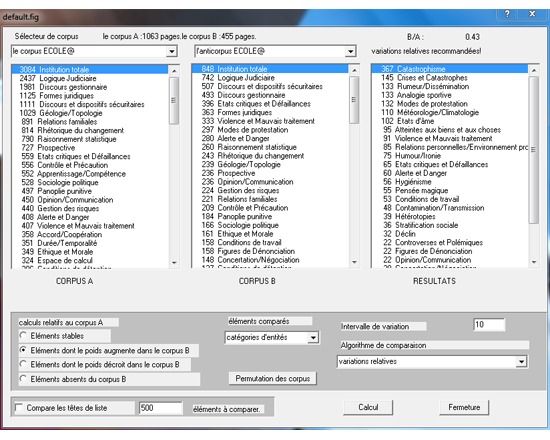
Prospéro (PROgramme de Sociologie Pragmatique, Expérimentale et Réflexive sur Ordinateur) is a free text analysis tool aimed at scholars in the Humanities capable of complex analysis on natural language. It permits users to classify and track records or thematic sets within a text or corpus for the purpose of exploration, analysis and comparison. It identifies places in a text that display uncertainty, controversy, criticism, and enables the user to establish rule and meta-rules to separate factual statements from views and interpretations. Prospéro is particularly designed for complex cases composed of large texts containing heterogenous discourse.

Rated 0.0 out of 5.

Protégé

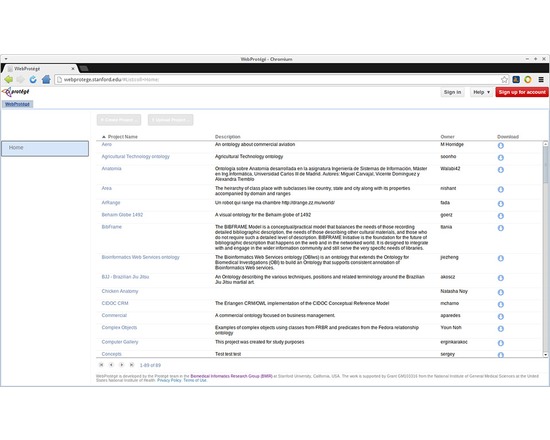
The Protege Project offers WebProtege and Protege Desktop, which are free and open source ontology editing applications. WebProtégé is an ontology development environment for the Web that makes it easy to create, upload, modify, and share ontologies for collaborative viewing and editing. WebProtégé fully supports the latest OWL 2 Web Ontology Language. The highly configurable user interface creates the perfect environment for beginners and experts alike. Collaboration features abound, including sharing and permissions, threaded notes and discussions, watches and email notifications. RDF/XML, Turtle, OWL/XML, OBO, and other formats available for ontology upload and download. Protégé Desktop is a feature rich ontology editing environment with full support for the OWL 2 Web Ontology Language, and direct in-memory connections to description logic reasoners like HermiT and Pellet. Protégé Desktop supports creation and editing of one or more ontologies in a single workspace via a completely customizable user interface. Visualization tools allow for interactive navigation of ontology relationships. Advanced explanation support aids in tracking down inconsistencies. Refactor operations available including ontology merging, moving axioms between ontologies, rename of multiple entities, and more.

Rated 0.0 out of 5.

Visualization

Protovis

Protovis composes custom views of data with simple marks such as bars and dots. Unlike low-level graphics libraries that quickly become tedious for visualization, Protovis defines marks through dynamic properties that encode data, allowing inheritance, scales and layouts to simplify construction. Protovis is free and open-source, provided under the BSD License. It uses JavaScript and SVG for web-native visualizations; no plugin required (though you will need a modern web browser)! Although programming experience is helpful, Protovis is mostly declarative and designed to be learned by example. Protovis is no longer being developed. The developers have moved on to a new visualization library, D3.

Rated 0.0 out of 5.

Proxémie

A French-developed Java application that displays the lexical relations of a word in a 3D environment.

Rated 0.0 out of 5.

Visualization

Ptolemaic

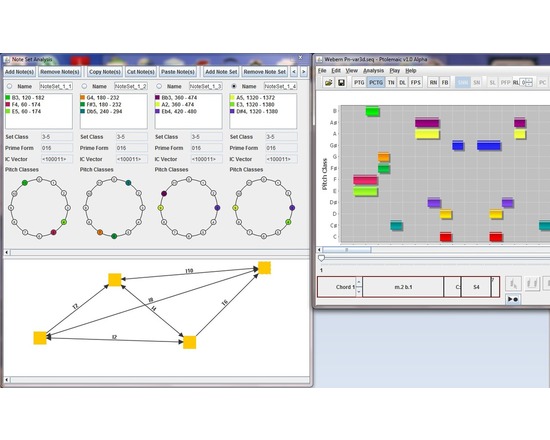
Ptolemaic is a computer application for music visualization and analysis written in the Java programming language. The software is designed to aid in the analysis of all types of Western music using established analytical techniques, including tonal functional analysis (Harrison 1994), pitch-class set analysis (Forte 1973), hierarchical linear analysis (Schenker 1935, Jones 2002), tonal pitch-space analysis on the Tonnetz (Riemann 1915), pitch-class set analysis (Forte 1973), and transformation analysis (Lewin 1987). Musical works and excerpts may be opened and saved using the de-facto standard music notation interchange format, MusicXML. To assist in analysis, Ptolemaic can display the music on a pitch/time graph, on a pitch-class/time graph, on a step-class/time graph (also called a diatonic lattice) (Jones 2002), on the Tonnetz, or using filtered point-symmetry (Douthett 2008). Pitch classes and chords are color coded so that the user can easily correlate them across each graph. The benefit of having a software tool to visualize and perform certain analysis tasks is in automating processes that are normally time-consuming for the musician, thus allowing the music scholar to focus on the musical issues, rather than the technical issues of graphing, and calculating chord classes. Ptolemaic provides useful ways of visualizing a piece of music and tools for gaining more information about that music, so that the user can efficiently make informed musical decisions about the music and preserve that analysis for future study.

Rated 0.0 out of 5.

›

Curated lists

Curated list created by experience authors in the fields.

All curated lists

Geoffrey Rockwell

Cool Voyant Tools

Not all Voyant tools show up in the default view or skin. Here is a list of some of the other tools worth trying.

4 tools

View list

Holly Pickering

Audio Production Software

Interested in audio production and editing? Here are a few programs that can help you get on your way. Some of them are free, some not, but all are helpful and useful.

3 tools

View list

Jason Bradshaw

TATR: Text Analysis for Twitter Research

This list compiles a suite of tools that make up Kynan Ly's Text Analysis for Twitter Research (TATR) Library. Recipes to these notebooks can be found on methodi.ca

6 tools

View list

The catalogue

  • 1321

    Tools catalogued

  • 15

    Curated lists

  • 22

    Analysis types

  • 671

    Community reviews

More is coming

Researchers, power users, and students will soon be able to contribute tools, share reviews, and curate lists around their own work.