Skip to content
TAPoR Text Analysis Portal for Research

For researchers who work with text

Find a text analysis tool that fits the work.

TAPoR catalogues concordancers, annotators, topic models, stylometry packages, and visualization environments. Every record notes the platform, the license, and what the tool is actually good for.

  • Platform, license, and method on every record
  • Reviews from people who teach with the tools
  • Lists assembled around a course or a corpus

Browse tools

Filter by the type of analysis.

View all tools
‹

Reframe It

Reframe It was a web browser plugin that created a space for comments in the righthand margin of any webpage. No plugin exists for Chrome, and the Firefox plugin is only available for older versions. Wikipedia lists project status as "unclear" as of May 23, 2014.

Rated 0.0 out of 5.

Organizing

RefWorks

RefWorks allows users to create personal databases and use them for a variety of research activities. References are quickly and easily imported from text files or online databases. The databases can then be used to manage, store, and share the information. Users can automatically insert references from their database into their papers and generate formatted bibliographies and manuscripts in seconds. RefWorks allows you to… Organize and create a personal database online – no more index cards to write out and organize. Everything is done automatically as you import the reference into RefWorks. Format bibliographies and manuscripts in seconds – this saves hours of typing time and decreases the number of errors in creating tedious bibliographies. Easily make changes to your paper and reformat in seconds. Import references from a variety of databases using the already created Import Filters. Manage Alerts – RefWorks has incorporated a RSS feed reader to allow you to establish links to your favorite RSS feeds and import data from those feeds directly into RefWorks. Searching your RefWorks database is fast and easy – RefWorks automatically creates author, descriptor and periodical indexes when importing so you just click on the word to perform the retrieval. Use Quick Search to search all fields for the most comprehensive results or Advanced Search to narrow your search to specific terms and fields.

Rated 0.0 out of 5.

Visualization

RelFinder

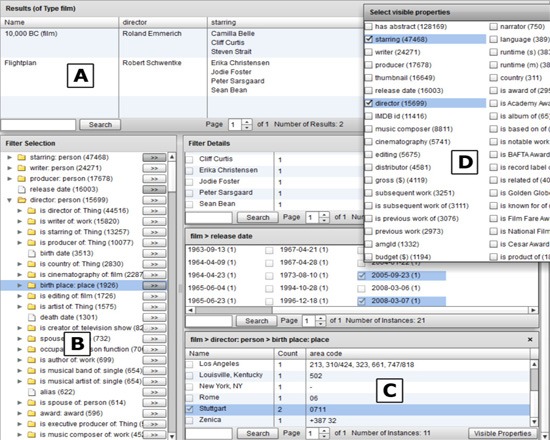
RelFinder is an RDF relationship discovery tool developed as part of the Visual Data Web toolset and based on the Adobe Flex open source framework. It is designed to provide an overview of RDF data through interactive visualization and exporation. Features include highlighting and filtering, and the tool permits both global and detail views. It is optimized for RDF data that provided standard SPARQL access.

Rated 0.0 out of 5.

Organizing

ResCarta Toolkit

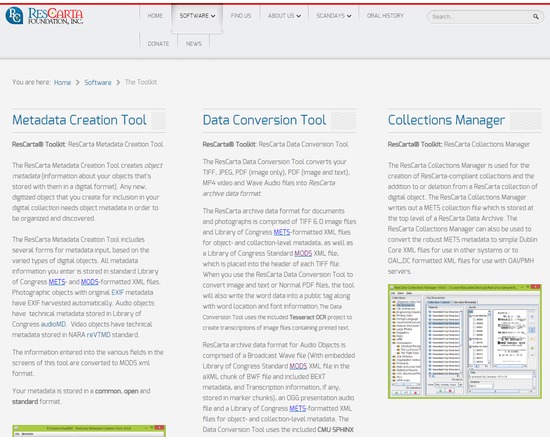
The ResCarta Toolkit is professional grade software designed to build and organize your digital collections.

Rated 0.0 out of 5.

Search

Reviews in Digital Humanities (RDH)

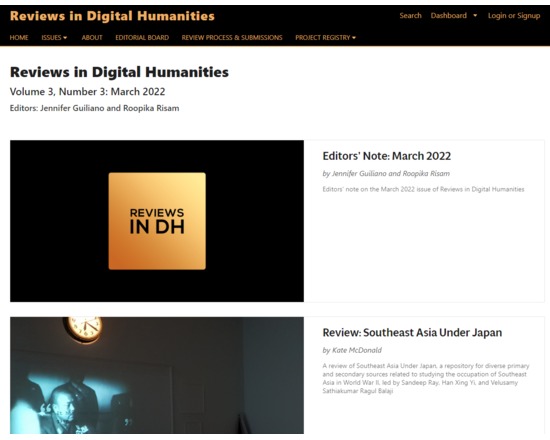
Reviews in Digital Humanities is a pilot of a peer-reviewed journal that facilitates scholarly evaluation of digital humanities work and its outputs. This may include, but is not limited to: digital archives, multimedia or multimodal scholarship, digital exhibits, visualizations, digital games, digital tools, and digital projects. The journal is hosted by PubPub. The journal responds to the challenge of the growth of the number and scale of digital projects outpacing review opportunities in existing journals. As such, it intervenes by bridging a gap in the evaluation of digital projects by arranging for peer review of digital scholarship. Project creators can submit their projects for review. RDH publishes monthly issues with an average of 5 reviews per issue. It also contains a registry of projects, some of which have not yet been reviewed. As of June 2022, Reviews in Digital Humanities has more than 76,800 page views, with 17,350+ unique users from 124 countries. Among fields of study for the projects we have reviewed, 30% of projects are in African diaspora studies, 21% are in Latinx studies, 9% are in Global Indigenous studies, and 19% are in Queer studies. The remaining 21% come from a variety of fields.

Rated 0.0 out of 5.

Natural Language Processing

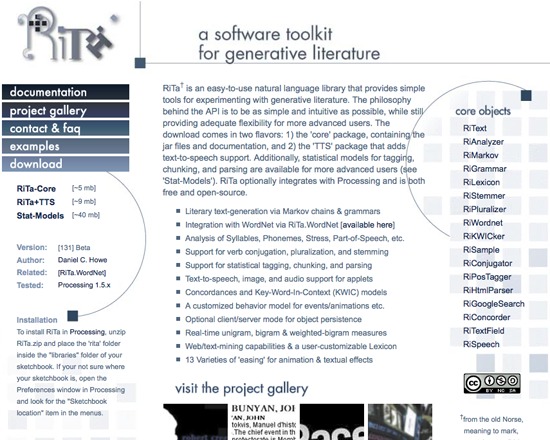
RiTa

RiTa is a free, open-source natural language library for work with generative literature, offered as both a 'core' package of jar files and documentation, and a text-to-speech package. It is designed to be simple and intuitive while still offering flexibility to advanced users via statistical models for tagging, chunking and parsing. RiTa may also be integrated with Processing.

Rated 0.0 out of 5.

›

Curated lists

Curated list created by experience authors in the fields.

All curated lists

Geoffrey Rockwell

Cool Voyant Tools

Not all Voyant tools show up in the default view or skin. Here is a list of some of the other tools worth trying.

4 tools

View list

Holly Pickering

Audio Production Software

Interested in audio production and editing? Here are a few programs that can help you get on your way. Some of them are free, some not, but all are helpful and useful.

3 tools

View list

Jason Bradshaw

TATR: Text Analysis for Twitter Research

This list compiles a suite of tools that make up Kynan Ly's Text Analysis for Twitter Research (TATR) Library. Recipes to these notebooks can be found on methodi.ca

6 tools

View list

The catalogue

  • 1321

    Tools catalogued

  • 15

    Curated lists

  • 22

    Analysis types

  • 671

    Community reviews

More is coming

Researchers, power users, and students will soon be able to contribute tools, share reviews, and curate lists around their own work.