
Natural Language Processing
SUSS (Sunderland University SENSEVAL System)
SUSS (Sunderland University SENSEVAL System) was an algorithm for word sense disambiguation developed for the inaugural SENSEVAL event in 1998.
For researchers who work with text
TAPoR catalogues concordancers, annotators, topic models, stylometry packages, and visualization environments. Every record notes the platform, the license, and what the tool is actually good for.
Filter by the type of analysis.
Natural Language Processing
SUSS (Sunderland University SENSEVAL System) was an algorithm for word sense disambiguation developed for the inaugural SENSEVAL event in 1998.
Search
SwiftRiver is a free, open source platform for filtering and processing large amounts of information. In particular, it can gather and filter data from common web sources such as email, Twitter or RSS. It also enables users to define 'buckets' according to their own criteria rather than relying on, for example, the information's social media popularity status. Utilizing a combination of filters and buckets, users create 'rivers' of data populated by their chosen sources. Developer Ushahidi has made all code available for general access via Github, though a custom, full-service, hosted version is available for a fee by contacting the company directly.
Visualization
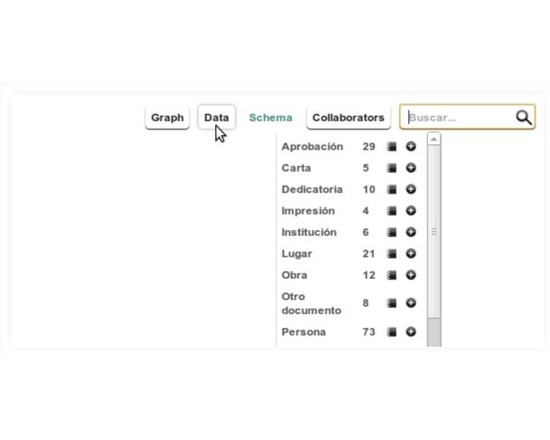
SylvaDB is a graph database management system. It allows users with no knowledge in graph theory to model, collect, query, and analyze data in a network structure. SylvaDB provides tools for easy creation of schemas and modelling, automatic forms creation to input the data, collaborative features, a visual query editor, global and local search, reports charts generation, networks metrics, and visualizations tools.
Analysis
T.A.P (Text Analysis Program) was a program for literary analysis developed in the 1970s at Emory University. It could also generate concordances and word-frequency lists, measure types and tokens, and show collocates for key words defined by the user. T.A.P. was developed in Assembly Language for Emory's UNIVAC Spectra 70/17.
Natural Language Processing
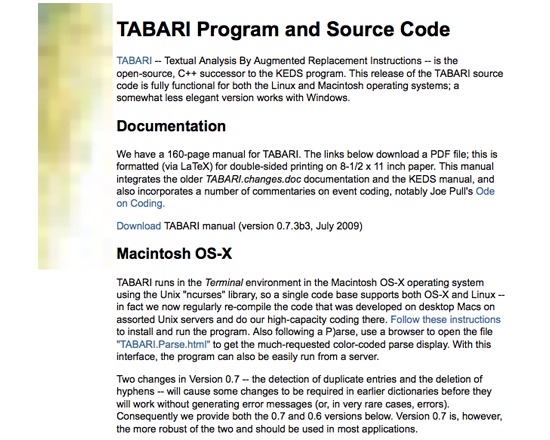
TABARI (Text Analysis By Augmented Replacement Instructions) is a legacy open-source successor to the KEDS program, written in C++ and maintained online to the present in an OS X edition. It runs in the Terminal command prompt, and is designed for analyzing short news stories such as wire service reports. It can determine who is acting against whom, the action and extract the date of the release.
Gathering
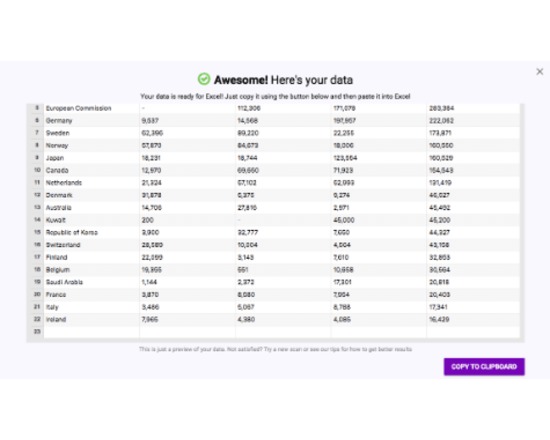
Tabello is a research tool that makes it easy to extract table data from PDFs to Excel. It is optimized for PDFs where tables are found on only a few pages (e.g. annual reports, research reports, academic papers) of a document. With Tabello you simply drag a selection box around the table you want to convert and it instantly becomes ready to paste into Excel. As Tabello comes as a Chrome extension you don't need to download/upload files but continue to work in your browser, making it always available.
Week of 8 Nov – 14 Nov
Three tools from the catalogue, each rated at least 3 stars. A new set appears each Sunday.
Curated list created by experience authors in the fields.

Geoffrey Rockwell
Not all Voyant tools show up in the default view or skin. Here is a list of some of the other tools worth trying.
4 tools
View list
Holly Pickering
Interested in audio production and editing? Here are a few programs that can help you get on your way. Some of them are free, some not, but all are helpful and useful.
3 tools
View list
Jason Bradshaw
This list compiles a suite of tools that make up Kynan Ly's Text Analysis for Twitter Research (TATR) Library. Recipes to these notebooks can be found on methodi.ca
6 tools
View list1321
Tools catalogued
15
Curated lists
22
Analysis types
671
Community reviews
Researchers, power users, and students will soon be able to contribute tools, share reviews, and curate lists around their own work.