Visualization
TerraME
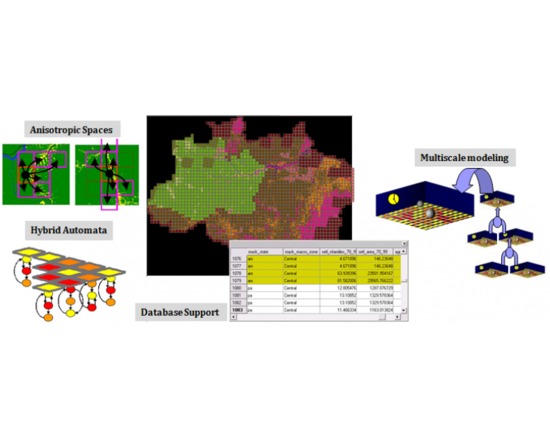
TerraME is a programming environment for spatial dynamical modelling. It supports cellular automata, agent-based models, and network models running in 2D cell spaces. TerraME provides an interface to TerraLib geographical database, allowing models direct access to geospatial data. Its modelling language has in-built functions that makes it easier to develop multi-scale and multi-paradigm models for environmental applications. Two important innovations in TerraME are its use of anisotropic spaces and of hybrid automata models. Anisotropic spaces arise when modeling natural and human-related phenomena. For example, land settlers in a new area do not occupy all places at the same time. They follow roads and rivers, leading to an anisotropic pattern. Anisotropic spaces are implemented in TerraME using Generalized Proximity Matrices (GPM). The GPM is an extension of the usual definition of the spatial relations and include a combination of neighborhood measures in the absolute space and in the relative space. A hybrid automaton is an abstract model for a system whose behavior has discrete and continuous parts. It extends the idea of finite automata to allow continuous change to take place between transitions. Adopting hybrid automata in spatial dynamical models allows complex models which include critical transitions.