Skip to content
TAPoR Text Analysis Portal for Research

For researchers who work with text

Find a text analysis tool that fits the work.

TAPoR catalogues concordancers, annotators, topic models, stylometry packages, and visualization environments. Every record notes the platform, the license, and what the tool is actually good for.

  • Platform, license, and method on every record
  • Reviews from people who teach with the tools
  • Lists assembled around a course or a corpus

Browse tools

Filter by the type of analysis.

View all tools
‹

Content Analysis

Bibliopedia

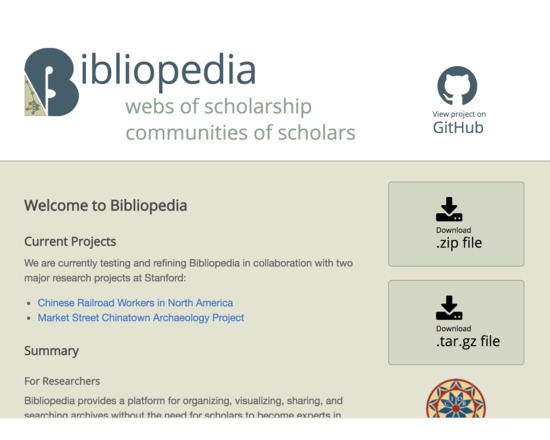
Bibliopedia will perform advanced data-mining and cross-referencing of scholarly literature to create a humanities-centered collaboratory. As a prototype, it will search resources including JSTOR and Library of Congress for metadata about scholarly articles and books that mention the famed medieval travel narrative The Travels of Sir John Mandeville, examine the articles and books for citations, then save the results in a publicly accessible database. Although using works centered around a single text as a test case, Bibliopedia will be designed to work with all humanities scholarship. Bibliopedia will also allow users to create browsable and customizable bibliographies of all the works cited by each article and book. Most importantly, it will use semantic web technology to perform automated textual analysis, data extraction, cross-referencing, and visualizations of the relationships among texts and authors. Bibliopedia will crawl, aggregate, cross-reference, and display multiple scholarly repositories such as JSTOR, Library of Congress, Project Muse, and Google Books. The project will transform bibliographic data that is currently readable only by humans into machine-readable data via semantic web technology, which will make scholarly resources available for automated analyses, inferences, and visualizations.
Rated 0.0 out of 5.

Organizing

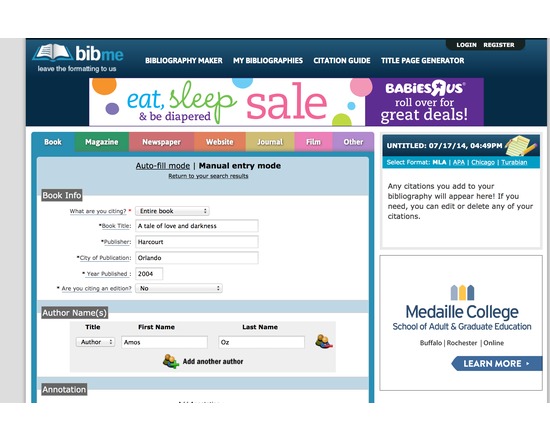
BibMe

BibMe is an automatic bibliography maker that auto-fills information, allowing you to build easily a works cited page. You can download your bibliography in either MLA, APA, Chicago, or Turbian formats.

Rated 0.0 out of 5.

Organizing

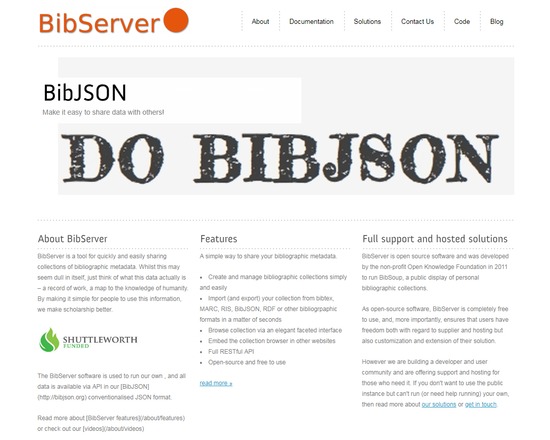
BibServer

BibServer is an open-source RESTful bibliographic data server. BibServer makes it easy to create and manage collections of bibliographic records such as reading lists, publication lists and even complete library catalogs. Its main features include Create and manage bibliographic collections simply and easily Import (and export) your collection from bibtex, MARC, RIS, BibJSON, RDF or other bibliogrpaphic formats in a matter of seconds Browse collection via an elegant faceted interface Embed the collection browser in other websites Full RESTful API

Rated 0.0 out of 5.

BibSonomy

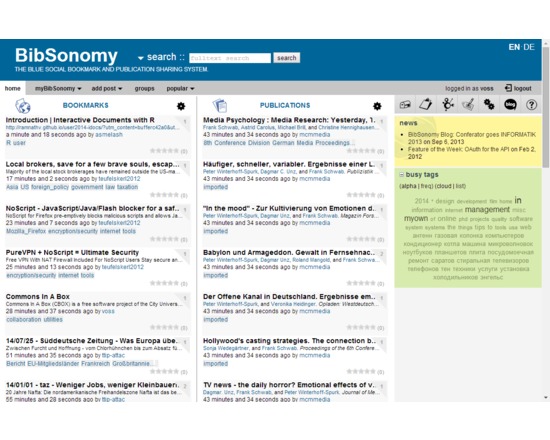
BibSonomy is a social bookmarking and publication-sharing system. It aims to integrate the features of bookmarking systems as well as team-oriented publication management. BibSonomy offers users the ability to store and organize their bookmarks and publication entries and supports the integration of different communities and people by offering a social platform for literature exchange. Both bookmarks and publication entries can be tagged to help structure and re-find information. As the descriptive terms can be freely chosen, the assignment of tags from different users creates a spontaneous, uncontrolled vocabulary: a folksonomy. In BibSonomy, the folksonomy evolves from the participation of research groups, learning communities and individual users, organizing their information needs. Publication posts in BibSonomy are stored in the BibTeX format. Export in other formats such as EndNote or HTML (e. g. for publication list creation) is possible. The service was developed by a team of students and scientists working at the Institute of Knowledge and Data Engineering and is hosted by the University of Kassel in Germany. [Description taken from the Wikipedia article about BiBSonomy]

Rated 0.0 out of 5.

Organizing

Bibus

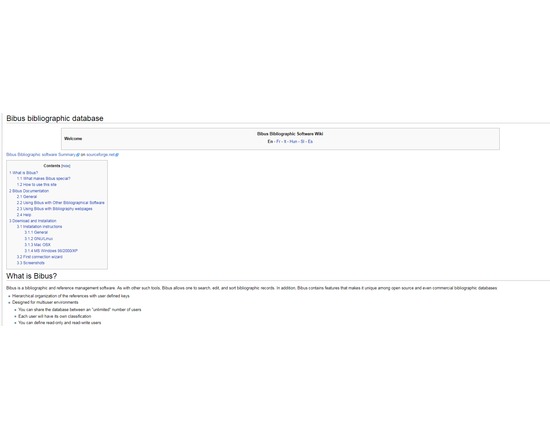
Bibus is a bibliographic and reference management software. As with other such tools, Bibus allows one to search, edit, and sort bibliographic records. In addition, Bibus contains features that makes it unique among open source and even commercial bibliographic databases: Hierarchical organization of the references with user defined keys Designed for multiuser environments Database sharing among an "unlimited" number of users Individual classification for each user Ability to define read-only and read-write users Live queries; that is searches that update as the database changes Online PubMed queries Online eTBLAST queries Insertion of references and formatting of bibliographies into three widely used Word Processors (LibreOffice.org,OpenOffice.org and Microsoft Word) Foreign language support through Unicode and gettext. As of version 1.4, Bibus is available in English, Chinese, Czech, French, German, Hungarian, Portuguese, Slovenian, Spanish.

Rated 0.0 out of 5.

Capture

BITEXT

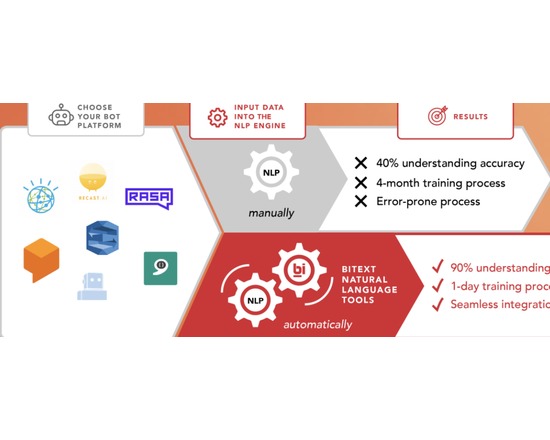
Bitext provides multilingual semantic technologies in the field of Text Analyics via API with services like Entity Extraction, Concept Extraction, Sentiment Analysis, and Text Categorisation.

Rated 0.0 out of 5.

›

Curated lists

Curated list created by experience authors in the fields.

All curated lists

Geoffrey Rockwell

Cool Voyant Tools

Not all Voyant tools show up in the default view or skin. Here is a list of some of the other tools worth trying.

4 tools

View list

Holly Pickering

Audio Production Software

Interested in audio production and editing? Here are a few programs that can help you get on your way. Some of them are free, some not, but all are helpful and useful.

3 tools

View list

Jason Bradshaw

TATR: Text Analysis for Twitter Research

This list compiles a suite of tools that make up Kynan Ly's Text Analysis for Twitter Research (TATR) Library. Recipes to these notebooks can be found on methodi.ca

6 tools

View list

The catalogue

  • 1321

    Tools catalogued

  • 15

    Curated lists

  • 22

    Analysis types

  • 671

    Community reviews

More is coming

Researchers, power users, and students will soon be able to contribute tools, share reviews, and curate lists around their own work.