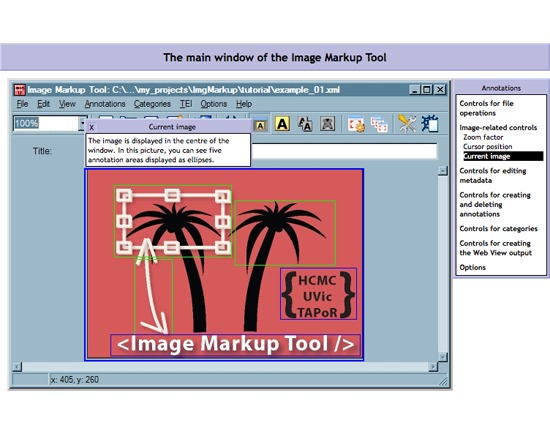
The UVic Image Markup Tool is a free tool for annotating images and storing the annotations in XML files from the University of Victoria's Humanities Computing and Media Centre. Its interface is designed for users without prior XML experience with additional functions for users familiar with XML, and supports multiple languages. The Image Markup Tool is available for Windows, and will also run in Linux with Wine.
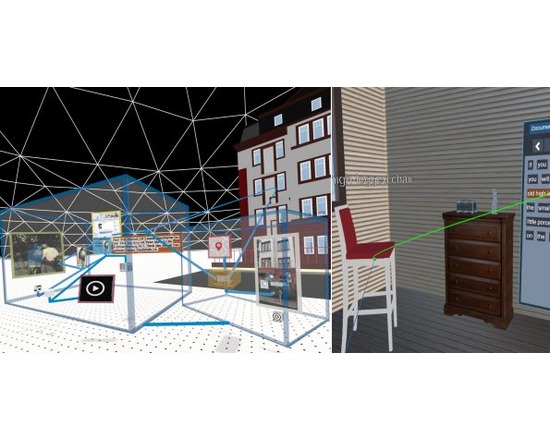
VAnnotatoR is a system that massively supports the annotation of multimedia, multimodal networks of linguistic and object-related data in virtual 3D environments. VAnnotatoR allows for segmenting and linking texts and images with other multimedia, multimodal data to ultimately create spatial hypertexts. It can be used to support concrete technical applications, e.g. the reconstruction of 3D scenes from texts as a preparatory step for the training of Text2Scene systems, or for applications in the digital humanities, such as the spatial reconstruction and linking of historical scenes or biographies with corresponding media content, such as images or 3D reconstructions of historical buildings. The entire system is interactively accessible with VR glasses in Virtual Reality (VR) and can be controlled and experienced accordingly. VAnnotatoR uses TextAnnotator as technological backbone and thus all its functions for annotation, task management, annotation evaluation as well as for collaborative and simultaneous processing of resources. Furthermore, VAnnotatoR uses TextImager to benefit from its NLP routines for automatic text analysis. VAnnotatoR is implemented on the basis of Unity3D and OpenVR and therefore runs with both systems and several VR glasses – it was tested on Oculus Rift, Oculus Rift S, Oculus Quest, HTC Vive and HTC Vive Cosmos under Windows 10. A demonstration of its usage can be found here https://www.youtube.com/watch?v=BBUg8mHT0iI
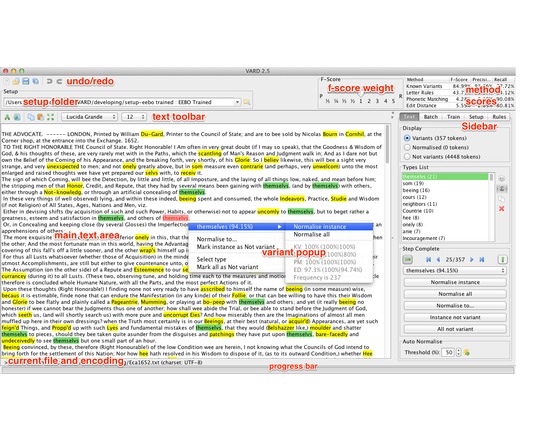
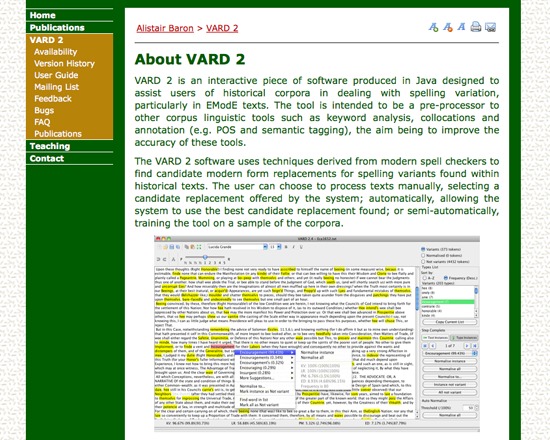
VARD 2 is an interactive piece of software produced in Java designed to assist users of historical corpora in dealing with spelling variation, particularly in Early Modern English texts. The tool is intended to be a pre-processor to other corpus linguistic methods such as keyword analysis, collocations and annotation (e.g. POS and semantic tagging), the aim being to improve the accuracy of these tools The VARD 2 software uses techniques derived from modern spell checkers to find candidate modern form replacements for spelling variants found within historical texts. The user can choose to process texts manually, selecting a candidate replacement offered by the system; automatically, allowing the system to use the best candidate replacement found; or semi-automatically, training the tool on a sample of the corpora. The tool is designed specifically for Early Modern English spelling variation, but it can be used to deal with possibly any form of spelling variation, in any language, by plugging in your own dictionary and spelling rules. Various related publications are available detailing the tool and its uses. And a full userguide is available.
VARD 2 is a free, creative commons tool for preprocessing historical corpora. Built in Java, it enables researchers to easily match up historic variant spellings with modern conventions. Though optimized for Early Modern English, other languages can be accomodated with user-supplied variant word lists.
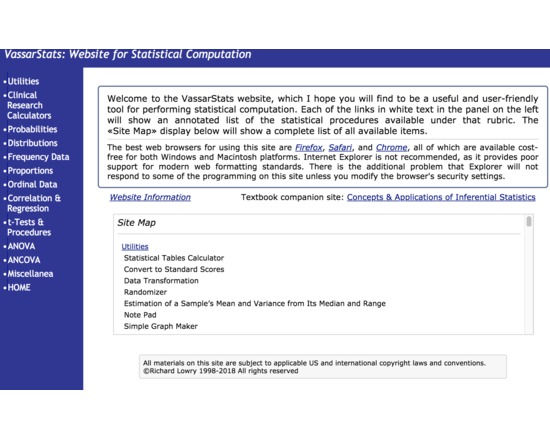
A website that explains statistical concepts and provides a web-based environment for performing those calculations. Tools include a graph maker, distribution generators, t-tests and procedures, and correlation and regression tests. All tools have been written in Javascript and run within the browser.
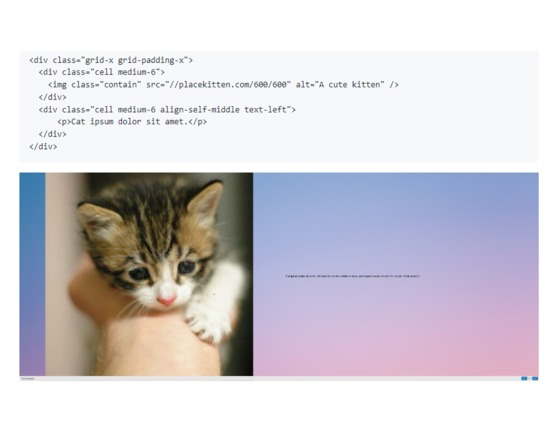
Vast is an open source tool that that is used to assist in the creation of web content to fit on very large displays. It helps the developer design web page while taking into consideration display aspect ratio, display size, content fit and viewing distance. The aim of this tool is to make design for large displays accessible for everyone. Examples and demos can be found in the tools GitHub webpage.
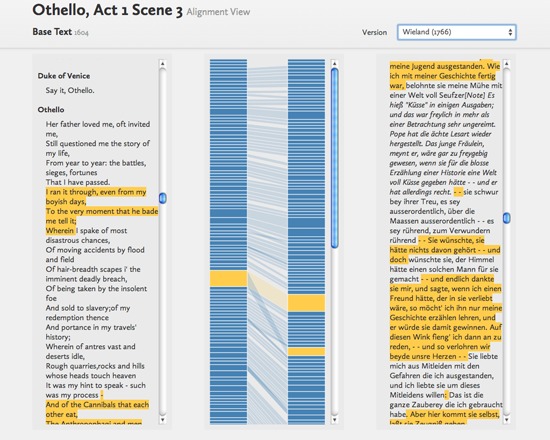
Version Variation Visualization is an interrelated set of free, usable prototypes for visualizing and exploring culturally important works in relation to their world-wide translations. It allows users to explore either the inlcuded corpora or their own texts via time-maps, alignment maps, parallel views or a concordance view accommodating multiple translations in the same viewer. Version Variation Visualization is particularly valuable for its focus on translation and re-translation of text, and its capacity to accommodate and show multiple version of the same text or passage.
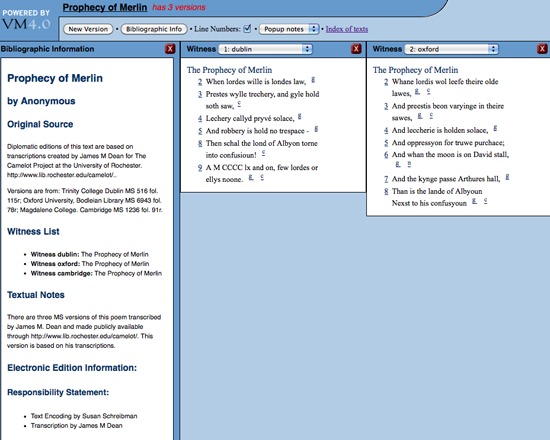
The Versioning Machine, now in version 4.0, is a framework and an interface for displaying multiple versions of text, and encodes the text according to TEI guidelines. It incorporates features found in both critical editions and electronic publication, in addition to providing an environment for textual editors to comparatively view the results of their edits. This tool may be downloaded for use on a local machine, or hosted on one's server for web usage.
VexFlow is an open-source online music notation rendering API. It is written completely in JavaScript, and runs right in the browser. VexFlow supports HTML5 Canvas and SVG.