Yahoo Pipes allows users to combine, filter, translate, and geocode data from RSS feeds, JSON, KML, or other similar formats, and power widgets/badges using that data.
Transkribus is an OCR platform for transcribing hand-written text. After manually transcribing 100 images, scholars can use a trained Handwritten Text Recognition (HTR) engine at the Technical University of Valencia to automate the transcription of the remaining pages of their documents. The platform has a number of tools and features for users in different disciplines.
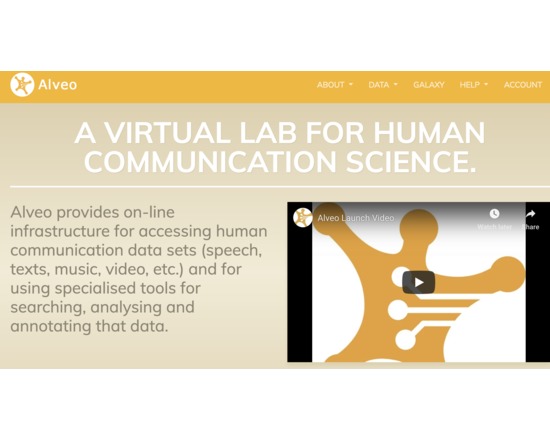
This is the project website for Alveo: Above and Beyond Speech, Language and Music, A Virtual Lab for Human Communication Science, a project funded by NeCTAR (National eResearch Collaboration Tools and Resources).
Recogito is an online platform for collaborative document annotation. Recogito provides a personal workspace where you can upload, collect and organize your source materials - texts and images - and collaborate in their annotation and interpretation. Recogito enables you to make your work more visible on the Web more easily, and to expose the results of your research as Open Data.
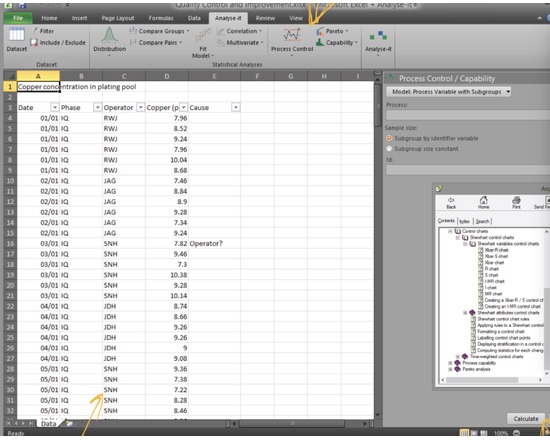
Analyse-it Quality Control & Improvement Edition provides the statistical analysis you need to understand processes, bring them under control, and find improvements that better your product. • Bring processes under statistical control so they are stable and predictable with powerful Shewhart, cumulative sum, and moving average control charts. Include Xbar-R, Xbar-S, R, S, I-MR, time weighted CUSUM, UWMA, EMA plots, and WECO, Nelson, Montomery or custom rulesets. • Ensure products are capable of meeting end-user specifications using capability indices to compare in-control process performance to your specification limits. • Improve processes and products by identifying solutions that really work using hypothesis tests and model fitting techniques. Includes ANOVA with multiple comparison, multiple linear and logistic regression, PCA and Factor analysis. • Identify actions that will reap the most rewards using Pareto analysis to identify commonly occurring defects and monitor them during process improvement.
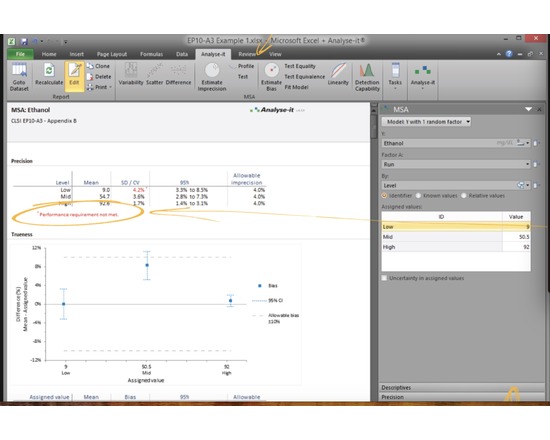
Analyse-it Method Validation Edition provides the statistical analysis you need to validate and verify analytical and diagnostic methods to meet the demands of regulatory compliance. With support for 11 CLSI protocols, it lets you: • Validate or verify analytical performance characteristics (precision, trueness, linearity, interferences, detection capability) of a measurement procedure to ensure they meet requirements for intended use or manufacturer's claims. • Compare methods to establish the real-world performance of a method against a reference method, or ensure comparability between two methods when making changes. Includes Deming, Weighted Deming, and Passing-Bablok regression, plus Bland-Altman limits of agreement. • Evaluate the diagnostic ability of a test to discriminate between two outcomes and compare test performance to find the most effective one. Includes ROC curves and Delong-Delong Clarke Pearson curve comparisons. • Establish a reference interval for a population of healthy individuals, or verify that existing intervals are transferable between laboratories or measurement procedures. Includes normal, quantile, robust bi-weight quantile, bootstrapped quantile, & Harrell-Davis quantile reference ranges.
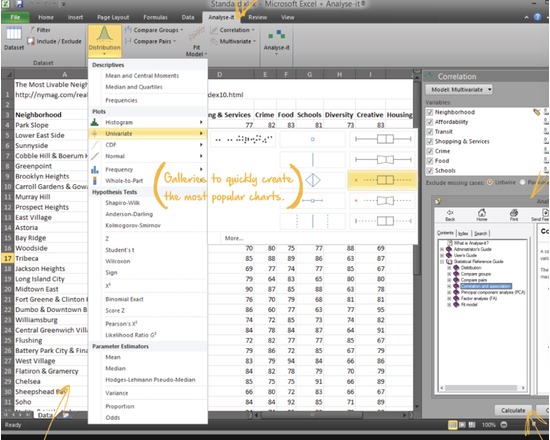
Analyse-it Standard Edition provides you with the powerful statistical analysis and regression you’d expect from an expensive statistics package, but without the complexity or the cost. • Describe your data with a wide range of statistics. • Visualize distributions, see trends and patterns, and spot outliers with powerful charts from histograms to scatter plots. • Infer and test hypotheses to get answers on distribution parameters, differences between populations, association between variables, and much more. Includes ANOVA, multiple comparisons, and an extensive range of parametric and non-parametric tests. • Discover relationships between variables and identify important factors with powerful regression and model fitting techniques. Include linear and logistic regression, with simple functions, or advanced models with crossed, polynomial and factorial terms. • Get insight into highly complex data by reducing dimensionality to get a clearer picture of the underlying structure. Includes correlation matrix, PCA (Principle Component Analysis) and Factor Analysis.
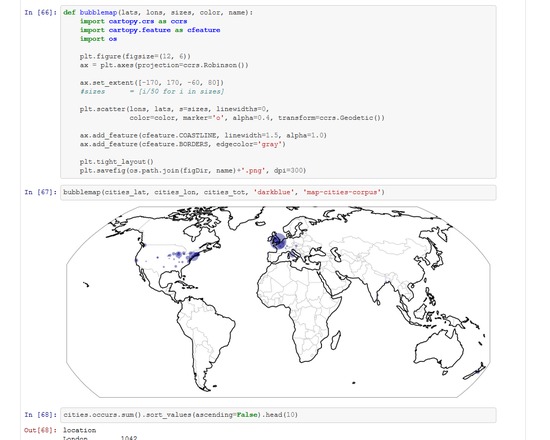
Parses text tagged by the Stanford named entity recognizer in order to collect and analyze mentions of locations. Also incorporates the Google API in order to geocode those locations and, ultimately, mark them on a map. This code was written in an IPython Notebook, so the code below is actually a collection of scattered code snippets. Please see the repository on github for full details and documentation, or the Methods Common recipe ( http://methodi.ca/recipes/mapping-locations-corpus ) for a step-by-step guide. NOTE: Users will be required to acquire their own Google API key, store it in a text file, and then point the code to that text file. Instructions can be found in the IPython Notebook itself. Search for "api_key_file" to find the line in code that needs to be changed.
Rated 5.0 out of 5.★★★★★5.0
McGill Characterization Process - Calculate Character Centrality
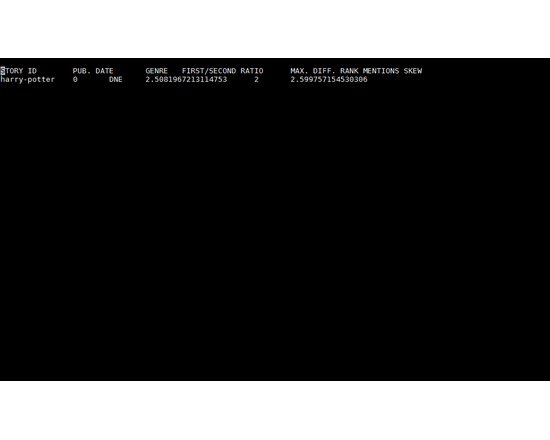
Part of the McGill Characterization Process family. Examines all the texts in a data directory, and using the analysis already done by the Collocate Parser, Alias Identifier, and Character Parser, gives data for the centrality of characters for each text, allowing the texts to be ranked against each other based on this. Extensive setup required. Please consult the readme on github for setup instructions.
Rated 0.0 out of 5.★★★★★0.0
McGill Characterization Process - Collocate Parser
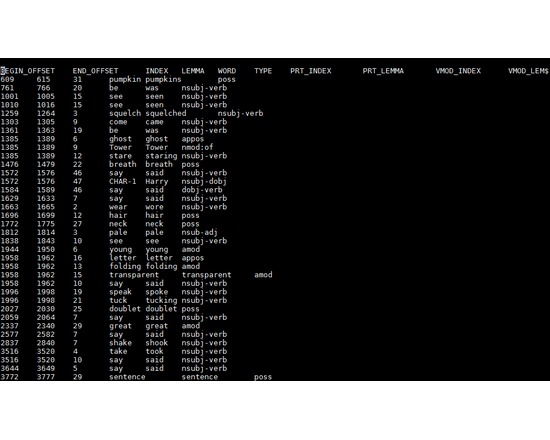
Part of the McGill Characterization Process family. Examines all the texts in a data directory and uses the output from the Alias Identifier to find the collocates for the words in the aforementioned texts. Output is in .tsv format and is required for the rest of the tools in this family. Extensive setup required. Please consult the readme on github for setup instructions.