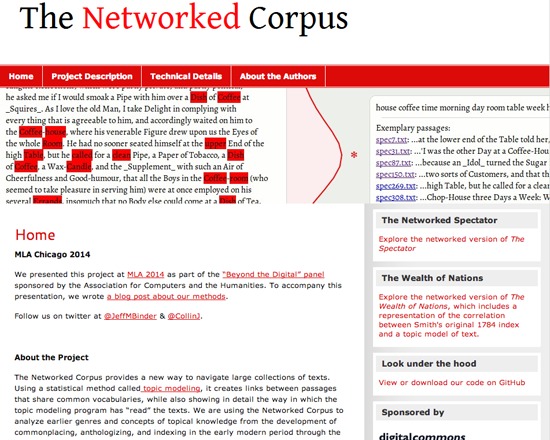
The Networked Corpus is a free, open source tool for navigating a corpus of plain text files via topic modelling using MALLET. The tool consistes of a Python script, and generates a collection of HTML files that can be explored further via the user's web browser. To use The Networked Corpus, users must have a minimum of Python 2.7.x, NumPy, SciPy and MALLET 2.0.7 installed on their system.
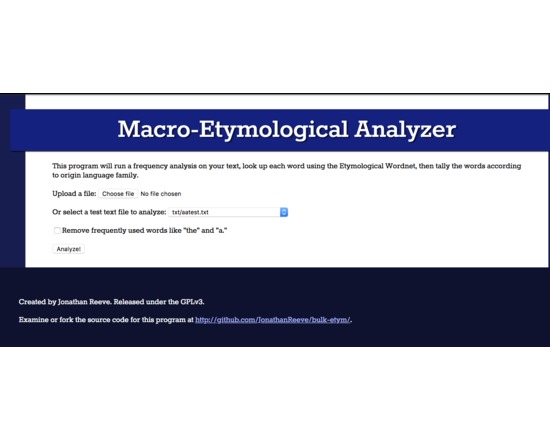
Formerly a web based app, the Macro-Etymological Analyzer is now available as a Command-line app. It is used for text analysis. It will look up every word of your text in the Etymological Wordnet, and generate statistics about the macro-etymology of your text, organized by language family. For instance, it can analyze a novel and tell you the proportions of words of Anglo-Saxon origin, or of Afroasiatic origin. First-generation and second-generation language ancestor data is included, and the output is highly granular, allowing the scholar to see the origins of individual words, and statistics about each ancestor language. This data can be useful as a particular type of topic modeling, since some macro-etymological data have have been correlated with particular genres, as well as the ages and sexes of their authors and/or speaking characters. For more details, read the introductory blog post and see these example experiments.
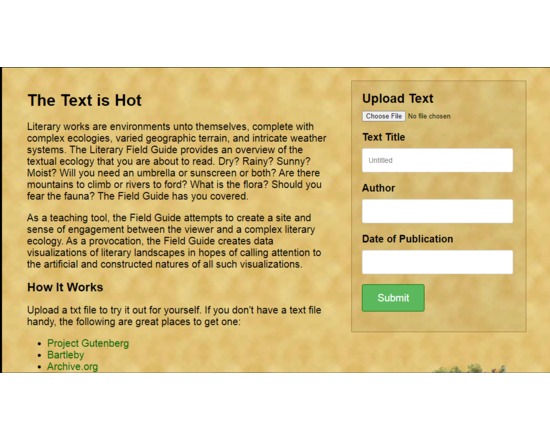
The Literary Field Guide provides an overview of the textual ecology of the text that you are about to read. It identifies mentions of ecological terms in the text and outputs an image that represents the environment the ecological terms of the text suggest. It also outputs the mentions and their frequencies under specific headings (for example: fauna, flora, amphibians, trees, landscapes, etc )
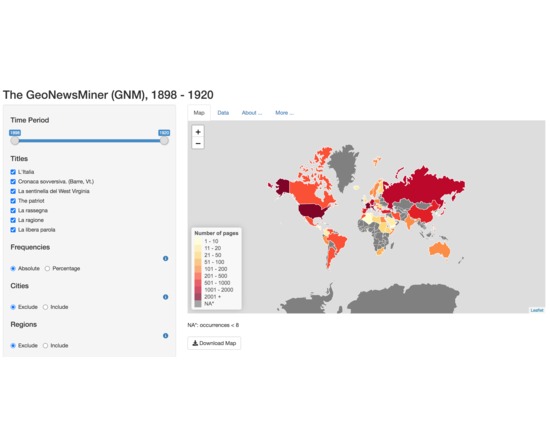
This is a project that had as goal to show on a map the references to geographical location from the text of publications from Italian language newspapers published in the United States between 1898 and 1920. They have made the code and dataset publicly available on GitHub and hence can be used by scholars with a similar project. A review of this project is available here https://utrecht-university.shinyapps.io/GeoNewsMiner/
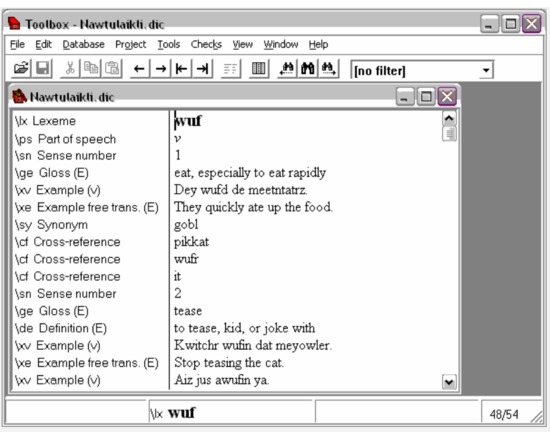
Toolbox is a data management and analysis tool for field linguists. It is especially useful for maintaining lexical data, and for parsing and interlinearizing text, but it can be used to manage virtually any kind of data. Toolbox is free to download and use. Toolbox is especially powerful for handling large corpora and dictionaries. It can handle a corpus of over a million words, and a dictionary of hundreds of thousands of words At heart, Toolbox is a text-oriented database management system (DBMS) with added functionality designed to meet the needs of a field linguist. The underlying DBMS offers full user flexibility in the design of any type of database. But for ease of use, the Toolbox package includes prepared database definitions for a typical dictionary and text corpus. Toolbox also has powerful linguistic functionality. It includes a morphological parser that can handle almost all types of morphophonemic processes. It has a word formula component that allows the linguist to describe all the possible affix patterns that occur in words. It has a user-definable interlinear text generation system which uses the morphological parser and lexicon to generate annotated text
The Chicago Homer is a multilingual database that uses the search and display capabilities of electronic texts to make the distinctive features of Early Greek epic accessible to readers with and without Greek. Except for fragments, it contains all the texts of these poems in the original Greek. In addition, the Chicago Homer includes English and German translations, in particular Lattimore's Iliad, James Huddleston's Odyssey, Daryl Hine's translations of Hesiod and the Homeric Hymns, and the German translations of the Iliad and Odyssey by Johan Heinrich Voss. Through the associated web site Eumaios users of the Chicago Homer can also from each line of the poem access pertinent Iliad Scholia and papyrus readings.
This tool calculates Term Frequency - Inverse Document Frequency (TF-IDF) for a collection of documents showing the salient words. It also does relative frequency.
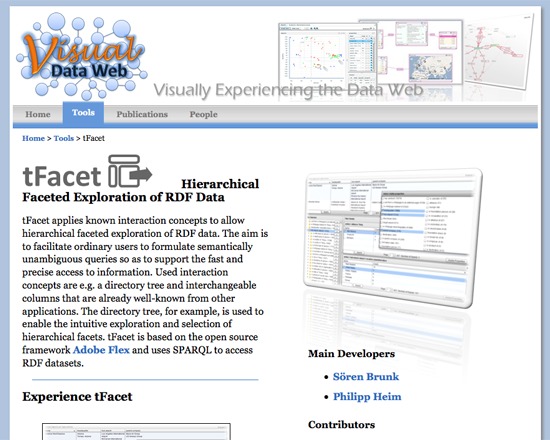
tFacet applies known interaction concepts to allow hierarchical faceted exploration of RDF data. The aim is to facilitate ordinary users to formulate semantically unambiguous queries so as to support the fast and precise access to information. Used interaction concepts are e.g. a directory tree and interchangeable columns that are already well-known from other applications. The directory tree, for example, is used to enable the intuitive exploration and selection of hierarchical facets. tFacet is based on the open source framework Adobe Flex and uses SPARQL to access RDF datasets.
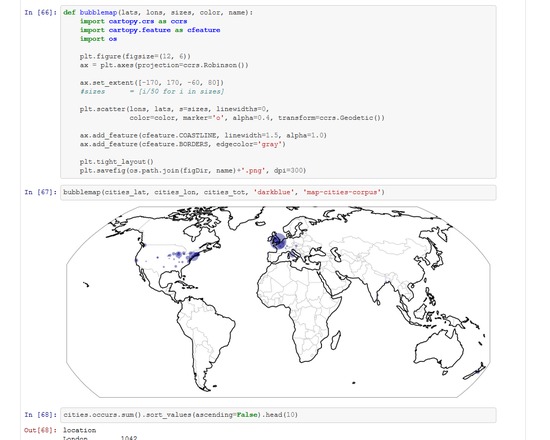
Parses text tagged by the Stanford named entity recognizer in order to collect and analyze mentions of locations. Also incorporates the Google API in order to geocode those locations and, ultimately, mark them on a map. This code was written in an IPython Notebook, so the code below is actually a collection of scattered code snippets. Please see the repository on github for full details and documentation, or the Methods Common recipe ( http://methodi.ca/recipes/mapping-locations-corpus ) for a step-by-step guide. NOTE: Users will be required to acquire their own Google API key, store it in a text file, and then point the code to that text file. Instructions can be found in the IPython Notebook itself. Search for "api_key_file" to find the line in code that needs to be changed.
Community textual editing tool that runs as a service over the web. Alllows one to see manuscript image and edit the XML. Also provides collation tools.