Skip to content
TAPoR Text Analysis Portal for Research

Tools

Sort by Name Rating ↓ Date

Visualization

Textual Geography Analyzer

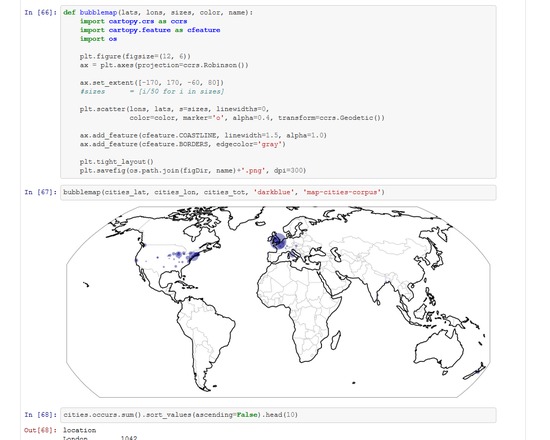
Parses text tagged by the Stanford named entity recognizer in order to collect and analyze mentions of locations. Also incorporates the Google API in order to geocode those locations and, ultimately, mark them on a map. This code was written in an IPython Notebook, so the code below is actually a collection of scattered code snippets. Please see the repository on github for full details and documentation, or the Methods Common recipe ( http://methodi.ca/recipes/mapping-locations-corpus ) for a step-by-step guide. NOTE: Users will be required to acquire their own Google API key, store it in a text file, and then point the code to that text file. Instructions can be found in the IPython Notebook itself. Search for "api_key_file" to find the line in code that needs to be changed.

Rated 5.0 out of 5.

Analysis

Voyant Tools

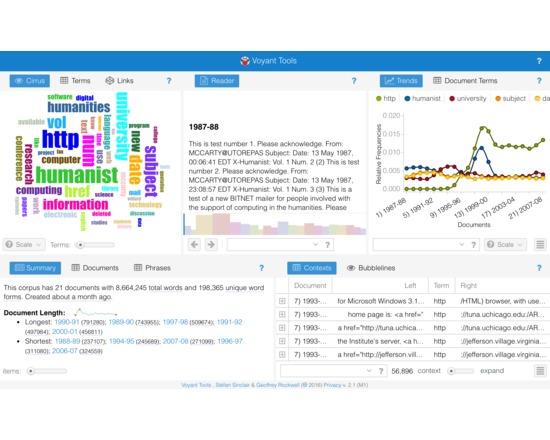
Voyant Tools is a web-based reading and analysis environment for digital texts.

Rated 5.0 out of 5.

Visualization

Heurist Data Manager / Visualiser / Publisher

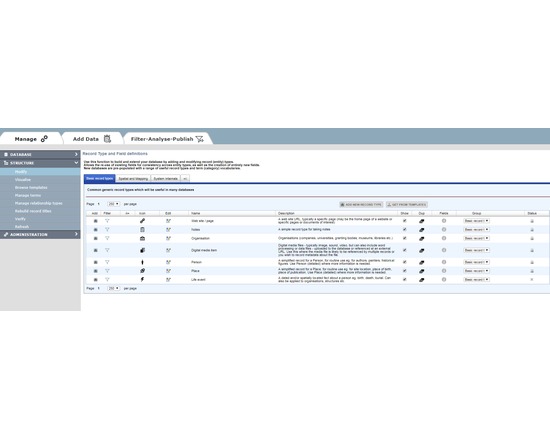
HEURIST (http://HeuristNetwork.org) is an extremely flexible, end-user oriented, web-based data management system designed specifically for Humanities data. Developed since 2005, it has been in active use across many projects since 2009. It is available both as a free web service for researchers (hosted at the University of Sydney Data Centre) or for installation on a physical or virtual server (Open Source on gitHub). Researchers can design, create, manage, analyse, visualise and publish their own richly-structured database(s) through a simple web interface, without the need for programmer(s). Quite complex databases can be built in a few hours by borrowing structures and vocabularies published by other users. Databases can be designed and built incrementally, as existing data are not affected by changes in structure. Databases created by Heurist are stored in MySQL with a repeatable structure facilitating sustainability and independent access by other software. Advanced features include record linking, graph structure, drill-down facet searches, rule-based queries, custom reports, linked map-timelines, network visualisation, normalised spreadsheet import, crosstabulation, XML feeds, XSLT transforms. The team provides initial email and skype assistance for project setup at no cost, and special customisations at modest cost. Heurist is applicable in many domains including History, Archaeology, Anthropology, Cultural Research, Linguistics, Media Studies etc. It handles everything from text, tags and categories, through networks of rich relationships and offset annotations, to images, video, spatial data and dating (including non-western systems and dating uncertainty). Sophisticated searches (including faceted and rule-based) can be saved, organised and rendered as layered interactive maps, timelines, network visualisations, crosstabulations, lists, custom reports, XML and XSLT transforms, all of which can easily be printed or embedded (live) in a website - Heurist provides the html code required to embed results in a web page or CMS. Databases can easily be migrated later to a personal or institutional server. Since the data are stored in a standard MySQL database with a fixed and well-documented structure, the data can be accessed directly via SQL from most programming languages independently of Heurist. Version 4.2 (Jan 2016 onwards) is available as a service via the Heurist website. Version 4 delivers a user-customisable interface of widgets, along with better mapping and visualisation. Existing version 3 databases are bidirectionally compatible with version 4.

Rated 5.0 out of 5.

Search

eXist-db

eXist-db is an open source database management system that stores XML data according to the XML data model and features efficient, index-based XQuery processing.

Rated 5.0 out of 5.

Visualization

Omeka

Omeka is a content management system designed for the display of library, museum, archives, and scholarly collections and exhibitions. Omeka falls at a crossroads of Web Content Management, Collections Management, and Archival Digital Collections Systems. Omeka is designed with non-IT specialists in mind, allowing users to focus on content and interpretation rather than programming. It brings Web 2.0 technologies and approaches to academic and cultural websites to foster user interaction and participation. It makes top-shelf design easy with a simple and flexible templating system. Its robust open-source developer and user communities underwrite Omeka’s stability and sustainability. Omeka allows users to publish cultural heritage objects, extend its functionality with themes and plugins, and curate online exhibits with digital objects.

Rated 5.0 out of 5.

Programming

Python

A general-purpose high-level programming language that places an emphasis upon code readability. Python supports a number of development models, including object oriented, imperative, and functional design. It provides automatic memory management and a fully dynamic type system. Features: Very clear, readable syntax Strong introspection capabilities Intuitive object orientation Natural expression of procedural code Full modularity, supporting hierarchical packages Exception-based error handling Very high level dynamic data types Extensive standard libraries and third party modules for virtually every task Extensions and modules easily written in C, C++ (or Java for Jython, or .NET languages for IronPython) Embeddable within applications as a scripting interface

Rated 5.0 out of 5.

Search

Voyant Tools 2.0 (Corpus View)

Voyant 2.0 is a complete rewrite of Voyant. It provides a suite of text analysis tools that will work with most texts you can upload or find on the web. These tools are combined in skins. For documentation see Documentation for Voyant 2.0

Rated 5.0 out of 5.

Web development

WordPress.com

Wordpress.com provides free ad-supported hosting for basic WordPress sites, with paid options for premium features (custom domain, extra storage, custom design, no ads, etc.)

Rated 4.0 out of 5.

Publishing

Omeka.net

Omeka.net provides a web-publishing platform to curate collections and create exhibitions of digitized content. Omeka.net has grown out of the Omeka project. Omeka.net provides some of the same functionality as Omeka, but does not require the user to provide hosting or to maintain their installation in any way. However, use of Omeka.net limits customization, and hosting more than 500MB of content requires a paid account. Objects in the collection can be cataloged with Dublin core metadata fields and georeferenced for display on a map. Omeka.net includes several plugins, including COinS (which makes objects in Omeka accessible to citations management software, like Zotero), HTML5 Media (to play audio and video), and Library of Congress Suggest (which will auto-populate fields with LoC authority and subject headings).

Rated 4.0 out of 5.

Visualization

Complex Sentiment Analysis

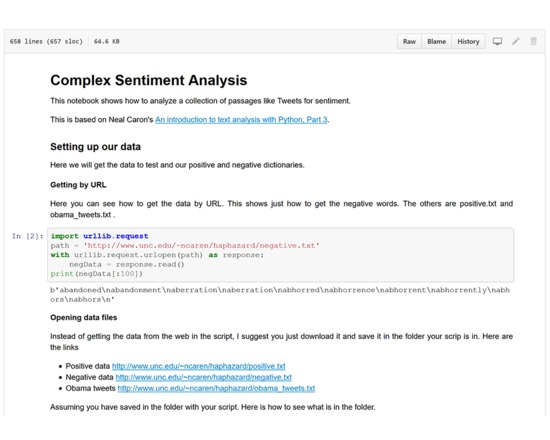
Code from an iPython notebook, based on: http://nealcaren.web.unc.edu/an-introduction-to-text-analysis-with-python-part-3/ This notebook shows how to conduct sentiment analysis on a collection of passages (e.g. Tweets) using dictionaries of positive and negative words.

Rated 4.0 out of 5.