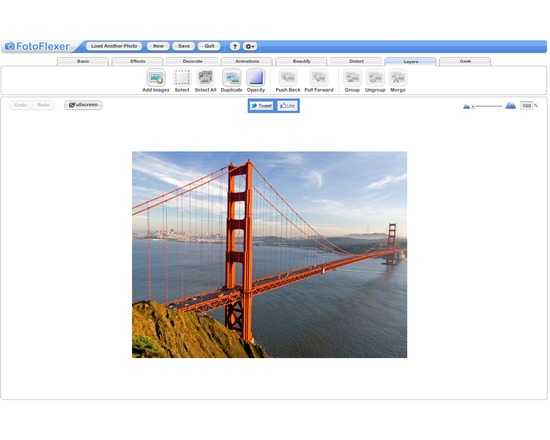
Web-based image editing with special effects and image manipulation features that can import content from PhotoBucket, Facebook, MySpace, Picasa, Flickr, Phanfare, or Smugmug. A free account is needed to save images. FotoFlexer also offers an Open API to provide a simple interface for external websites to use the editing features - no API keys, REST or SOAP.
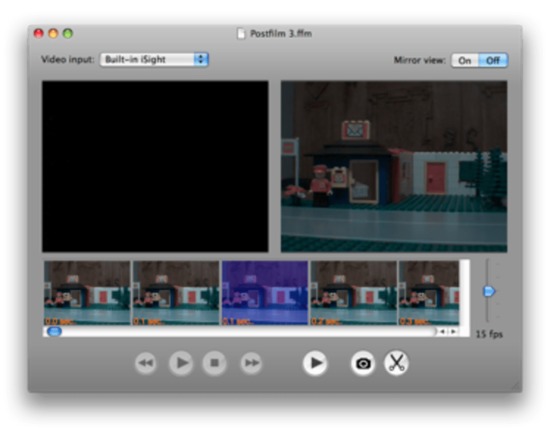
FramebyFrame is a basic application to create stopmotion with your webcam. Currently it works with only Mac computers. Many reviewers complained of the app crashing frequently.
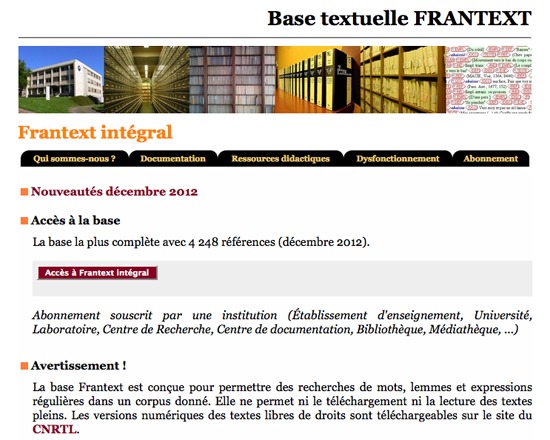
FRANTEXT is a historically and culturally important database of French literary, philosophical and technical texts with an emphasis on diversity and representation, spanning the Middle Ages to the present, and offered on a subscription basis. This resource is aimed at linguists and literary scholars in the humanities and social sciences, and is notable for its inclusion of a powerful search engine called Stella. Stella is a sophisticated NLP search suite, and includes regular expression search, lemmatization, vocabulary list and entity categorization functions.
Freebase was "an open, Creative Commons Attribution (aka CC-BY) licensed collection of structured data," and a "platform for accessing and manipulating that data" via API. Almost 40 million entities and assertions about those entities are stored within a graph database. The database was built by pulling in open data and relies on community contribution to stay updated. Freebase was part of the semantic web and emits Linked Open Data (via RDF) for all its entities.
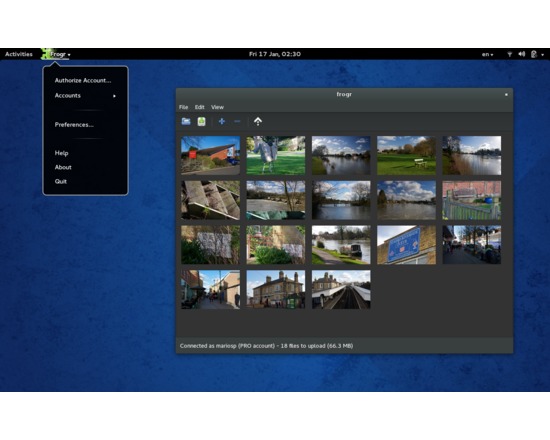
Frogr is a small application for the GNOME desktop that allows users to manage their accounts in the Flickr image hosting website. It supports all the basic Flickr features, including uploading pictures, adding descriptions, setting tags and managing sets and groups pools. The latest stable version of Frogr (0.10) currently features a basic flickr uploader with the following features: Allow upload of pictures and videos to flickr, specifying details such as title, description, tags, visibility, content type, safety level and whether to "show up on global search results". Allow uploading pictures and videos from remote machines, through different protocols (SMB, SSH, FTP...). Allow loading/saving the work session from/to 'project' files. Allow setting specific licenses and geolocation information for pictures right from the desktop. Allow specifying sets and group pools for the elements to be added to after the upload process. Allow to create sets right from frogr, opposite to just adding elements to already existing ones. Command line interface and integration as MIME type handler for pictures. Import tags from picture's metainformation (if present) when loading. Support for handling multiple Flickr accounts. Support for specifying HTTP proxies manually. Integrated with GNOME Shell and the Mac OS X desktops.
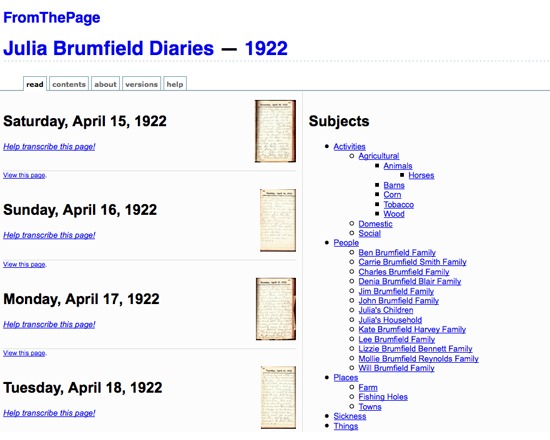
FromThePage is a free software for manuscript transcription, allowing volunteers to transcribe document pages online. Transcriptions can then be marked up and annotated in a wiki-like enviroment, with the resultant text displayed on the public web. It includes a discussion environment, enabling collaboration on particularly difficult pages. FromThePage is currently in beta, permitting up to 100 pages per project, and is in the process of developing a paid version for larger projects requiring more server space, with price determined primarily by server and maintenance costs. Privacy features are also under development, and further features forthcoming based on feedback from users.
FUNES was an NLP system for analyzing short newspaper stories. It was written in Prolog and conducted syntactic parsing and semantic analysis on a text to create a case-based semantic representation.
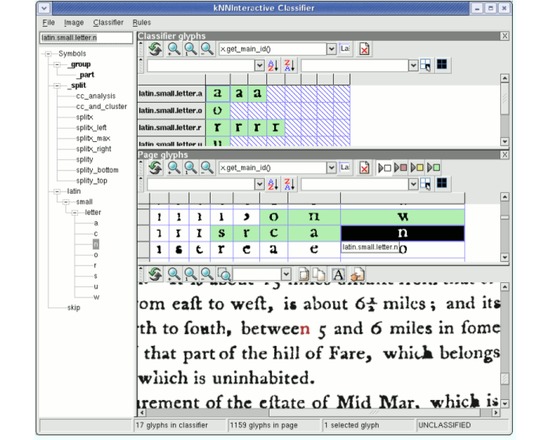
A free (under the GNU General Public License) toolkit for the development of document image recognition systems. Features: Custom dictionaries may be created to assist with analysis of specific record types Extensible functionality Optical character recognition (OCR) toolkit plugin
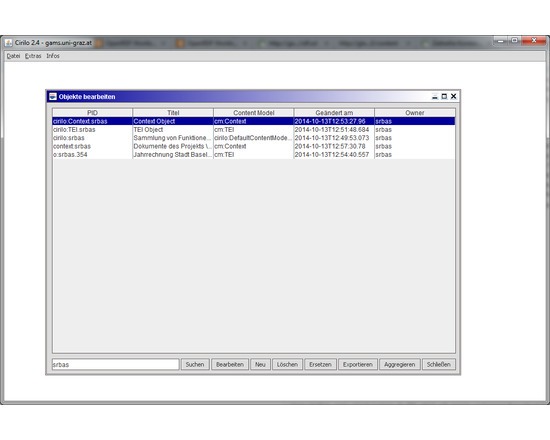
GAMS/Cirilo is an application developed for content preservation and data curation in FEDORA-based repository systems. Content preservation and data curation include object creation and management, versioning, normalization and standards, and the choice of data formats. The client offers functionalities which are especially prone to be used as tools for mass operations on FEDORA objects, such as ingest or replacement processes. Cirilo uses a collection of predefined content models, which can be used without further adjustments for standard workflow scenarios like the management of collections of TEI objects. It encapsulates functions for the resolvement of place names or ontology concepts, thus semantically enriching resources in the digital archive. Various dissemination options can also be assigned with the client. Cirilo is a contribution to the DARIAH-EU task “Reference Software Packages. The source code of the client can be found at https://github.com/acdh/cirilo, the documentation is available at http://gams.uni-graz.at/doku. An „archive-in-a-box“-installation package (Client including a FEDORA 3.5 instance) for Debian-based Linux-distributions can be downloaded from http://gams.uni-graz.at/download/cirilo-installer-2.4.tar.gz