Skip to content
TAPoR Text Analysis Portal for Research

Tools

Sort by Name Rating ↑ Date

Visualization

SemLens

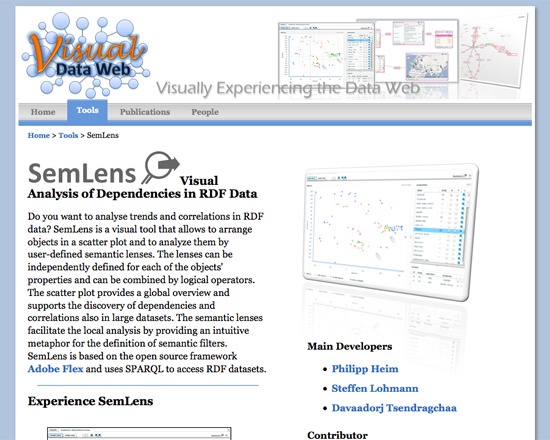
SemLens is a tool for visualizing and analyzing RDF data developed as part of the Visual Data Web toolset and based on the Adobe Flex open source framework. Using SPARQL to access the user's dataset, it arranges RDF data into a scatter plot which can be analyzed via semantic lenses generated based on the dataset, and with logical operators. The tool provides a global overview of the user's dataset, and can do so even for large datasets.

Rated 0.0 out of 5.

Visualization

gFacet

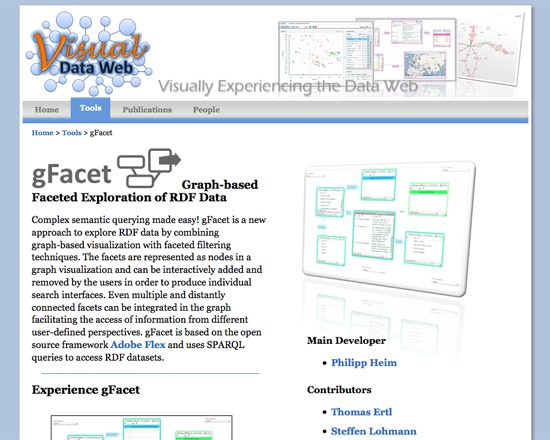
gFacet is a tool for graph-based visualization of RDF data developed as part of the Visual Data Web toolset and based on the Adobe Flex open source framework. Using SPARQL to access the user's dataset, it integrates filtering based on facets represented as nodes within the visualization to enable users to select which they wish to work with and create custom search interfaces.

Rated 0.0 out of 5.

Visualization

tFacet

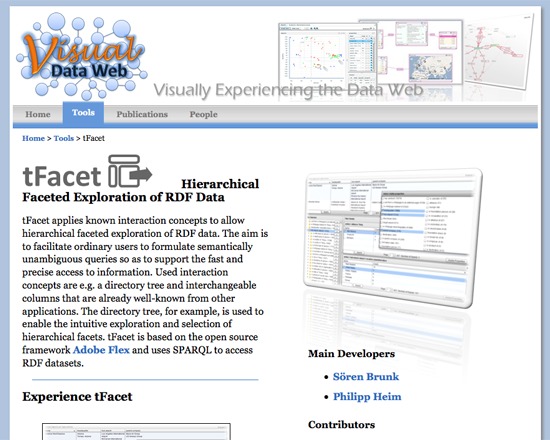
tFacet applies known interaction concepts to allow hierarchical faceted exploration of RDF data. The aim is to facilitate ordinary users to formulate semantically unambiguous queries so as to support the fast and precise access to information. Used interaction concepts are e.g. a directory tree and interchangeable columns that are already well-known from other applications. The directory tree, for example, is used to enable the intuitive exploration and selection of hierarchical facets. tFacet is based on the open source framework Adobe Flex and uses SPARQL to access RDF datasets.

Rated 0.0 out of 5.

Search

minezy

minezy is a prototype application for exploring and mining large email archives. Its interface is designed to make it easy to find the answers to common questions: who the message originator was, when messages were sent, how frequently, who was included in the exchange, and the subject and content. The app interface is designed around search, filters and a series of panels that open to the right when results and sub-results are clicked on. The prototype can be tried out via the minezy website, and is pre-loaded with the Enron collection of emails for exploration.

Rated 0.0 out of 5.

JSON Extractor

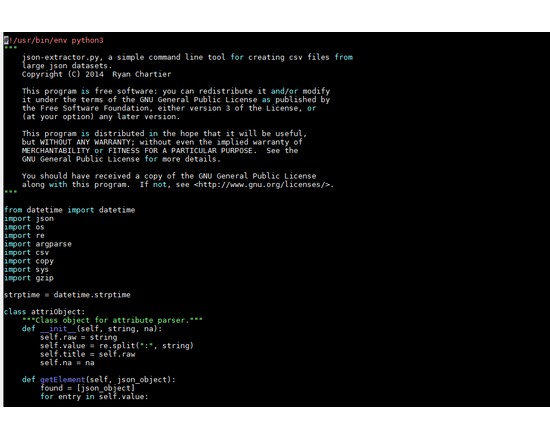
json-extractor.py is a simple command line tool for creating csv files from large json datasets.

Rated 0.0 out of 5.

Visualization

nodegoat

nodegoat creates visualizations and provides a graphical user interface for the maintenance of data. It combines a variety of data management functions into one program.

Rated 0.0 out of 5.

Search

Doodle

Doodle is an online scheduling tool to help collaborators find a common time to meet. An organizer can set up a number of proposed meeting times and send a survey to participants who indicate availability. The free version offers scheduling and the option for a MeetMe page, which allows users to see your available time slots; paid versions include options such as calendar integration, automatic reminders, SSL encryption, and seeing who is missing. Private plans are $39 a year and business/group plans vary in price, which is dependent on the number of Doodle organizers. Ideal for team work planning and easy to use.

Rated 0.0 out of 5.

MapTiler

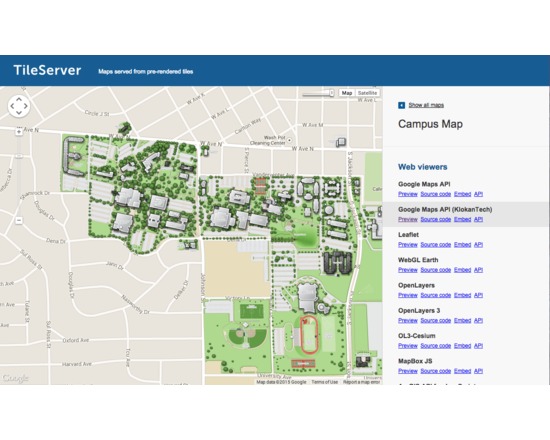
MapTiler allows efficient and fast multi-core paralellized rendering of raster geodata (TIFF/GeoTIFF, MrSID, ECW, JPEG2000, Erdas HFA, NOAA BSB/KAP, Ozi Explorer OZF2/OZFx3, JPEG, GIF, PNG and more…) into map tiles suitable for Google Maps API mashups (OpenStreetMap, Microsoft Bing, MapQuest, MapBox, Google Earth; MBTiles format is supported), native mobile applications (iPhone/iPad/Android) with Apple MapKit, RouteMe or OSMDroid. It automatically produces large seamless maps from several input files (MapTiler Pro) and directly optimizes the produced tiles for minimal filesize which allows extremely fast distribution of maps from any ordinary webserver or from a cloud CDN (Rackspace Cloud Files, Apache, PHP, Linux, DropBox, Google Drive, Amazon S3/CloudFront, Google Cloud Storage). Interaction with the software and tips are available in Youtube tutorials at:https://www.youtube.com/playlist?list=PLGHe6Moaz52PiQd1mO-S9QrCjqSn1v-ay

Rated 0.0 out of 5.

Content Analysis

The Macro-Etymological Analyzer

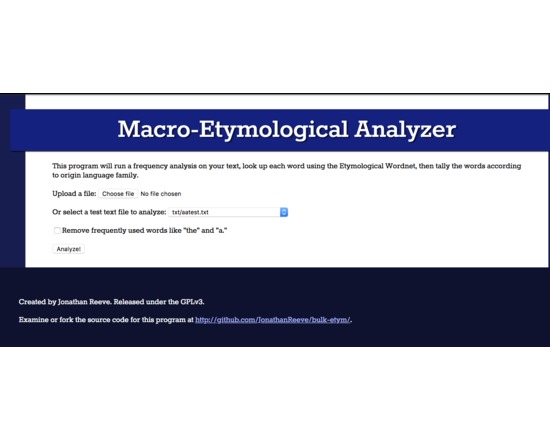
Formerly a web based app, the Macro-Etymological Analyzer is now available as a Command-line app. It is used for text analysis. It will look up every word of your text in the Etymological Wordnet, and generate statistics about the macro-etymology of your text, organized by language family. For instance, it can analyze a novel and tell you the proportions of words of Anglo-Saxon origin, or of Afroasiatic origin. First-generation and second-generation language ancestor data is included, and the output is highly granular, allowing the scholar to see the origins of individual words, and statistics about each ancestor language. This data can be useful as a particular type of topic modeling, since some macro-etymological data have have been correlated with particular genres, as well as the ages and sexes of their authors and/or speaking characters. For more details, read the introductory blog post and see these example experiments.

Rated 0.0 out of 5.

Uncategorized

paint.net

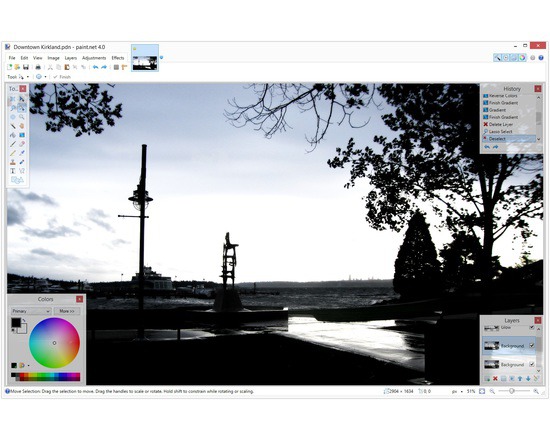
From the website: Paint.NET is free image and photo editing software for PCs that run Windows. It features an intuitive and innovative user interface with support for layers, unlimited undo, special effects, and a wide variety of useful and powerful tools. An active and growing online community provides friendly help, tutorials, and plugins.

Rated 0.0 out of 5.