Skip to content
TAPoR Text Analysis Portal for Research

Tools

Sort by Name Rating ↓ Date

Natural Language Processing

grling-sdm

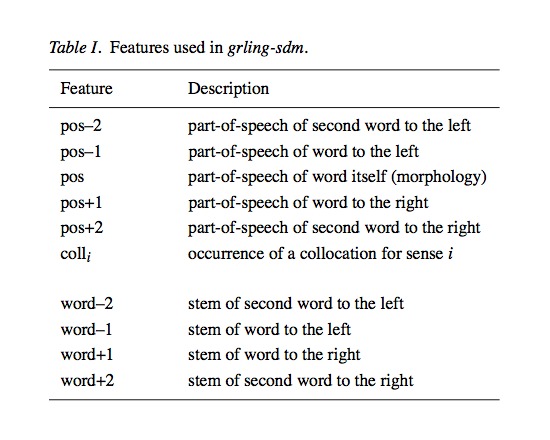
grling-sdm (graphical models for linguistic applications - supervised decomposable model search) was a system for assigning probabilistic classification to words developed for the 1998 SENSEVAL competition for word-sense disambiguation. Its selection approach also had applications to related natural language processing problems.

Rated 0.0 out of 5.

Analysis

Wisdom

Wisdom was a word sense disambiguation system that participated in the 1998 SENSEVAL competition. It used a simple supervised learning algorithm, drawing on co-occurrence statistics.

Rated 0.0 out of 5.

Natural Language Processing

SCBD (Sentence and Chunk Boundaries Detector)

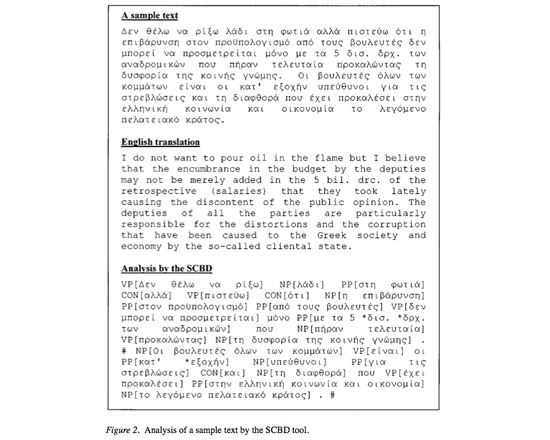
SCBD (Sentence and Chunk Boundaries Detector) was an NLP tool suited to Modern Greek text. It could detect sentence and chunk boundaries within an unrestricted text, could assign style markers, and was effective even on a large corpus of 200,000 words

Rated 0.0 out of 5.

Natural Language Processing

EXPLEX

EXPLEX (EXtracting information about Proper nouns to provide LEXical information) was a natural language processing system available in the 1990s. It was developed to create lexical entries for nouns appearing in the Wall Street Journal .

Rated 0.0 out of 5.

Natural Language Processing

IITagger

IITagger was a part of speech tagging system developed in the 1990s to assign part of speech information to words from the Wall Street Journal .

Rated 0.0 out of 5.

Natural Language Processing

WinBrill

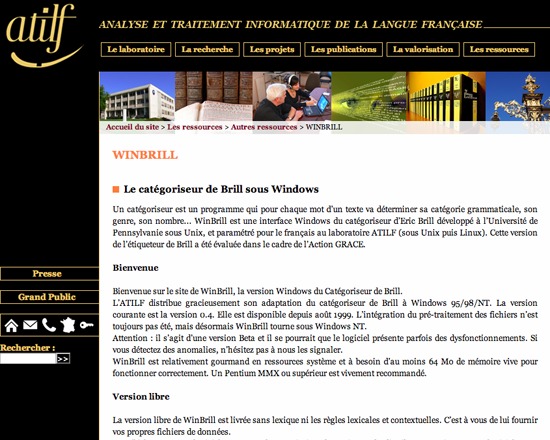
WinBrill is a part-of-speech tagger developed by Eric Brill in the 1990s for the French language laboratory ATILF. It was originally available for UNIX, with WinBrill optimized for Windows 95/98/NT as of 1999. The ATILP provided a vocabulary and rules files based on FRANTEXT data. Versions of the Brill tagger are still extant online.

Rated 0.0 out of 5.

Natural Language Processing

SRILM (SRI Language Modelling Toolkit)

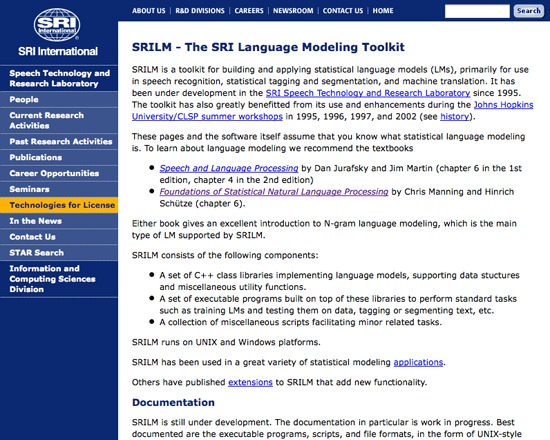
SRILM (SRI Language Modelling Toolkit) is a toolkit for language modelling first developed in the 1990s and still in active development. It has applications in speech recognition, statistical tagging, segmentation and machine translation. The toolkit is available for Windows and UNIX, and users have developed a variety of extensions for it.

Rated 0.0 out of 5.

Search

Doodle

Doodle is an online scheduling tool to help collaborators find a common time to meet. An organizer can set up a number of proposed meeting times and send a survey to participants who indicate availability. The free version offers scheduling and the option for a MeetMe page, which allows users to see your available time slots; paid versions include options such as calendar integration, automatic reminders, SSL encryption, and seeing who is missing. Private plans are $39 a year and business/group plans vary in price, which is dependent on the number of Doodle organizers. Ideal for team work planning and easy to use.

Rated 0.0 out of 5.

MapTiler

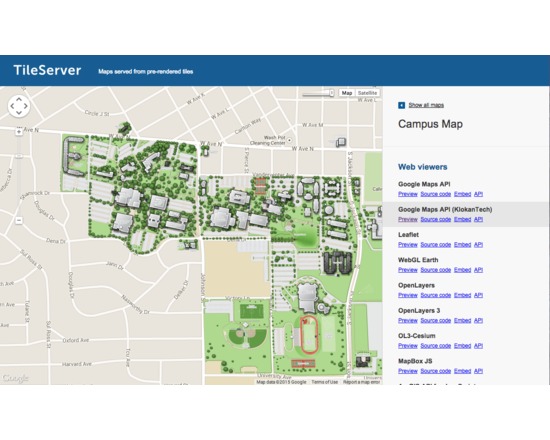
MapTiler allows efficient and fast multi-core paralellized rendering of raster geodata (TIFF/GeoTIFF, MrSID, ECW, JPEG2000, Erdas HFA, NOAA BSB/KAP, Ozi Explorer OZF2/OZFx3, JPEG, GIF, PNG and more…) into map tiles suitable for Google Maps API mashups (OpenStreetMap, Microsoft Bing, MapQuest, MapBox, Google Earth; MBTiles format is supported), native mobile applications (iPhone/iPad/Android) with Apple MapKit, RouteMe or OSMDroid. It automatically produces large seamless maps from several input files (MapTiler Pro) and directly optimizes the produced tiles for minimal filesize which allows extremely fast distribution of maps from any ordinary webserver or from a cloud CDN (Rackspace Cloud Files, Apache, PHP, Linux, DropBox, Google Drive, Amazon S3/CloudFront, Google Cloud Storage). Interaction with the software and tips are available in Youtube tutorials at:https://www.youtube.com/playlist?list=PLGHe6Moaz52PiQd1mO-S9QrCjqSn1v-ay

Rated 0.0 out of 5.

Content Analysis

The Macro-Etymological Analyzer

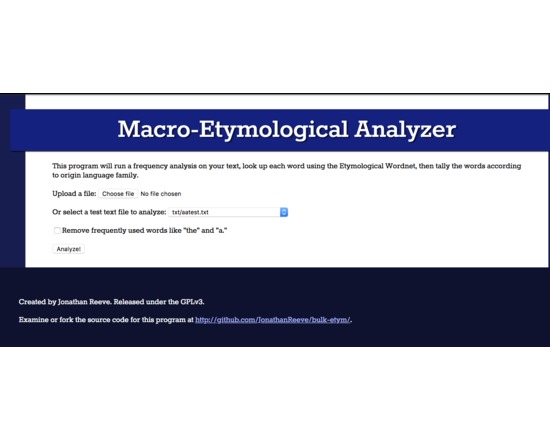
Formerly a web based app, the Macro-Etymological Analyzer is now available as a Command-line app. It is used for text analysis. It will look up every word of your text in the Etymological Wordnet, and generate statistics about the macro-etymology of your text, organized by language family. For instance, it can analyze a novel and tell you the proportions of words of Anglo-Saxon origin, or of Afroasiatic origin. First-generation and second-generation language ancestor data is included, and the output is highly granular, allowing the scholar to see the origins of individual words, and statistics about each ancestor language. This data can be useful as a particular type of topic modeling, since some macro-etymological data have have been correlated with particular genres, as well as the ages and sexes of their authors and/or speaking characters. For more details, read the introductory blog post and see these example experiments.

Rated 0.0 out of 5.