Skip to content
TAPoR Text Analysis Portal for Research

Tools

Sort by Name Rating ↓ Date

Capture

MassMine

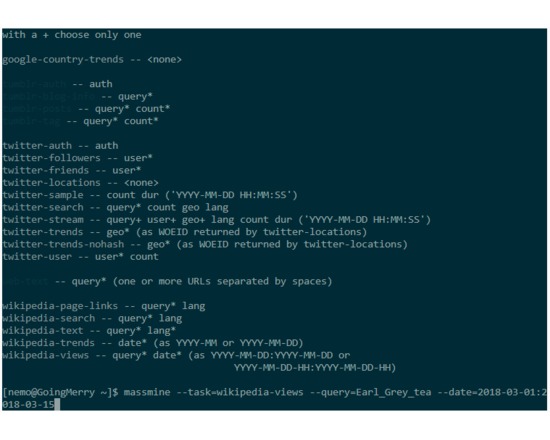
MassMine is a command line tool designed for researchers to simplify the collection and use of data from online sources such as social media networks. Geared toward novices and power users alike. Designed for use on personal computers or on headless servers. Handles the acquisition of API data while managing rate limits imposed by these services. Makes setting up custom data requests easy, allowing for flexible deployment for individualized research needs. Creates and manages databases of collected data automatically. This means that all tweets, trends, posts, etc. related to your research questions are saved permanently on your local hard drive. Designed for long-running data collection projects. MassMine makes it easy to create your own database of social media content spanning days, months, or years.
Rated 0.0 out of 5.

Analysis

FastSense

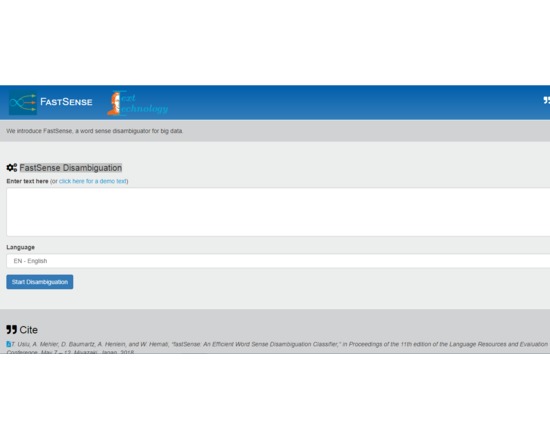
It is used for word sense disambiguation. It is used to determine the meaning of an ambiguous word in a given context. It is available as an online tool. It highlights named entities and provides links to the Wikipedia page of the highlighted word.

Rated 0.0 out of 5.

Visualization

LitViz

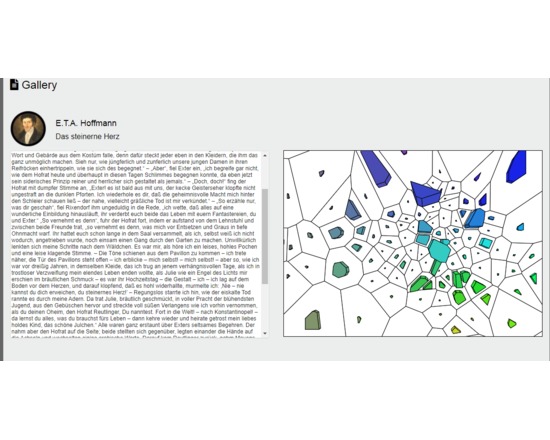
LitViz is a tool available online for the visualisation of text-information as a 3D-graph. The algorithm uses multiple techniques from NLP (Natural Language Processing) like Stanford PoS-Tagger, Lemmatizer, Tokenizer and more to generate the necessary dataset for the 3D-function.

Rated 0.0 out of 5.

Analysis

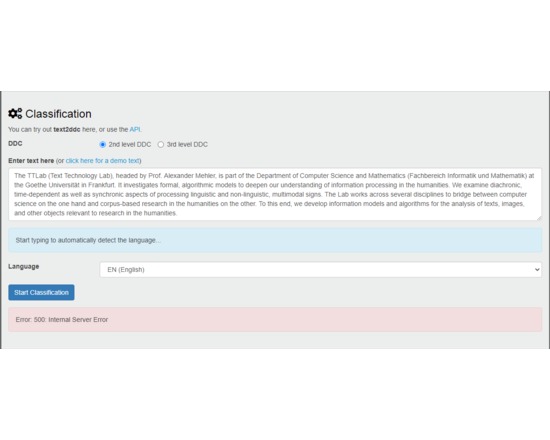
Text2DDC

Text2DDC is an online tool that provides an API which analyzes unstructured text and generates labeled topic classifications based on the Dewey Decimal Classification (DDC). It is available to use online or through an API. It is currently not working.

Rated 0.0 out of 5.

Analysis

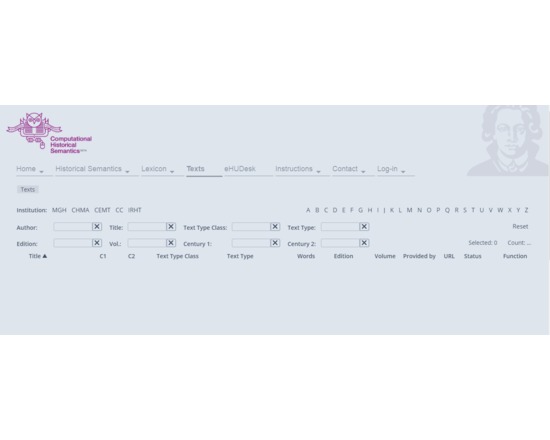
CompHistSem

It is a set of tools to work with Latin text. It provides a database of Latin texts and a morphological structured Latin Lexicon. All texts are lemmatized and ready for comparative analysis of word frequencies.

Rated 0.0 out of 5.

Visualization

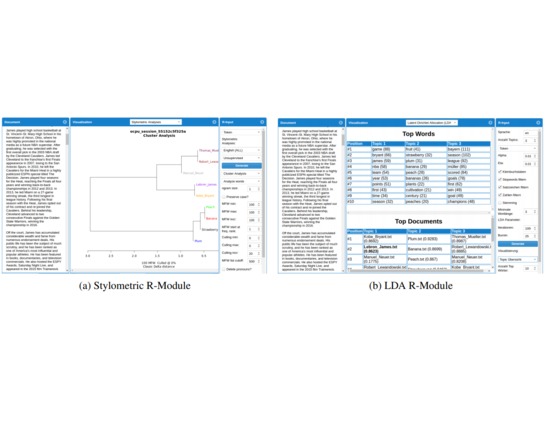
TextImager

TextImager is a UIMA-based framework that offers a range of NLP and visualization tools by means of a user-friendly GUI. Using TextImager requires no programming skills. It can be used as on online web application. Note: The tool is presently not functional.

Rated 0.0 out of 5.

Visualization

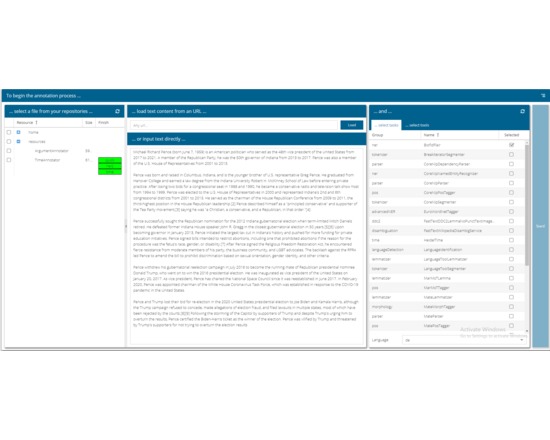
TextAnnotator

TextAnnotator is a web based annotation tool implemented with the JavaScript framework ExtJS and the visualization library d3.js that can process and annotate NLP documents in UIMA (Unstructured Information Management applications) format. TextAnnotator is a framework that offers several annotation tools for generating IMA-compliant training data that can be used to train classifiers in support of the needs of humanities scholars. Note: The tool is currently not working.

Rated 0.0 out of 5.

Visualization

VAnnotatoR

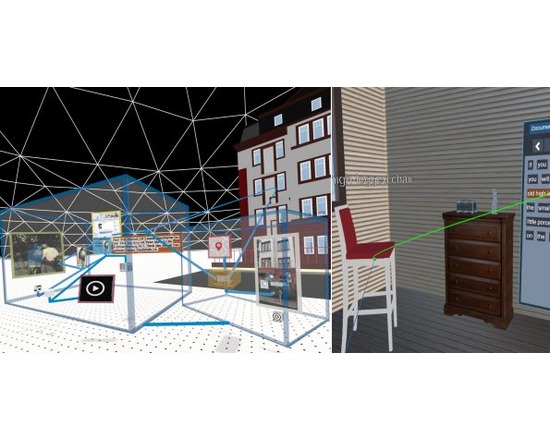
VAnnotatoR is a system that massively supports the annotation of multimedia, multimodal networks of linguistic and object-related data in virtual 3D environments. VAnnotatoR allows for segmenting and linking texts and images with other multimedia, multimodal data to ultimately create spatial hypertexts. It can be used to support concrete technical applications, e.g. the reconstruction of 3D scenes from texts as a preparatory step for the training of Text2Scene systems, or for applications in the digital humanities, such as the spatial reconstruction and linking of historical scenes or biographies with corresponding media content, such as images or 3D reconstructions of historical buildings. The entire system is interactively accessible with VR glasses in Virtual Reality (VR) and can be controlled and experienced accordingly. VAnnotatoR uses TextAnnotator as technological backbone and thus all its functions for annotation, task management, annotation evaluation as well as for collaborative and simultaneous processing of resources. Furthermore, VAnnotatoR uses TextImager to benefit from its NLP routines for automatic text analysis. VAnnotatoR is implemented on the basis of Unity3D and OpenVR and therefore runs with both systems and several VR glasses – it was tested on Oculus Rift, Oculus Rift S, Oculus Quest, HTC Vive and HTC Vive Cosmos under Windows 10. A demonstration of its usage can be found here https://www.youtube.com/watch?v=BBUg8mHT0iI

Rated 0.0 out of 5.

Natural Language Processing

TreeTagger

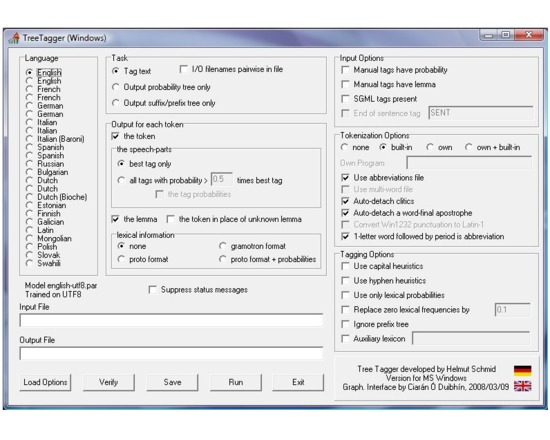
The TreeTagger is a program developed by Helmut Schmid at the University of Stuttgart (now at the University of München), for part-of-speech tagging and lemmatization. Language models (known as “parameters”, file extension .par) are supplied on the TreeTagger webpage for using the program with texts in English, French, German, Italian, Spanish, Russian, Bulgarian, Dutch, Estonian, Finnish, Galician, Latin, Mongolian, Polish, Slovak and Swahili, and models for some other languages are available from sites linked to the TreeTagger webpage. For a language for which no model exists, it is necessary to hand-tag some text, and then run a training program (provided with the TreeTagger) to create the model.

Rated 0.0 out of 5.

Natural Language Processing

Nocode app

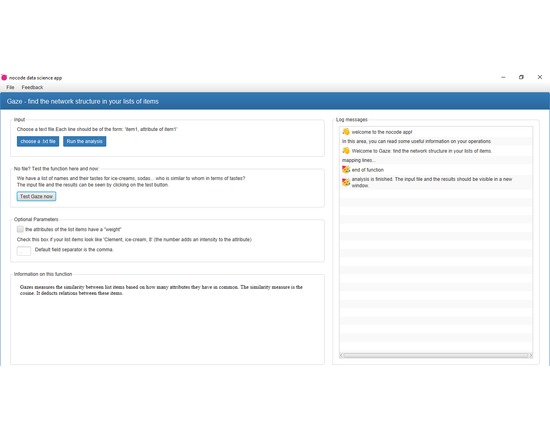
The Nocode app is a suite of data exploration tools (or functions) that can be used by analysts, students, researchers and journalist to analyse text. It currently has 5 functions: Umigon: sentiment analysis for social media, in English and French. Cowo: transform your texts into networks. Topics: identify the key topics in texts of any language. Gaze: find the network structure in your list of items. Organic: distinguish natural from corporate tweets. It is free to use. It can be used on a browser and the app can be downloaded and installed on a local computer.

Rated 0.0 out of 5.