Skip to content
TAPoR Text Analysis Portal for Research

For researchers who work with text

Find a text analysis tool that fits the work.

TAPoR catalogues concordancers, annotators, topic models, stylometry packages, and visualization environments. Every record notes the platform, the license, and what the tool is actually good for.

  • Platform, license, and method on every record
  • Reviews from people who teach with the tools
  • Lists assembled around a course or a corpus

Browse tools

Filter by the type of analysis.

View all tools
‹

Analysis

CLAWS Part-of-Speech Tagger

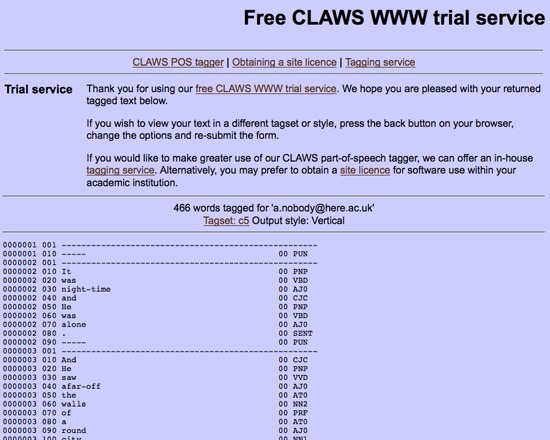
CLAWS (Constituent Likelihood Automatic Word-tagging System) is a free parts-of-speech tagging tool from Lancaster University. It has been continuously developed since the 1980s, has consistently achieved 96-97% accuracy, and has been applied to the over 100 million word British National Corpus. This tool is available for download in addition to an on-line 'trial' version.
Rated 0.0 out of 5.

Analysis

CLOC

CLOC is a general purpose text analysis package originally offered by the University of Birmingham Computing Centre in the late 1970s, and now avaiable for download. It can generate concordances, collocates and word lists for a text. This tool was developed in Fortran.

Rated 0.0 out of 5.

Analysis

CMU-Cambridge Statistical Language Modelling Toolkit

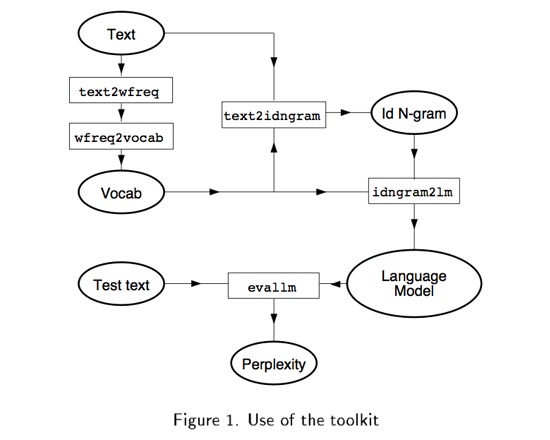
The CMU-Cambridge Statistical Language Modelling Toolkit is a longstanding set of Unix tools offered by Carnegie Mellon University and Cambridge University. It includes functions for word frequency, n-grams, vocabulary and words marked as 'context cues'. Version 1 was written by Roni Rosenfel and released in 1994.

Rated 0.0 out of 5.

Analysis

COCOA

COCOA was a program and markup language for generating word counts and concordances written in FORTRAN, from the University College Cardiff and the Atlas Computer Laboratory. It produced keyword-in-context concordances and word frequency profiles for texts, and was considered to be a powerful, highly flexible program for punched card computers.

Rated 0.0 out of 5.

Analysis

Coggle

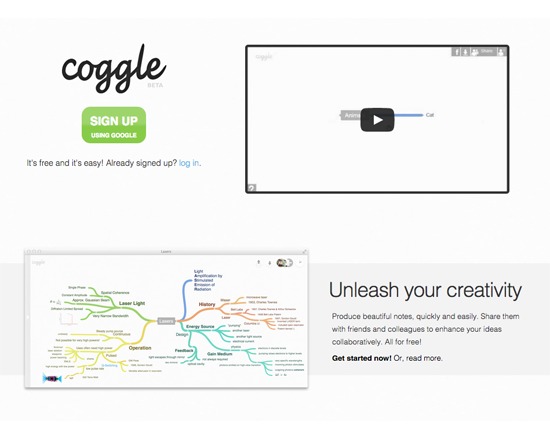
Coggle is a web-based tool for visualizing and applying non-linear structuring to information. Though Coggle has been used for mind mapping, it is primarily a method of documenting branching and non-linear information, and encompassing multiple perspectives. It utlizes a drag and drop interface for integrating images, permits multiple users to edit at the same time without causing data conflicts, and supports Markdown and LaTeX formatting. Coggle diagrams can be interlinked, branches of one diagram can be spawned off into its own diagram connected back to the original, and individual branches can be linked via hashtags. The tool includes an API that permits users to interface their diagrams with other programs and manupulate or examine them, and diagrams can also be exported in various formats such as plain-text outline, vector PDFs or images. Coggle is free except where users require more than 100 monthly active users or a closed source version.

Rated 0.0 out of 5.

Analysis

COGS-3

COGS-3 was a general-purpose concordance program for IBM and DEC mainframe computers at the University of Toronto. It was developed in the 1980s in PL/I and also included a lemmatization feature.

Rated 0.0 out of 5.

›

Curated lists

Curated list created by experience authors in the fields.

All curated lists

Geoffrey Rockwell

Cool Voyant Tools

Not all Voyant tools show up in the default view or skin. Here is a list of some of the other tools worth trying.

4 tools

View list

Holly Pickering

Audio Production Software

Interested in audio production and editing? Here are a few programs that can help you get on your way. Some of them are free, some not, but all are helpful and useful.

3 tools

View list

Jason Bradshaw

TATR: Text Analysis for Twitter Research

This list compiles a suite of tools that make up Kynan Ly's Text Analysis for Twitter Research (TATR) Library. Recipes to these notebooks can be found on methodi.ca

6 tools

View list

The catalogue

  • 1321

    Tools catalogued

  • 15

    Curated lists

  • 22

    Analysis types

  • 671

    Community reviews

More is coming

Researchers, power users, and students will soon be able to contribute tools, share reviews, and curate lists around their own work.