Skip to content
TAPoR Text Analysis Portal for Research

For researchers who work with text

Find a text analysis tool that fits the work.

TAPoR catalogues concordancers, annotators, topic models, stylometry packages, and visualization environments. Every record notes the platform, the license, and what the tool is actually good for.

  • Platform, license, and method on every record
  • Reviews from people who teach with the tools
  • Lists assembled around a course or a corpus

Browse tools

Filter by the type of analysis.

View all tools
‹

Natural Language Processing

CETA Parser

The CETA (Centre pour l'Etude de la Traduction Automatique) Parser was a program developed in the 1960s that could automatically reduce Russian sentences to a string of words and provide equivalents for each in French. CETA developed its parser in conjunction with Professor Mel'chuk of Moscow.
Rated 0.0 out of 5.

Natural Language Processing

CLARIN-PL

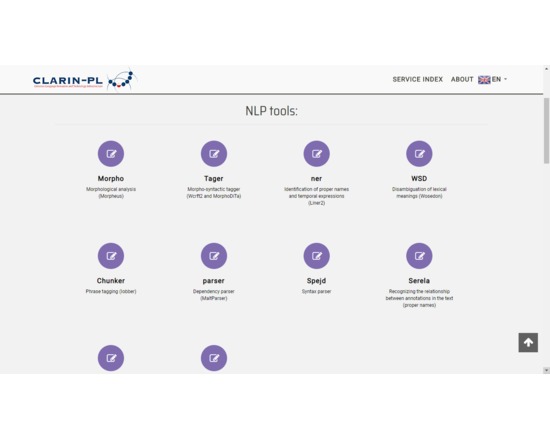
It is a set of tools created by the Polish branch of Common the Language Resource and Technology Infrastructure (CLARIN) mainly for the analysis of Polish text. It has many Natural Language Processing (NLP) tools among which are verb annotations, named entity recognition, phrase parser, and spacial expression recognition. Some of the tools can be used for German and English.

Rated 0.0 out of 5.

Natural Language Processing

CLAS (Computerized Language Analysis System)

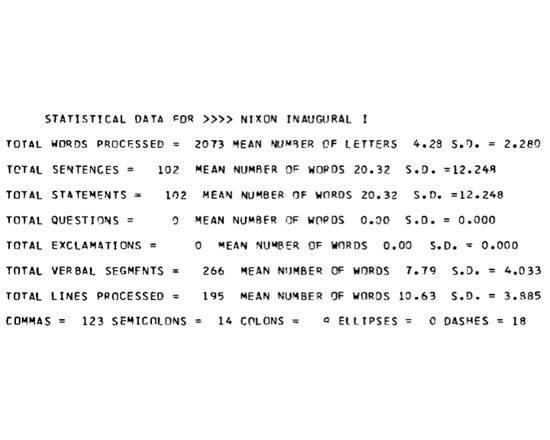
CLAS (Computerized Language Analysis System) was an important historic text analysis system available in the 1970s. It was written in PL/I for IBM 360/370 punch card machines and performed standard statistical tests and concordances on natural language texts.

Rated 0.0 out of 5.

Natural Language Processing

CLAWS Part-of-Speech Tagger

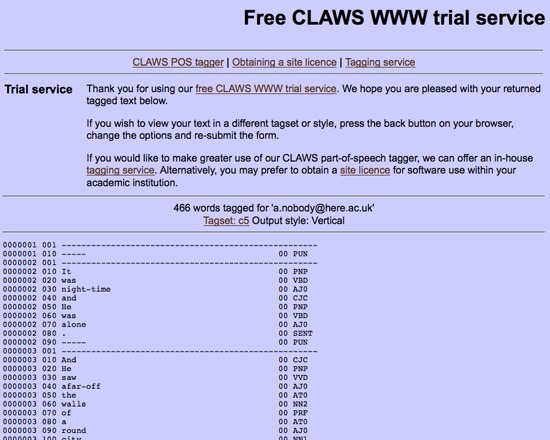
CLAWS (Constituent Likelihood Automatic Word-tagging System) is a free parts-of-speech tagging tool from Lancaster University. It has been continuously developed since the 1980s, has consistently achieved 96-97% accuracy, and has been applied to the over 100 million word British National Corpus. This tool is available for download in addition to an on-line 'trial' version.

Rated 0.0 out of 5.

Natural Language Processing

COMIT

COMIT was an early string processing programming language developed for IBM 700/7000 computers at MIT from the late 1950s to mid 1960s. It was particularly designed for linguistics and natural language processing, and was taught to humanists to aid their research in the 1960s.

Rated 0.0 out of 5.

Natural Language Processing

Comparator - HTML (TAPoRware)

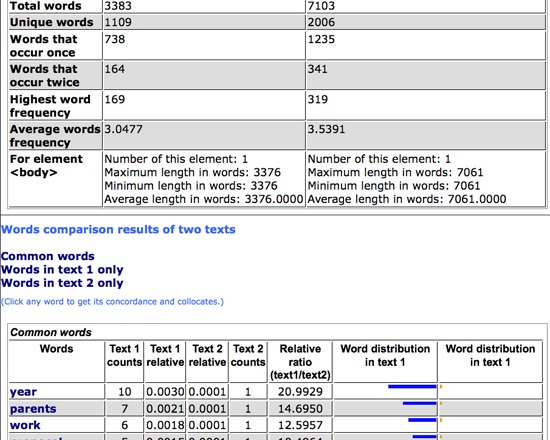
This tool compares two documents by comparing the words in each according to user specifications. XML and plain text versions are also available in the TAPoRware toolsets. This tool’s functionality has been incorporated into Voyant available online at www.voyant-tools.org

Rated 0.0 out of 5.

›

Curated lists

Curated list created by experience authors in the fields.

All curated lists

Geoffrey Rockwell

Cool Voyant Tools

Not all Voyant tools show up in the default view or skin. Here is a list of some of the other tools worth trying.

4 tools

View list

Holly Pickering

Audio Production Software

Interested in audio production and editing? Here are a few programs that can help you get on your way. Some of them are free, some not, but all are helpful and useful.

3 tools

View list

Jason Bradshaw

TATR: Text Analysis for Twitter Research

This list compiles a suite of tools that make up Kynan Ly's Text Analysis for Twitter Research (TATR) Library. Recipes to these notebooks can be found on methodi.ca

6 tools

View list

The catalogue

  • 1321

    Tools catalogued

  • 15

    Curated lists

  • 22

    Analysis types

  • 671

    Community reviews

More is coming

Researchers, power users, and students will soon be able to contribute tools, share reviews, and curate lists around their own work.