Skip to content
TAPoR Text Analysis Portal for Research

For researchers who work with text

Find a text analysis tool that fits the work.

TAPoR catalogues concordancers, annotators, topic models, stylometry packages, and visualization environments. Every record notes the platform, the license, and what the tool is actually good for.

  • Platform, license, and method on every record
  • Reviews from people who teach with the tools
  • Lists assembled around a course or a corpus

Browse tools

Filter by the type of analysis.

View all tools
‹

Visualization

Omeka

Omeka is a content management system designed for the display of library, museum, archives, and scholarly collections and exhibitions. Omeka falls at a crossroads of Web Content Management, Collections Management, and Archival Digital Collections Systems. Omeka is designed with non-IT specialists in mind, allowing users to focus on content and interpretation rather than programming. It brings Web 2.0 technologies and approaches to academic and cultural websites to foster user interaction and participation. It makes top-shelf design easy with a simple and flexible templating system. Its robust open-source developer and user communities underwrite Omeka’s stability and sustainability. Omeka allows users to publish cultural heritage objects, extend its functionality with themes and plugins, and curate online exhibits with digital objects.
Rated 5.0 out of 5.

Search

Pundit

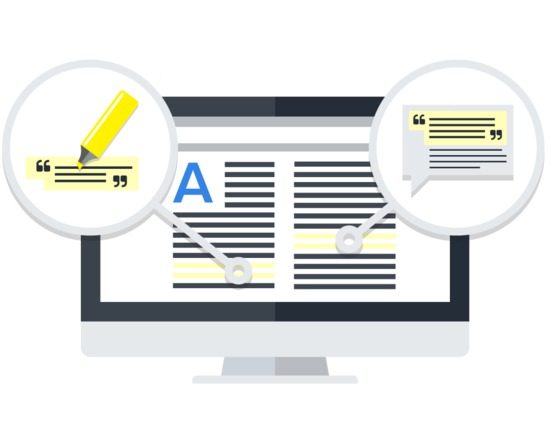
Pundit is a cloud service that allows users to 'take notes' on web documents, like a web page or a PDF file. It consists of a set of components, amongst them the Annotator, a free extension for the Google Chrome browser used by users to create the annotations. Annotations can be highlights of text parts or comments, applied either on a selection of the text or on the whole document. It is also possible to create annotations to tag a selected text or an entire web page. Pundit supports semantic annotations, real RDF triples (subject - predicate -> object) to specify formal, structured and reusable statements associated to the annotated content.

Rated 5.0 out of 5.

Programming

Python

A general-purpose high-level programming language that places an emphasis upon code readability. Python supports a number of development models, including object oriented, imperative, and functional design. It provides automatic memory management and a fully dynamic type system. Features: Very clear, readable syntax Strong introspection capabilities Intuitive object orientation Natural expression of procedural code Full modularity, supporting hierarchical packages Exception-based error handling Very high level dynamic data types Extensive standard libraries and third party modules for virtually every task Extensions and modules easily written in C, C++ (or Java for Jython, or .NET languages for IronPython) Embeddable within applications as a scripting interface

Rated 5.0 out of 5.

Analysis

Textalyser

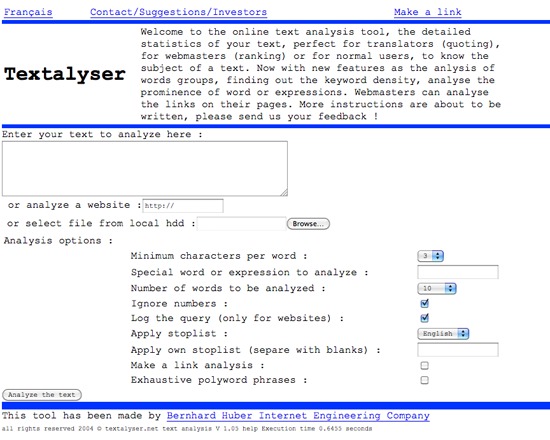
Textalyser is a free web-based text analysis tool offered by the Bernhard Huber Internet Engineering Company. Users can paste text into the provided entry field, upload a file or provide a URL for analysis. Textalyser provides detailed statistics on the text to determine subject, analyse word groupings, determine keyword density and deterimine the most prominent phrase. The Textalyser website is no longer available as of late 2014. It has been captured by the Internet Archive, and can still be viewed there.

Rated 5.0 out of 5.

Visualization

TextArc

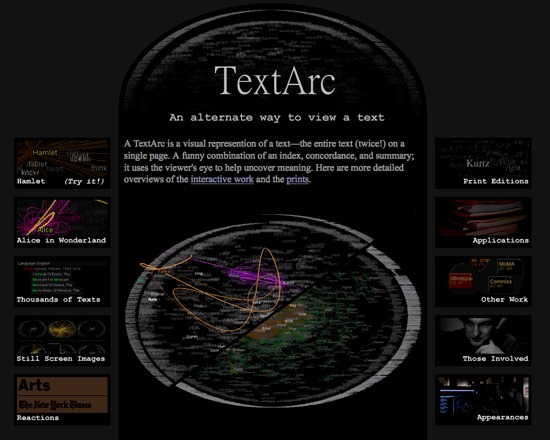
TextArc is a free visualization tool that represents an entire text on a single page. It has elements of an index, concordance and summary all in one place, encouraging the viewer to use its juxtapositions to uncover meaning. The web-based applet is preloaded with thousands of text collected from Project Gutenberg. Note: TextArc was designed for browsers circa 2002 and requires Java SE 6 to run.

Rated 5.0 out of 5.

Visualization

Textual Geography Analyzer

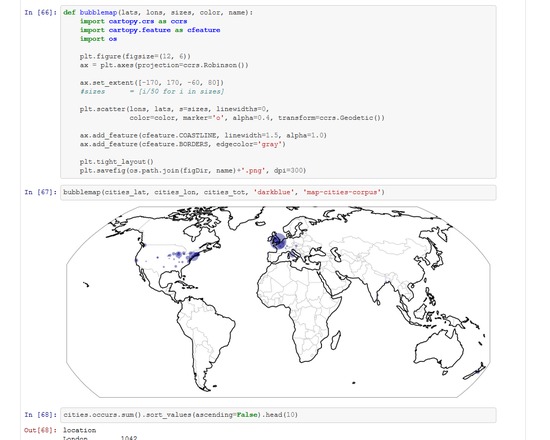
Parses text tagged by the Stanford named entity recognizer in order to collect and analyze mentions of locations. Also incorporates the Google API in order to geocode those locations and, ultimately, mark them on a map. This code was written in an IPython Notebook, so the code below is actually a collection of scattered code snippets. Please see the repository on github for full details and documentation, or the Methods Common recipe ( http://methodi.ca/recipes/mapping-locations-corpus ) for a step-by-step guide. NOTE: Users will be required to acquire their own Google API key, store it in a text file, and then point the code to that text file. Instructions can be found in the IPython Notebook itself. Search for "api_key_file" to find the line in code that needs to be changed.

Rated 5.0 out of 5.

›

Curated lists

Curated list created by experience authors in the fields.

All curated lists

Geoffrey Rockwell

Cool Voyant Tools

Not all Voyant tools show up in the default view or skin. Here is a list of some of the other tools worth trying.

4 tools

View list

Holly Pickering

Audio Production Software

Interested in audio production and editing? Here are a few programs that can help you get on your way. Some of them are free, some not, but all are helpful and useful.

3 tools

View list

Jason Bradshaw

TATR: Text Analysis for Twitter Research

This list compiles a suite of tools that make up Kynan Ly's Text Analysis for Twitter Research (TATR) Library. Recipes to these notebooks can be found on methodi.ca

6 tools

View list

The catalogue

  • 1321

    Tools catalogued

  • 15

    Curated lists

  • 22

    Analysis types

  • 671

    Community reviews

More is coming

Researchers, power users, and students will soon be able to contribute tools, share reviews, and curate lists around their own work.